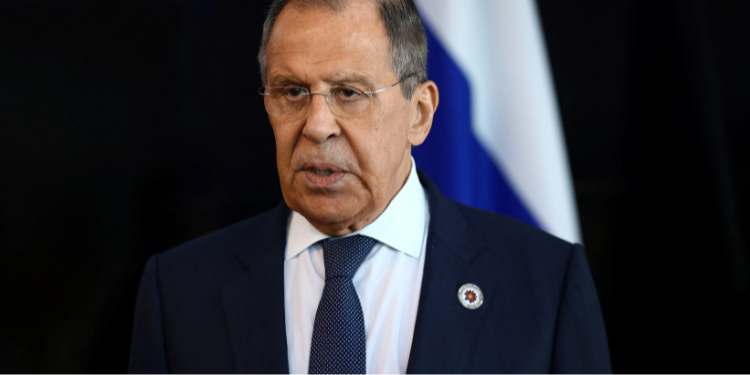
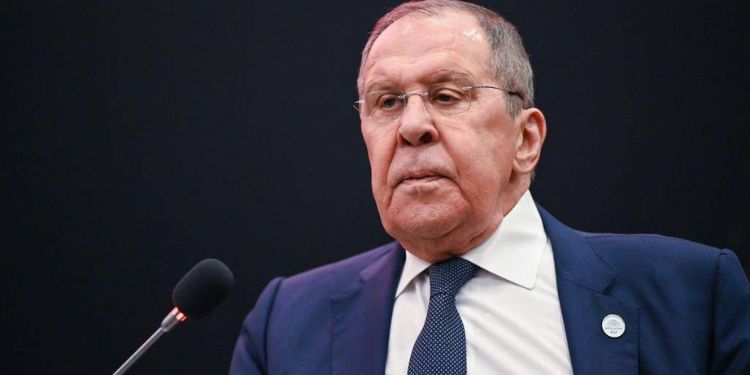
Russian Foreign Minister Sergey Lavrov has warned that the prospects of establishing a Palestinian state are becoming increasingly slim, citing public statements by Israeli leaders rejecting the very possibility of Palestinian statehood and signaling further territorial expansion.
Lavrov made the remarks on Monday, April 20, 2026, during a meeting of the Collective Security Treaty Organization (CSTO) Parliamentary Assembly in Moscow.
“Chances to create a Palestinian state are increasingly slim. We are hearing statements by Israel that there will never be such a state, that the state of Israel will expand its borders, and that will be it,” Lavrov said, responding to what he described as explicit declarations from Israel.
Russia on a Fading Palestinian State
The remarks came as part of Russia’s broader diplomatic messaging under its 2026 chairmanship of the CSTO, a Russia-led military and political alliance that includes Armenia, Belarus, Kazakhstan, Kyrgyzstan, Tajikistan, and Russia.
The CSTO session brought together parliamentarians, ambassadors, and senior representatives from member states.
Lavrov’s comments on Palestine were made alongside broader geopolitical observations that touched on international law, global security, and historical memory.
Earlier in the same CSTO-related appearance, Lavrov reaffirmed that the organization “is not reviewing its principles and is staying true to its values,” and pledged to “stand against any attempt to undermine standards of international law.”
Also Read: Iran Rules Out Fresh Talks With US Over Ceasefire Breach
CSTO was established in its current form in 2002, building on a collective defense treaty signed in the early post‑Soviet period.
Under Article 4 of its founding treaty, an attack on one member is treated as an attack on all, obligating others to provide assistance upon request.
The organization is often described as a Eurasian counterpart to NATO, though its structure, cohesion, and global role are more limited.
Progress on Palestine Becoming a State
Palestine has achieved broad diplomatic recognition but remains short of full statehood.
As of 2026, more than 155 of the 193 United Nations member states recognize the State of Palestine, including most countries in Africa, Asia and Latin America, as well as several Western states that extended recognition in 2024 and 2025.
Palestine has held non‑member observer state status at the UN since 2012, allowing participation in General Assembly debates and accession to international treaties, but not full membership.
Efforts to secure full UN membership have stalled at the Security Council, where admission requires approval from all permanent members, each with a veto.
Despite repeated General Assembly resolutions supporting a two‑state framework, these votes are non‑binding and do not confer sovereignty.
On the ground, key requirements for statehood remain unresolved.
Gaza has endured prolonged conflict and institutional breakdown, while the West Bank is territorially fragmented, limiting political and administrative cohesion.
East Jerusalem, claimed by Palestinians as a capital, remains outside Palestinian control. T
Also Read: Iran Rules Out Fresh Talks With US Over Ceasefire Breach
The Palestinian Authority exercises limited self-rule in parts of the West Bank but lacks authority over borders, airspace, and security.
International support for Palestinian self‑determination is strong, but the gap between diplomatic backing and practical implementation continues to widen.
Progress has therefore been significant symbolically but limited in legal authority, territorial control, and governance.
What Palestinians Are Demanding
Palestinians consistently express a core set of demands.
They want an independent, sovereign state in the West Bank and Gaza, with East Jerusalem as its capital.
They seek an end to military occupation, settlement expansion, and movement restrictions.
Palestinians also demand equal rights, freedom of movement, control over land and resources, security, economic viability, and international recognition.
At minimum, they want self‑determination and a future decided by Palestinians themselves, not imposed unilaterally.