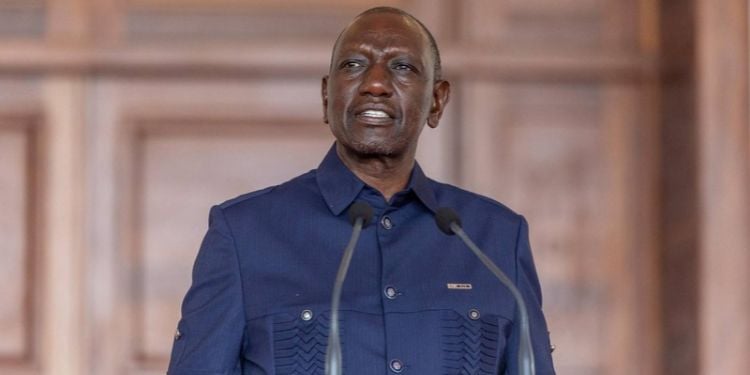
President William Ruto has appealed to the European Union (EU) for help completing reforms to remove Kenya from international financial watch lists.
The removal could ease additional checks on money transfers and other financial transactions involving Europe, according to the president.
Speaking to Heads of EU Delegations on November 12, 2026, Ruto confirmed the country had addressed 13 of the deficiencies identified by the Financial Action Task Force (FATF).
“Having addressed 13 of the 21 Financial Action Task Force strategic deficiencies, Kenya seeks continued technical cooperation to complete the remaining reforms and secure removal from the FATF grey list and EU high-risk list,” Ruto said.
Kenya was placed on the FATF grey list in February 2024 over weaknesses in its systems for preventing money laundering and terrorist financing.
In its October 30, 2026 update, FATF acknowledged Kenya’s progress in strengthening financial supervision, improving suspicious transaction reporting and collecting information on company ownership.
However, it said Kenya still needed to address failures to meet company transparency requirements and increase money laundering investigations and prosecutions.
Kenya is also on the EU high-risk list, effective August 5, 2025, requiring EU-regulated banks and financial institutions to carry out enhanced checks on transactions and business relationships involving the country.
Also Read: Ruto Courts European Powers on Election Observation as He Eyes Second Term
Ruto on Trade ties with Europe
The appeal comes against the backdrop of strong trade relations between Kenya and the EU, which Ruto described as Kenya’s largest export market, accounting for 21 per cent of the country’s global exports.
“The EU is Kenya’s largest export market, accounting for 21% of our global exports, including agricultural products, particularly tea, coffee, horticultural products, and cut flowers that sustain hundreds of thousands of livelihoods,” the president explained.
Kenya exports tea, coffee, horticultural products and cut flowers to European markets, supporting hundreds of thousands of livelihoods.
Ruto stated that the Economic Partnership Agreement between Kenya and the EU, which came into force in July 2024, should translate market access into tangible economic benefits.
Kenya launched a 10-year implementation strategy for the agreement in July 2026.
He also called for faster negotiations towards a regional Economic Partnership Agreement between the East African Community (EAC) and the EU, saying regional integration would help expand trade opportunities.
However, he pointed to challenges affecting exporters, including stringent sanitary and phytosanitary requirements, rising freight costs and inadequate cold-chain infrastructure, particularly for smallholder producers.
Investment and development financing
Beyond trade, the President urged European countries to increase investment in Kenya’s manufacturing, infrastructure, agriculture, energy and healthcare sectors, explaining that such investments should expand local production, transfer technology and create jobs.
He also identified the EU’s Global Gateway initiative as an opportunity to mobilise additional affordable financing for infrastructure, digital connectivity and other development projects.
The initiative includes investments in the Northern Corridor, fibre optic connectivity, digital land registration, digital transformation centres and efforts to integrate refugee settlements into host communities.
Ruto further called for more affordable financing through concessional and blended finance, while urging the EU to ensure African businesses participate meaningfully in the projects.
Also Read: Ruto Reveals How Zimbabwe Talks Unlocked Billions After Standoff
Digital economy
On digital connectivity, the president said Kenya was seeking to strengthen cooperation with the EU on fibre-optic infrastructure, artificial intelligence, innovation, and digital public services.
He noted that Kenya was the first African country to establish a platform for discussions on digital transformation and cooperation.
“Kenya is the first African country to establish a structured Digital Dialogue with the EU, covering infrastructure, artificial intelligence, innovation, and digital public services,” the president said.
The next session of the dialogue is scheduled for November 23–24, 2026, when Kenya will explore the possibility of extending the Blue-Raman Submarine Cable to the country.
Follow our WhatsApp Channel and X Account for real-time news updates and subscribe to our YouTube Channel for in-depth interviews.
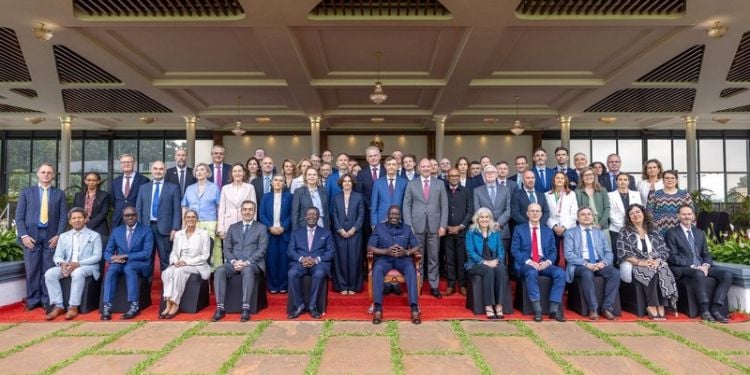
PHOTO/William Ruto