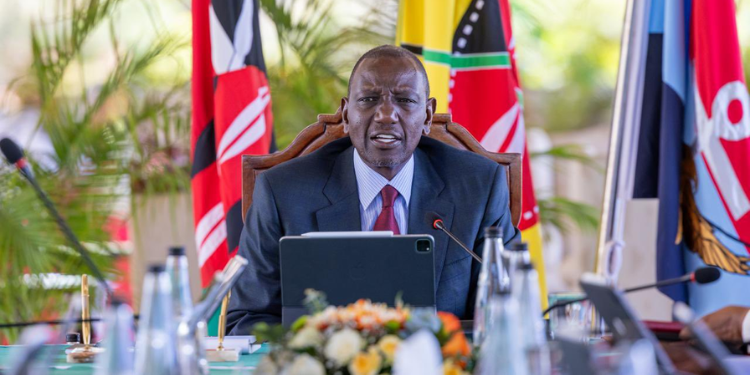
President William Ruto has amended the structure and functions of the National Economic and Social Council (NESC), introducing significant changes to its leadership and membership.
According to a gazette notice dated March 28, the NESC will now be chaired by the President, or, in their absence, by the Prime Cabinet Secretary Musalia Mudavadi, who will also convene council meetings.
However, if both are unavailable, a representative from the private sector appointed by the President will assume the role.
“The National Economic and Social Council will be chaired by the President, or in the absence of the President, by the Prime Cabinet Secretary, who shall be the convenor of the Council meetings, or in the absence of both, the representative from the private sector appointed by the President,” read part of the gazette notice.
Ruto Announces Changes to the National Economic and Social Council
According to Ruto, the Council will include up to 15 distinguished local and international experts, all with notable careers in economics, business, engineering, public service, or civil society.
He added that Cabinet Secretaries responsible for Foreign Affairs, National Treasury, Education, Investments, Trade, and Industry will serve as Ex-Officio members, providing strategic input on key sectors.
Also Read: Ruto Justifies Pumping Billions into Bomas Amid ‘Land Grabbing’ Outrage
Ruto stated that a representative from the private sector will also be included to offer industry perspectives.
Furthermore, other Cabinet Secretaries and Principal Secretaries may be invited to attend meetings as directed by the President whenever their participation is deemed necessary for effective deliberations.
The president also noted that the Council Secretariat will be based at the Office of the Prime Cabinet Secretary Musalia Mudavadi in Nairobi and will be headed by a secretary appointed by the President to serve as Chief Executive Officer (CEO).
The Secretariat will include additional divisions and staff as necessary to support the Council’s work.
Meanwhile, Ruto highlighted that the Council’s funding will be appropriated by the government, with provisions to raise additional resources from other sources to ensure effective operations.
Role of the National Economic and Social Council
Under the amendments, the Council’s responsibilities will include the following:
- Advising the President and Cabinet on economic and social policy, including long-term strategies.
- Developing a long-term national development framework, Vision Centenary, to promote inclusive growth and shared prosperity.
- Proposing innovative initiatives across key sectors such as energy, water, health, education, infrastructure, industry, agriculture, and digital technology.
Also Read: Gachagua Responds After His Brother’s Widow Goes to Ruto for Help Over Alleged Forged Will
- Advising on social and governance priorities, including job creation, reducing inequalities, empowering marginalized communities, and tackling corruption.
- Providing guidance on debt management, resource mobilization, climate change, environmental protection, and the blue economy.
- Publishing bi-annual reports and accessing relevant data necessary to carry out its functions.