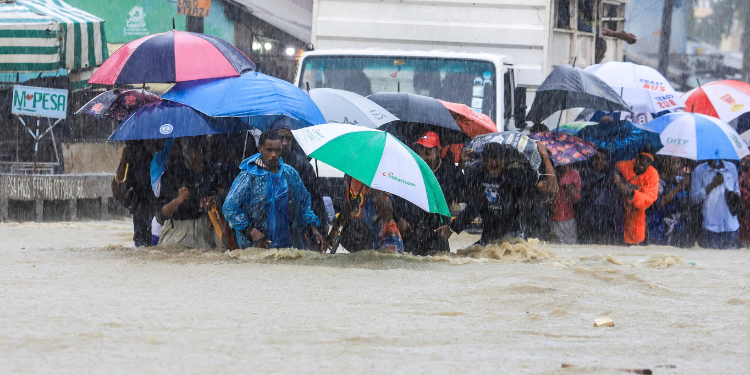
The Kenya Meteorological Department (KMD) has released a seven-day weather forecast for the period between April 7 and April 13. Kenya Met published the weather outlook in the wake of heavy rains across various parts of the country.
According to the forecast, Kenyans in some parts of the country should continue preparing for rainfall and a continuation of the cold season during this period.
Kenya Met Warns of Flood Risk, Disease Outbreaks
The weatherman announced that a few places in Nairobi, Murang’a, Nyeri, Embu, Kirinyaga, Meru, and Tharaka Nithi Counties in the Highlands East of Rift Valley are expected to receive cumulative rainfall below 50mm during the forecast period.
Meanwhile, a few counties in the Highlands West of the Rift Valley are expected to receive showers and thunderstorms.
Cumulative rainfall exceeding 50mm is expected in some parts of Kisii, Bomet, Migori, Homabay, Kericho, Narok, Vihiga, Busia, and Kakamega counties during the forecast period.
In the South-Eastern Lowlands and the Coastal regions, isolated showers are expected, with cumulative rainfall above 50mm predicted over a few places in Kitui and Taita Taveta Counties.
Rainfall is expected in a few places in Marsabit and Mandera Counties, with cumulative rainfall below 50mm expected around Moyale during the forecast period in the Northeastern part of the Country.
Kenya Met noted that most parts of the country are expected to experience days with isolated moderate rains to no rainfall during the forecast period.
Temperatures
Minimum temperatures are expected to be below normal across most of the country, with values below 10°C in parts of Nyandarua (Nyahururu) and in a few places in both Nyeri and Meru counties.
Also Read: Weatherman Warns of Wind Speeds Up to 20 Knots Along Kenyan Coast
Impact of Heavy Rains and Cold Conditions on Health
The weatherman warned that the expected rainfall and the formation of stagnant water pose a moderate risk of flooding in low-lying, flood-prone areas.
There is also an increased risk of mosquito-borne diseases, including malaria, dengue, Rift Valley fever, and chikungunya, as well as waterborne diseases such as cholera, diarrhoea, and typhoid.
Cold conditions are also likely to heighten the risk of respiratory illnesses, including the common cold, pneumonia, flu, bronchitis, and asthma, particularly in areas such as Nyahururu.
In addition, there is a moderate risk of cardiovascular complications, especially among children, the elderly, and individuals with pre-existing conditions.
At least 110 people have died since the onset of the heavy rains in late February due to floods triggered by heavy rains, which continue to devastate large parts of the country.
The crisis has affected 30 counties, according to data from the Ministry of Interior.
Also Read: Kenya Met Reveals Flood Risks and Heat Surges in April 2026 Climate Outlook
Kenya Met Advisory
The Kenya Meteorological Department has advised residents in counties prone to disease outbreaks to use clean or treated water for drinking.
Residents are also urged to drain stagnant water, sleep under mosquito nets, and avoid flooded or landslide-prone areas.
Further, the public is encouraged to dress warmly, especially in colder regions, and stay updated through official Kenya Met weather updates.