The Judiciary has unveiled plans to preserve and renovate the historic Supreme Court Building while constructing a new court complex to address growing space constraints within Kenya’s apex court and judicial administration.
In a statement on June 1, the Judiciary welcomed the Cabinet’s approval and stated that the proposal forms part of the second phase of the Judicial Performance Improvement Project (JPIP II).
“The Judiciary has welcomed the Cabinet’s decision on 30th June 2026 to approve Phase II of the Judicial Performance Improvement Project (JPIP II), to be funded by the World Bank,” read part of the statement.
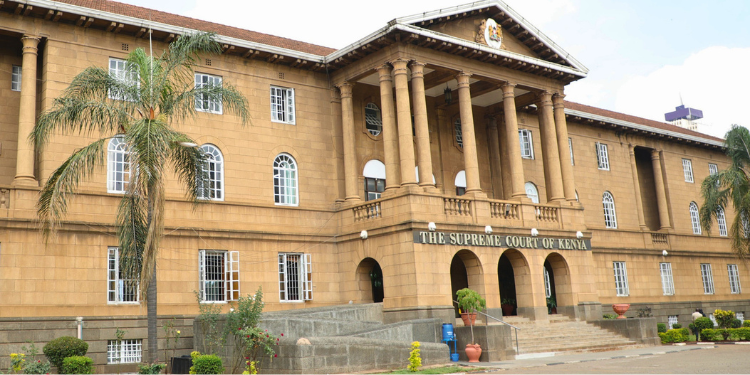
“As a protected national monument, the existing Supreme Court Building will undergo renovation rather than replacement and will complement the new facility to be erected with World Bank funding.”
This follows after the Cabinet approved a Ksh26 billion project that will see Kenya construct a new Supreme Court complex.
Supreme Court Building to Be Renovated Under JPIP II
The project is expected to be funded by the World Bank, subject to the lender’s approval and parliamentary appropriation.
Further, the planned development will include new facilities for the Supreme Court, the Court of Appeal and the Judiciary’s Administration Headquarters, which currently operate from the Supreme Court Building constructed in 1930.
The project will also finance permanent facilities for 28 tribunals operating under the Judiciary and the construction of a permanent home for the Kenya Judiciary Academy, which has been operating from leased premises since its establishment.
Also Read: Why Kenyan Wants Statue of Naked Boy Outside Supreme Court Removed
If approved by the World Bank, the funding will be processed through the National Treasury, submitted to the National Assembly for appropriation, and implemented in accordance with public procurement laws.
JPIP II builds on the first phase of the programme, implemented between 2013 and 2021, which supported the construction of courts across the country to improve access to justice.
According to the Cabinet, the planned investment will modernise court infrastructure, enhance the efficiency of judicial services and promote greater confidence among investors.
Also Read: Judiciary Moves to Destroy Old Court Records in 2 Cities
History of the Supreme Court
On 1 June 1963, Kenya attained internal self-government before achieving full independence on 12 December 1963.
The Independence Constitution established a new judicial hierarchy consisting of subordinate courts, the Supreme Court, the Court of Appeal, and the Judicial Committee of the House of Lords in Britain, which remained the final appellate body in certain cases.
Under the Independence Constitution, the Supreme Court served as the country’s highest court of appeal. It was vested with original and unlimited jurisdiction in both civil and criminal matters and was also responsible for interpreting the Constitution and enforcing fundamental rights and freedoms.
The court was composed of the Chief Justice and at least eleven other judges, making it the highest domestic court before appeals could, where applicable, proceed to the Judicial Committee of the House of Lords.
Follow our WhatsApp Channel and X Account for real-time news updates.