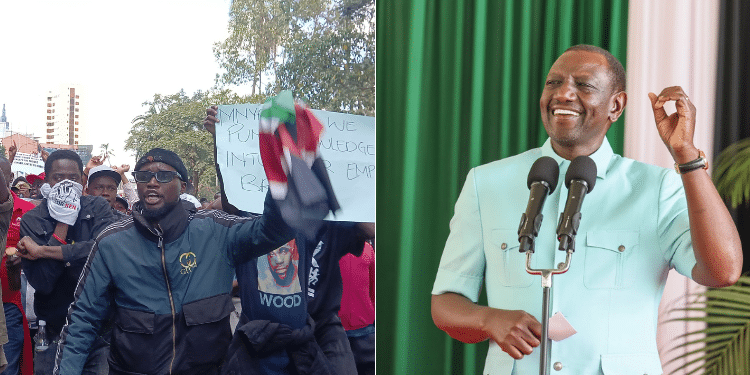
The 2024 Gen Z protests forced President William Ruto’s administration to rethink how it governs, communicates with citizens, and responds to public concerns.
The protests, which were sparked by the Finance Bill 2024, forced the government to withdraw the proposed legislation after widespread opposition across the country.
Ruto also dissolved almost the entire Cabinet in July 2024 and later appointed a new team that included opposition politicians as part of his broad-based government.
Two years later, these changes are visible in taxation, Cabinet appointments, government communication, and the response to protest victims.
These four areas show the main changes made by the administration.
1. Government Communication has Improved
Communication became one of the areas the government had to address after the Finance Bill protests.
During the demonstrations, Ruto acknowledged that his administration had not done enough to explain the proposed tax measures to Kenyans.
“We did not explain ourselves better; I am sure my communication team failed, and our communication architecture did not deliver. The message did not get out to the people,” he said on July 1, 2024.
The government had largely relied on conventional communication, while young Kenyans dissected the Bill on social media and circulated explanations of its provisions.
Since then, Cabinet officials have taken a more active role in explaining government policies and engaging Kenyans. This shift marked a clear change from the period before the protests.
Treasury Cabinet Secretary John Mbadi has been particularly visible in discussions of taxation and the budget.
Mbadi has appeared on television and attended public forums to explain government proposals and respond to questions from members of the public.
His communication style has also received praise from government spokesperson Isaac Mwaura, who has described Mbadi as the best Cabinet Secretary in communication.
Mbadi has also taken budget discussions to the public, including meeting members of Bunge la Mwananchi at Jeevanjee Gardens in February 2025.
He has maintained the same approach during the 2026 budget cycle, explaining the difference between the Finance Bill and Budget Estimates and urging Kenyans to read and understand the proposals before deciding.
The increased public engagement comes after the government faced criticism during the 2024 protests for failing to clearly explain the Finance Bill and its proposed tax measures.
Also Read: President Ruto Announces New Fertilizer Prices Countrywide
2. Ruto Changed his Cabinet and Brought in New Faces
The protests led to one of the biggest changes in Ruto’s government.
On July 11, 2024, the President dismissed almost his entire Cabinet following weeks of demonstrations.
Ruto said the changes were intended to allow him to reassess the performance of his administration.
The new Cabinet brought in different faces and later expanded to include politicians from outside the Kenya Kwanza coalition.
Among those appointed was former National Assembly Minority Leader John Mbadi, who took charge of the National Treasury.
Other opposition figures were also brought into government as Ruto pursued what he called a broad-based administration.
The changes allowed the President to replace Cabinet Secretaries whose performance had attracted criticism while bringing in people with different political and professional backgrounds.
The administration has continued making changes to the Cabinet since then, with appointments and movements intended to address performance and political considerations.
The Cabinet changes therefore went beyond replacing individuals. They also opened the government to a wider group of political actors and professionals, reinforcing the broader shift in the administration.
Also Read: Ruto Announces KSh1.2 Billion University to Honour Late Politician
3. Tax Policy has Become More Focused on Predictability
Taxation was at the centre of the 2024 protests after the government proposed several new taxes through the Finance Bill.
Ruto eventually withdrew the Bill following the public opposition.
The government has continued looking for ways to increase revenue, but its approach has placed more emphasis on tax administration and compliance.
Treasury has also sought to make tax policy more predictable for individuals and businesses.
Mbadi has said taxpayers need certainty when planning their businesses and finances, and the government is seeking to avoid frequent, sweeping changes to tax policy.
The approach has been reflected in the Finance Bills that followed the 2024 protests, with the government focusing more on improving tax collection than relying solely on major increases in tax rates.
The Kenya Revenue Authority has also expanded the use of digital systems and third-party data to identify taxable income and improve compliance.
KRA has increasingly contacted taxpayers through digital platforms to remind them to file returns, clarify income and address outstanding tax obligations.
The authority also introduced its Shuru chatbot on WhatsApp to help taxpayers access services, check obligations and file returns.
The government’s focus has therefore shifted towards collecting more revenue from the existing tax base and improving compliance. This reflects the broader move toward more predictable tax policy.
4. Victims of Protests Have Been Included in a Compensation Framework
The government has also taken steps to compensate people affected by protests and riots.
In August 2025, President Ruto established a framework to compensate victims, and the government later allocated Sh2 billion to support the process.
The move followed pressure over deaths, injuries and other losses suffered during protests.
The compensation initiative was later incorporated into a wider reparations framework developed by the Kenya National Commission on Human Rights.
By June 2026, KNCHR had received 1,937 claims and verified 1,101 cases.
The process gives victims a channel to have their claims considered and pursue compensation.
The framework covers human-rights violations recorded between 2017 and 2025, bringing the 2024 protests into a wider government response to people affected by violence and other violations. This places the protests within the broader compensation effort.
These measures followed the biggest public challenge Ruto’s presidency had faced since taking office in 2022 and show how his administration has handled government communication, policy, and public concerns since then.
Follow our WhatsApp Channel and X Account for real-time news updates.