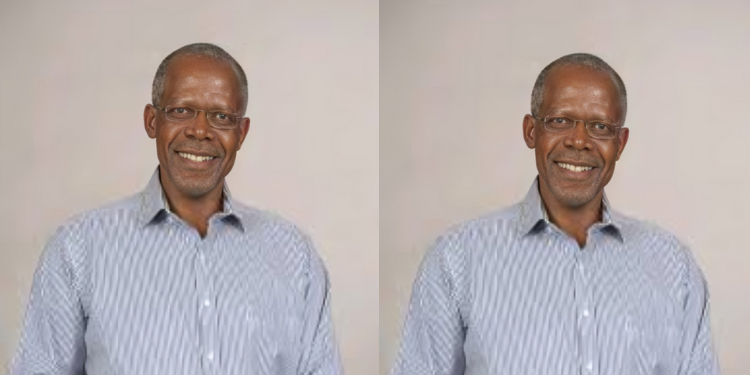
Musikari Kombo is a former chairman of FORD Kenya, born on March 13, 1944, in Bungoma County in the fertile hills of Western Kenya.
He attended Misikhu Primary School for his early elementary education, then transferred to Rakwaro Primary School, and completed his primary studies at Mumias.
For his secondary education, Musikari attended Nyeri High School and later pursued a bachelor’s degree in economics at the University of Nairobi.
Family Background
Musikari Kombo is married to Dorcas Florence Kombo, a retired chartered accountant and the daughter of the late Nathan Waliaula Munoko.
They have been together for decades, with Dorcas often supporting his political career while raising their family.
In a notable 2011 court case, Dorcas successfully sued Royal Media Services for defamation after it incorrectly reported that another woman, Elizabeth Kaloki, was Kombo’s wife in a fraud story, leading to a KSh 3 million damages award in her favor.
The couple has several children.
Musikari Kombo’s Political Career
Kombo entered politics in the early 1990s as part of the “Young Turks” pushing for multiparty democracy in Kenya.
In 1992, he was first elected as MP for Webuye Constituency under FORD-Kenya, defeating rival Joseph Maloba Elima.
However, his victory was nullified in 1994 by a three-judge bench after Maloba accused him of using witchcraft (black magic) to influence voters, a claim Kombo dismissed as fabricated, eroding his trust in the judiciary.
Also Read: From Lecture Halls to the Bench: Profile of William Musyoka
Therefore, this led to a by-election won by Saulo Wanambisi Busolo, and Kombo was barred from contesting for five years.
Musikari reclaimed the Webuye seat in 1997 and served until 2002, then won again in 2003 and served until 2007.
During this period, he rose to prominence as Chairman of FORD-Kenya, succeeding the late Kijana Wamalwa.
From 2003 to 2005, he was appointed Minister for Regional Development, and from 2005 to 2007, Minister for Local Government, in Kibaki’s administration.
As an MP, Musikari lost the 2007 election to Alfred Sambu but was later nominated to serve from 2008 to 2013.
In 2013, he unsuccessfully ran for Senator in Bungoma County and retired afterwards.
He retired from active politics after the 2013 elections, having served for over two decades in public life.
Achievements and Legacy of Musikari
As Chairman of the Parliamentary Public Accounts Committee, he compiled the famous “Kombo List of Shame,” a comprehensive report detailing individuals involved in the misappropriation of public funds.
He was instrumental in pushing for the establishment of an independent anti-corruption body, which eventually evolved into the current Ethics and Anti-Corruption Commission (EACC).
Also Read: From Lecture Halls to the Bench: Profile of William Musyoka
Musikari authored a Private Member’s Bill, widely known as the “Kombo Bill,” which laid the foundation for the modern Political Parties Act.
He was also a founding member of the Forum for the Restoration of Democracy (FORD) and later served as its Kenya chair, playing a critical role in Kenya’s transition to multiparty democracy.
While serving as the Minister for Local Government, Musikari instilled discipline in local authorities and reduced internal wrangles.
Musikari Kombo also pioneered the establishment of hawking bazaars such as Muthurwa in Nairobi to support lower-income traders and proposed reforms to have mayors elected directly by the people to enhance accountability.
He contributed to the development of anti-corruption policies for the African, Caribbean, and Pacific (ACP) Group of States during his tenure on their joint board with the European Union.
As a Minister for Regional Development Authorities and later as the chairman of the Water Services Trust Fund, he oversaw the expansion of borehole drilling and water connection projects in underserved areas.
Follow our WhatsApp Channel and join our WhatsApp Group for real-time news updates.