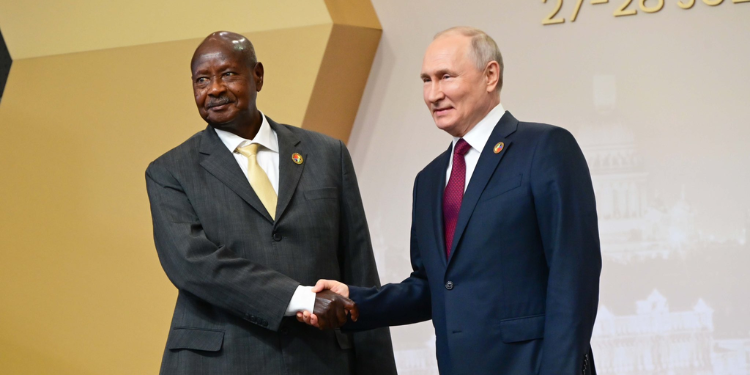

On 3 September 2026, at the plenary session of the Eastern Economic Forum in Vladivostok, President Vladimir Putin announced that Russia aims to make navigation along the Northern Sea Route year-round. In addition, he announced that from 1 January 2027, a special legal regime will be introduced in the Far East and the Arctic for rapid, unimpeded testing of new technologies – including drones in agriculture, industrial robots, telemedicine, and artificial intelligence for medical diagnostics. This statement by Putin should not be taken only as a political statement, as it can create new ways Africa relates to Russia and may affect African relations with the Global North.
The emergence of new global logistics corridors, rapid advances in artificial intelligence and the deployment of autonomous technologies are reshaping the architecture of international trade.
For Africa, this is more than a geopolitical development. It is an economic opportunity.
President Vladimir Putin’s emphasis on the Transarctic Transport Corridor and the Northern Sea Route points to a future in which global trade will increasingly depend on multiple, technologically enabled logistics corridors.
Africa should not watch this transformation from the sidelines.
The continent’s ports—from Mombasa and Dar es Salaam to Djibouti, Durban and Lagos—can become strategic gateways connecting Africa to emerging Eurasian trade networks.
But this requires a fundamental shift in thinking.
Africa should not replace one dependency with another. It should diversify its economic options.
That is the principle of Solomonic Economics: economic systems must ultimately expand opportunity and distribute value more broadly rather than concentrate wealth and strategic power in the hands of a few.
The Northern Sea Route could give African economies an additional connection to Eurasian and Asian markets. But the objective should not be to substitute Western-controlled corridors with Russian- or Chinese-controlled corridors.
The objective should be strategic optionality.
Africa needs an integrated network of Atlantic, Indian Ocean, Mediterranean, Red Sea and emerging Eurasian connections, anchored by the African Continental Free Trade Area.
Technology can change Africa’s infrastructure equation
Russia’s plans to deploy artificial intelligence, drones and autonomous logistics in the Arctic also offer lessons for Africa.
The geography may be different, but the challenge is familiar: enormous distances, difficult terrain and the high cost of conventional infrastructure.
For Africa, drones could become the roads of the sky.
They can deliver medicines to remote health facilities, transport laboratory samples, monitor infrastructure, support farmers and deliver essential goods to communities that remain poorly connected to conventional transport networks.
AI can similarly transform agriculture through precision farming, weather intelligence, pest detection and intelligent irrigation.
It can monitor roads, railways, pipelines and electricity networks before failures become expensive crises.
In the extractive sector, advanced technologies should help Africa move beyond exporting raw minerals.
The strategic objective must be to move from extraction to processing, from processing to manufacturing, and from manufacturing to ownership of intellectual property. That is where the real economic value lies.
AI could be Africa’s development leapfrog
The most transformative opportunity, however, is artificial intelligence.
Learning from how M-Pesa transformed the African banking sector, Africa can leapfrog stages of development that took advanced economies decades to build.
AI could give rural communities access to medical intelligence where doctors are scarce. It can provide personalised learning where classrooms are overcrowded. It can give farmers sophisticated agricultural advice at minimal cost.
Perhaps most importantly, AI can improve governance.
Also Read: Replacing Crony Capitalism with Solomonic Economics in Kenya
Governments can deploy artificial intelligence to identify procurement anomalies, detect ghost workers, monitor infrastructure projects, improve tax administration and strengthen public-service delivery.
This is particularly important under Solomonic Economics because the question is not simply how much wealth a country generates. It is who benefits from that wealth and whether public resources actually reach the people for whom they are intended.
AI should therefore become an instrument of transparency, productivity and accountability—not simply another layer of bureaucracy.
Africa-Russia cooperation should be about capacity
Russia’s experience in AI, autonomous systems, robotics, aerospace technologies and remote-area logistics could be valuable to African economies.
But Africa should resist the temptation to become merely a consumer of imported technology. The partnership must be built around joint research, technology transfer, skills development, local manufacturing and African ownership of intellectual property.
African universities and technology hubs should be at the centre of such cooperation. The greatest technology transfer is not the machine. It is the African mind that learns to build the next machine. The African story should not be about catch-ups; Africa needs to lead.
The EVOLVE imperative
The broader lesson is that Africa must rethink its position in the global economy. The continent cannot build its future by choosing which external power will develop it.
Whether the opportunity is an Arctic shipping corridor, artificial intelligence, autonomous logistics, digital assets or advanced mineral extraction, Africa must ask the same question:
What do we own?
The EVOLVE Doctrine calls for Africa to move from dependency to agency; from extraction to value addition; from consumption to production; and from imported technology to African innovation. A nation cannot leverage being employed to drive other nations’ agenda, nor be a market for other developed nations to leverage what it owns, now much of the value it creates. This calls on Africa to desist from leveraging off sweat equity, as other nations used Africa as slaves, but to leverage on intellectual equity. Africa should not merely participate in the next global economic transformation.
Africa must own a meaningful share of it.
That is not isolationism. It is economic sovereignty.
Follow our WhatsApp Channel and X Account for real-time news updates.