On 15 August 2022, four IEBC commissioners appeared at the Serena Hotel while their chairman, Wafula Chebukati, prepared to declare the presidential result at Bomas of Kenya. Vice-chairperson Juliana Cherera, speaking for Francis Wanderi, Irene Masit, Justus Nyang’aya and herself, said they could not take ownership of the result to be announced because of the “opaque nature” of its final phase. A seven-member commission had completed one national election and reached two public positions on whether to announce the result.
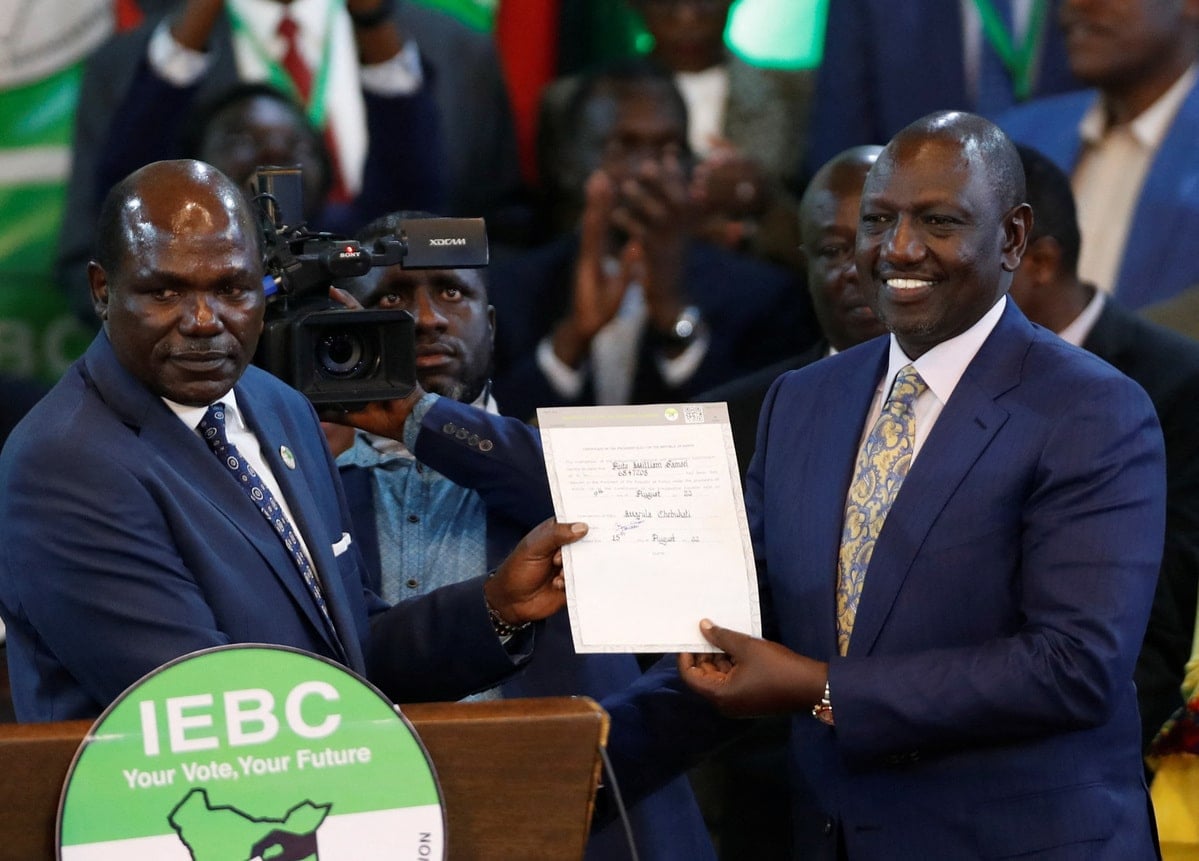
Chebukati declared William Ruto president-elect later that day with 7,176,141 votes, or 50.49 per cent of the valid votes cast. Raila Odinga received 6,942,930 votes, or 48.85 per cent. The difference between them was 233,211 votes. Since Ruto had crossed the constitutional threshold by less than half a percentage point, the commissioners’ walkout did not look like an office quarrel that could be settled after tea. It seemed to pit the commission’s authority against its declared result.
What the Court Actually Examined
That appearance shaped the court petitions that followed, but it was not the evidence upon which the Supreme Court decided the case. Odinga and other petitioners alleged that ‘outsiders’ had intercepted Forms 34A and altered results before uploading; they claimed that ‘outsiders’ had used unauthorized users to access IEBC systems and manipulate the final totals. They also cited the division within the commission, arguing that Chebukati had excluded the other commissioners from verifying and declaring the final results.

Also Read: The 2017 Presidential Election Results Court Cancelled Without Deciding Who Won
On 5 September 2022, the seven judges at the Supreme Court unanimously upheld Ruto’s election. The Court said the evidence did not show that Forms 34A placed on the public portal differed significantly from the forms delivered to the national tallying center or from copies held by party agents. Its scrutiny of contested polling stations did not establish the alleged interference. The Court also rejected the claim that turnout had been deliberately reduced in selected areas and found no proof that Ruto’s total had been rounded upwards to carry him above 50 per cent.
The Elections Observation Group offered a separate check. Its parallel vote tabulation used a random sample of 1,000 polling stations and received usable reports from 990. ELOG found that the official share announced for each of the four presidential candidates fell within its projected range. A sample cannot authenticate all 46,233 polling-station returns, and it cannot decide whether commissioners followed their internal procedures. It did, however, make the claim of a substantially different national vote distribution harder to sustain.
Split Inside the IEBC, Not Proof the Figures Were False
The commissioners’ split therefore requires careful analysis. Their refusal to join Chebukati was evidence of a breakdown inside IEBC. However, it was not, by itself, proof that the declared figures were false. The Supreme Court found that the four commissioners had taken part in tallying and verification until the final stage. It also held that the Constitution assigns the chairman, as national returning officer, the task of declaring the presidential result. In that light, the four commissioners’ absence did not remove that authority or invalidate Chebukati’s power to declare the presidential winner.
The Court did not excuse the commission’s behavior but was not persuaded that the split affected the outcomes of the election. In delivering the judgment, Chief Justice Martha Koome asked whether the election could be nullified because of a “last-minute boardroom rupture.” The Court said the dysfunction inside IEBC concerned its governance but did not affect the presidential result. The dispute exposed a question the commission failed to settle before polling day: what decisions commissioners must take collectively during national verification, and which decisions belong to the chairperson alone as returning officer? This important question remains unanswered.
Also Read: 2013: When Kenya’s Election Technology Failed on Voting Day
The four commissioners raised several objections after leaving Bomas. Among them was the claim that the percentages announced for the four candidates added up to 100.01 rather than 100. The Court accepted IEBC’s explanation that the extra one-hundredth came from rounding the candidates’ percentages to two decimal places, not from additional votes. Their more serious complaint was that they had not been allowed to examine the final aggregation before Chebukati declared it. Yet they did not present an alternative total showing which constituency figure was wrong, how many votes were affected or which candidate’s tally should change.
This is where public suspicion and proof parted company. Kenyans saw commissioners withholding consent, security officers surrounding the chairman, and scuffles on the Bomas floor. Those events gave the commission’s dispute institutional weight. However, the forms examined by the Court, the scrutiny findings and ELOG’s statistical estimate did not support the claim that another candidate could have won. The available evidence therefore supported Ruto’s declared victory, while the conduct of IEBC’s senior officials gave Kenyans a valid reason to question how the commission was being managed.
What Still Has to Be Fixed Before 2027
The Supreme Court’s decision settled the legal challenge, but it did not excuse a commission that reached declaration day without an agreed procedure for its final decisions. In 2022, what was claimed to be credible figures still attracted suspicion because commission officials could not show who verified them and who accepted responsibility for them.
Before 2027, IEBC should publish a binding national-tally protocol. It must explain how each Form 34B will be received and checked; how the finality of constituency results established in the Maina Kiai case will be respected; when polling-station forms may be consulted; and how corrections will be recorded. Every commissioner should sign the final verification record or submit a dated objection naming the constituency, disputed figure and supporting document. IEBC should test this procedure publicly before election day, not improvise it at Bomas of Kenya.
In 2022, the four commissioners did not prove that the result was false. Their departure showed that IEBC let an internal disagreement become a national crisis without leaving a record of where agreement ended. In 2027, objections must be written beside the disputed figures inside the tallying center, not announced later on social media or from a hotel across Nairobi.
This article was written by George Nyongesa, a lecturer in philosophy and logic at the University of Nairobi and Chuka University.
Follow our WhatsApp Channel and X Account for real-time news updates.