Wednesday, September 9, 2026
  • News
    • Latest News
    • Breaking News
    • Fact Check
    • Investigations
    • Explainers
  • Politics
    • Global Politics
    • Elections
    • Government & Policy
    • Diplomacy
    • Conflicts & Security
    • Political Analysis
  • Business
    • Global Economy
    • Markets
    • Technology
    • Startups
    • Energy
    • Finance
  • World News
    • Americas
    • Asia
    • Asia Pacific
    • Africa
    • Europe
    • Middle East
  • Africa
    • Central Africa
    • East Africa
    • West Africa
    • Southern Africa
  • Health
    • Global Health
    • Public Health
    • Health Policy
    • Medical Research
    • Diseases & Conditions
    • Mental Health
    • Nutrition
    • Climate & Health
    • Health Explainers
  • Sports
    • World Cup 2026
    • Athletics
    • Basketball
    • Boxing
    • Cricket
    • Football
    • Formula 1
    • Golf
    • Rugby
  • Weather
    • Climate Business
    • Climate Change
    • Climate Solutions
    • Living Green
  • Culture
    • Arts
    • Film & TV
    • Food and Recipes
    • Music
    • Lifestyle
    • People
    • Travel
  • Opinion
    • Editorials
    • Letters
  • Behind The Brand
REGISTER
LOGIN
No Result
View All Result
The Kenya Times
  • News
    • Latest News
    • Breaking News
    • Fact Check
    • Investigations
    • Explainers
  • Politics
    • Global Politics
    • Elections
    • Government & Policy
    • Diplomacy
    • Conflicts & Security
    • Political Analysis
  • Business
    • Global Economy
    • Markets
    • Technology
    • Startups
    • Energy
    • Finance
  • World News
    • Americas
    • Asia
    • Asia Pacific
    • Africa
    • Europe
    • Middle East
  • Africa
    • Central Africa
    • East Africa
    • West Africa
    • Southern Africa
  • Health
    • Global Health
    • Public Health
    • Health Policy
    • Medical Research
    • Diseases & Conditions
    • Mental Health
    • Nutrition
    • Climate & Health
    • Health Explainers
  • Sports
    • World Cup 2026
    • Athletics
    • Basketball
    • Boxing
    • Cricket
    • Football
    • Formula 1
    • Golf
    • Rugby
  • Weather
    • Climate Business
    • Climate Change
    • Climate Solutions
    • Living Green
  • Culture
    • Arts
    • Film & TV
    • Food and Recipes
    • Music
    • Lifestyle
    • People
    • Travel
  • Opinion
    • Editorials
    • Letters
  • Behind The Brand
  • News
    • Latest News
    • Breaking News
    • Fact Check
    • Investigations
    • Explainers
  • Politics
    • Global Politics
    • Elections
    • Government & Policy
    • Diplomacy
    • Conflicts & Security
    • Political Analysis
  • Business
    • Global Economy
    • Markets
    • Technology
    • Startups
    • Energy
    • Finance
  • World News
    • Americas
    • Asia
    • Asia Pacific
    • Africa
    • Europe
    • Middle East
  • Africa
    • Central Africa
    • East Africa
    • West Africa
    • Southern Africa
  • Health
    • Global Health
    • Public Health
    • Health Policy
    • Medical Research
    • Diseases & Conditions
    • Mental Health
    • Nutrition
    • Climate & Health
    • Health Explainers
  • Sports
    • World Cup 2026
    • Athletics
    • Basketball
    • Boxing
    • Cricket
    • Football
    • Formula 1
    • Golf
    • Rugby
  • Weather
    • Climate Business
    • Climate Change
    • Climate Solutions
    • Living Green
  • Culture
    • Arts
    • Film & TV
    • Food and Recipes
    • Music
    • Lifestyle
    • People
    • Travel
  • Opinion
    • Editorials
    • Letters
  • Behind The Brand
No Result
View All Result
The Kenya Times ~ Trending, Breaking News and Videos
No Result
View All Result
ADVERTISEMENT

2013: When Kenya’s Election Technology Failed on Voting Day

The Kenya Times - Opinion DeskbyThe Kenya Times - Opinion Desk
September 9, 2026
Reading Time: 6 mins read
Ruto Has Introduced Several Taxes Since Taking Over From Uhuru Gachagua

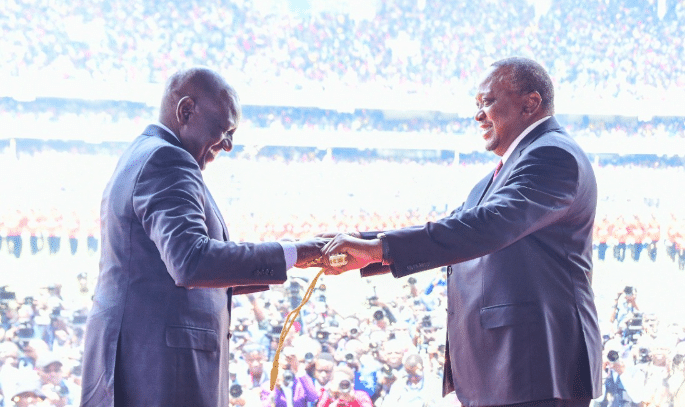
President William Ruto with his predecessor Uhuru Kenyatta during his swearing in ceremony. PHOTO/PCS.

FacebookTwitterLinkedInRedditWhatsApp
Advertisement

At the national tallying center in Bomas of Kenya, presidential results initially appeared on a large electronic screen as they arrived from polling stations. Kenyans could also follow the figures on television, radio and online. Then the transmission system stalled after receiving results from about 14,000 of the country’s 32,613 polling stations. The screen meant to make the election visible became an advertisement for a system that had stopped working.

Technology carried unusual expectations into the election held on 4 March 2013. Kenya was voting under a new Constitution and through a new electoral commission after the 2007 post-election crisis. This election rested upon the promise that biometric registration would clean the voter register, electronic devices would identify voters, and polling officers would transmit provisional results directly from polling stations. Each system promised to close an opening through which previous elections had been questioned and the country thrown into crisis.

Three technologies, three different jobs

The three technologies did not perform the same task in the election process. Biometric voter registration captured fingerprints and personal details while preparing the register. Electronic voter identification devices were supposed to confirm voters at polling stations. The results transmission system was meant to send provisional figures after votes were counted manually. Failure in one system did not prove that another had been manipulated, although public discussion often combined them into one story about election technology.


Also Read: The 2007 Presidential Election No One Could Prove Who Won


Biometric registration produced a register containing about 14.35 million voters, but the commission had only thirty days to conduct the exercise. IEBC chairman Ahmed Issack Hassan later estimated that approximately three million eligible Kenyans remained unregistered. The European Union Election Observation Mission reached a similar conclusion and found that some marginalized communities still lacked the national identity documents required for registration.

ADVERTISEMENT

The more visible breakdown occurred during voter identification. Electronic devices were either unavailable, unused or not working in roughly half the polling stations observed by the European Union mission. Hassan later said that only about 40 per cent worked during the election. Officials returned to printed registers, lists of voters whose biometric details had not been captured and, in some places, the green books used during registration. These alternatives allowed voting to continue, but they left no single method for recording who had been identified and permitted to vote.

The results screen that stopped working

The transmission system then failed to provide the promised second layer of public verification. It had been designed to send provisional presidential results from polling stations through configured mobile phones over a closed network. Those figures were never meant to replace the signed paper returns used for the official tally. They were supposed to let the public compare what polling stations reported with what the commission later announced.

Its collapse mattered because the provisional system had become IEBC’s main public window into the count. A programming error made rejected votes appear eight times higher than the figures being entered, briefly pushing their displayed proportion above five per cent. The transmission platform later stopped after receiving results from fewer than half the polling stations. IEBC then concentrated on manually tallying the official constituency returns while candidates and citizens waited for figures they could no longer follow independently.

What observers and the Court actually found

That failure did not prove that Uhuru Kenyatta had been awarded votes he did not receive. The European Union observers reported that counting was conducted properly in the polling stations they attended and that recorded results reflected the votes cast there. They found minor discrepancies during tallying, but almost all were below one per cent and showed no overall pattern favoring either leading candidate. Technology had failed, yet the available observer evidence did not establish that the failure changed the winner.

The official result gave Kenyatta 6,173,433 votes, representing 50.07 per cent of valid votes cast, while Raila Odinga received 5,340,546. That narrow passage above the constitutional threshold made every dispute concerning rejected votes, the register and the tally politically significant. Odinga and other petitioners challenged the election before the Supreme Court, arguing that the register was unreliable and that the collapse of electronic identification and transmission had damaged the result.

ADVERTISEMENT

The Court unanimously upheld Kenyatta’s election after hearing the consolidated presidential petitions. It found that electronic technology was intended to support the election rather than replace the legally recognized manual process, and that failure of the electronic systems did not invalidate the paper-based tally. It also ruled that rejected ballots should not be included when calculating whether a candidate had obtained more than half of all votes cast. The Court concluded that the petitioners had not supplied sufficient proof that the irregularities overturned the result declared by IEBC.

The lesson Kenya still needs before 2027

The Court upheld the result, but its judgment did not erase the documented failure of the election technology. The European Union mission found that IEBC introduced some systems only months before polling, leaving too little time for procurement, testing, deployment and practical training. After the election, Hassan described the mistake through a proverb: “Never test the depth of a river with both feet.” By then, IEBC had already stepped into the river carrying three new technologies and the credibility of the first presidential election conducted under the 2010 Constitution.


Also Read: Kenyans Warned of Media Blackout and Internet Shutdown


The mistake was not simply buying and deploying machines that failed. IEBC allowed public confidence to depend on systems whose breakdown was not matched by an equally visible fallback. Manual voting and tallying can produce a valid election, but citizens must know beforehand which record becomes authoritative when a device refuses a fingerprint or a server stops receiving results. The fallback cannot appear after failure as an explanation offered by officials under pressure.

Before 2027, IEBC must publish the purpose, testing record and failure procedure for every election technology it intends to use. Polling officials should know which document controls when a device fails, while agents and observers should be able to follow the replacement procedure without waiting for instructions from Nairobi. Under the principle later affirmed in the Maina Kiai case, constituency presidential results are final and cannot be altered at the national tallying center, although the national process still has the necessary work of verification, aggregation and declaration. Kenya does not need another electronic screen that works beautifully until the presidential figures become close. It needs a count that remains visible after the screen goes blank. 

Follow our WhatsApp Channel and X Account for real-time news updates.

This article was written by George Nyongesa, a lecturer in philosophy and logic at the University of Nairobi and Chuka University.

Raila Odinga Is A Frontrunner In The African Union Commission Chairmanship.
Kenya’s former PM, the late Raila Odinga (Left), with President of Nigeria Bola Ahmed Tinubu and President William Ruto at the Africa Heads of State Energy Summit. PHOTO/Raila Press Team.
Tags: IEBCKenya Election 2027Wafula Chebukati
The Kenya Times - Opinion Desk

The Kenya Times - Opinion Desk

The Kenya Times Opinion Desk publishes independent commentary and analysis from contributors and invited voices. Views expressed are those of the authors and do not represent the newsroom’s reporting or editorial positions.

Related Posts

Sher Khan And Education Beyond The Classroom: Preparing Children For Life

Beyond Marks and Degrees: Preparing Children for Life – Lessons from Sher Khan

September 9, 2026
China’s President Xi Jinping Hosts African Leaders During China Africa Forum 2024 In Beijing. Photo/Pcs.

Why Africa Must Own the New Architecture of Global Trade

September 9, 2026
A Past Photo Of Siaya Governor James Orengo With Late President Mwai Kibaki And Former Prime Minister Raila Odinga. Photo/ Kenua Yearbook Editorial Board.

The 2007 Presidential Election No One Could Prove Who Won

September 8, 2026
Jobs In Africa: University Fees, Helb Loans, Government Scholarships And Grants Determine The Final Amount Payable By A Student In 2026 Depending On Programs.

Can Universities Solve Unemployment in Africa?

September 8, 2026

Leave a Reply Cancel reply

Your email address will not be published. Required fields are marked *

ADVERTISEMENT

The Kenya Times Facebook

LATEST NEWS

  • 2013: When Kenya’s Election Technology Failed on Voting Day
  • DCI Arrests 12 for Blocking Rachel Ruto’s Motorcade
  • The Three Types of El Niño That Could Shape Kenya’s Future
  • From Ugali to Fast Food: How Changing Lifestyles Are Fueling Obesity in Kenya 
  • Comprehensive vs Third-Party: The Vehicle Insurance Cover Motorists Should Have Ahead of Predicted El Niño
  • From Free to KSh 53,554: What C1, C2, C3 and C4 Senior School Fees Will Cost Parents Next Year
  • Kenya Met Explains How 2026 El Niño Compares to 1997
  • Ruto Reveals Why Kenya Wants to Host the Grammy Awards
  • Which Learners Qualify for Boarding Schools of Choice Under New Grade 10 Placement Formula
  • Beyond Marks and Degrees: Preparing Children for Life – Lessons from Sher Khan
  • Massive Traffic Jam Hits Waiyaki Way: Here Are Alternative Routes for Motorists
  • Widow of Lawyer Gunned Down in Nairobi Shares Heartfelt Message, A Year Later
  • Nairobi to Host Over 500 Top CEOs, Global Leaders and EU Investors  
  • Why Africa Must Own the New Architecture of Global Trade
  • Nairobi Set for Historic Global Cup as Kenya Named Africa’s Esports Hub
ADVERTISEMENT

Company

About Us

Our Authors

Our Experts

Social Media

Policies

Privacy Policy

House Rules

Standards and Policies

Terms and Conditions

Subscription

My Account

Contact Us

Contact Us

Join Our Team

Advertise With Us

© Copyright 2026 | The Kenya Times | All Rights Reserved

Welcome Back!

Sign In with Facebook
Sign In with Google
Sign In with Linked In
OR

Login to your account below

Forgotten Password? Sign Up

Create New Account!

Sign Up with Facebook
Sign Up with Google
Sign Up with Linked In
OR

Fill the forms below to register

All fields are required. Log In

Retrieve your password

Please enter your username or email address to reset your password.

Log In
Your Privacy and Cookies
We use cookies on our website to give you the most relevant experience by remembering your preferences and repeat visits. By clicking “Accept”, you consent to the use of ALL the cookies.
Do not sell my personal information.
Cookie settingsACCEPT
Privacy & Cookies Policy

Privacy Overview

This website uses cookies to improve your experience while you navigate through the website. Out of these cookies, the cookies that are categorized as necessary are stored on your browser as they are essential for the working of basic functionalities of the website. We also use third-party cookies that help us analyze and understand how you use this website. These cookies will be stored in your browser only with your consent. You also have the option to opt-out of these cookies. But opting out of some of these cookies may have an effect on your browsing experience.
Necessary
Always Enabled
Necessary cookies are absolutely essential for the website to function properly. This category only includes cookies that ensures basic functionalities and security features of the website. These cookies do not store any personal information.
Functional
Functional cookies help to perform certain functionalities like sharing the content of the website on social media platforms, collect feedbacks, and other third-party features.
Performance
Performance cookies are used to understand and analyze the key performance indexes of the website which helps in delivering a better user experience for the visitors.
Analytics
Analytical cookies are used to understand how visitors interact with the website. These cookies help provide information on metrics the number of visitors, bounce rate, traffic source, etc.
Advertisement
Advertisement cookies are used to provide visitors with relevant ads and marketing campaigns. These cookies track visitors across websites and collect information to provide customized ads.
Others
Other uncategorized cookies are those that are being analyzed and have not been classified into a category as yet.
SAVE & ACCEPT
LOGIN | REGISTER
  • Login
  • Sign Up
  • Cart
No Result
View All Result
  • News
    • Latest News
    • Breaking News
    • Investigations
    • Explainers
    • Fact Check
  • Politics
    • Global Politics
    • Conflicts & Security
    • Elections
    • Diplomacy
    • Government & Policy
    • Political Analysis
  • Business
    • Global Economy
    • Markets
    • Technology
    • Startups
    • Energy
    • Finance
  • World News
    • Americas
    • Asia
    • Asia Pacific
    • Africa
    • Europe
    • Middle East
  • Africa
    • East Africa
    • West Africa
    • Southern Africa
    • Central Africa
  • Health
    • Global Health
    • Public Health
    • Health Policy
    • Medical Research
    • Diseases & Conditions
    • Mental Health
    • Nutrition
    • Climate & Health
    • Health Explainers
  • Sports
    • World Cup 2026
    • Athletics
    • Basketball
    • Boxing
    • Cricket
    • Football
    • Formula 1
    • Golf
    • Rugby
  • Weather
    • Climate Business
    • Climate Change
    • Climate Solutions
    • Living Green
  • Culture
    • Arts
    • Film & TV
    • Food and Recipes
    • Lifestyle
    • Music
    • People
    • Travel
  • Opinion
    • Editorials
    • Letters
  • Behind The Brand
  • Contact Us

Not enough quota to unlock this post
Unlock left : 0
Are you sure want to cancel subscription?