
Tuesday, June 2, 2026
  • News
    • Latest News
    • Breaking News
    • Fact Check
    • Investigations
    • Explainers
  • Politics
    • Global Politics
    • Elections
    • Government & Policy
    • Diplomacy
    • Conflicts & Security
    • Political Analysis
  • Business
    • Global Economy
    • Markets
    • Technology
    • Startups
    • Energy
    • Finance
  • World News
    • Americas
    • Asia
    • Asia Pacific
    • Africa
    • Europe
    • Middle East
  • Africa
    • Central Africa
    • East Africa
    • West Africa
    • Southern Africa
  • Health
    • Global Health
    • Public Health
    • Health Policy
    • Medical Research
    • Diseases & Conditions
    • Mental Health
    • Nutrition
    • Climate & Health
    • Health Explainers
  • Sports
    • Athletics
    • Basketball
    • Boxing
    • Cricket
    • Football
    • Formula 1
    • Golf
    • Rugby
  • Weather
    • Climate Business
    • Climate Change
    • Climate Solutions
    • Living Green
  • Culture
    • Arts
    • Film & TV
    • Food
    • Music
    • Lifestyle
    • Travel
  • Opinion
    • Editorials
    • Letters
  • Behind The Brand
REGISTER
LOGIN
No Result
View All Result
The Kenya Times
  • News
    • Latest News
    • Breaking News
    • Fact Check
    • Investigations
    • Explainers
  • Politics
    • Global Politics
    • Elections
    • Government & Policy
    • Diplomacy
    • Conflicts & Security
    • Political Analysis
  • Business
    • Global Economy
    • Markets
    • Technology
    • Startups
    • Energy
    • Finance
  • World News
    • Americas
    • Asia
    • Asia Pacific
    • Africa
    • Europe
    • Middle East
  • Africa
    • Central Africa
    • East Africa
    • West Africa
    • Southern Africa
  • Health
    • Global Health
    • Public Health
    • Health Policy
    • Medical Research
    • Diseases & Conditions
    • Mental Health
    • Nutrition
    • Climate & Health
    • Health Explainers
  • Sports
    • Athletics
    • Basketball
    • Boxing
    • Cricket
    • Football
    • Formula 1
    • Golf
    • Rugby
  • Weather
    • Climate Business
    • Climate Change
    • Climate Solutions
    • Living Green
  • Culture
    • Arts
    • Film & TV
    • Food
    • Music
    • Lifestyle
    • Travel
  • Opinion
    • Editorials
    • Letters
  • Behind The Brand
  • News
    • Latest News
    • Breaking News
    • Fact Check
    • Investigations
    • Explainers
  • Politics
    • Global Politics
    • Elections
    • Government & Policy
    • Diplomacy
    • Conflicts & Security
    • Political Analysis
  • Business
    • Global Economy
    • Markets
    • Technology
    • Startups
    • Energy
    • Finance
  • World News
    • Americas
    • Asia
    • Asia Pacific
    • Africa
    • Europe
    • Middle East
  • Africa
    • Central Africa
    • East Africa
    • West Africa
    • Southern Africa
  • Health
    • Global Health
    • Public Health
    • Health Policy
    • Medical Research
    • Diseases & Conditions
    • Mental Health
    • Nutrition
    • Climate & Health
    • Health Explainers
  • Sports
    • Athletics
    • Basketball
    • Boxing
    • Cricket
    • Football
    • Formula 1
    • Golf
    • Rugby
  • Weather
    • Climate Business
    • Climate Change
    • Climate Solutions
    • Living Green
  • Culture
    • Arts
    • Film & TV
    • Food
    • Music
    • Lifestyle
    • Travel
  • Opinion
    • Editorials
    • Letters
  • Behind The Brand
No Result
View All Result
The Kenya Times ~ Trending, Breaking News and Videos
No Result
View All Result
ADVERTISEMENT

Journalists Believe News and Opinion are Separate, but Readers Can’t Tell the Difference

Kevin M LernerbyKevin M Lerner
June 24, 2020
Reading Time: 7 mins read
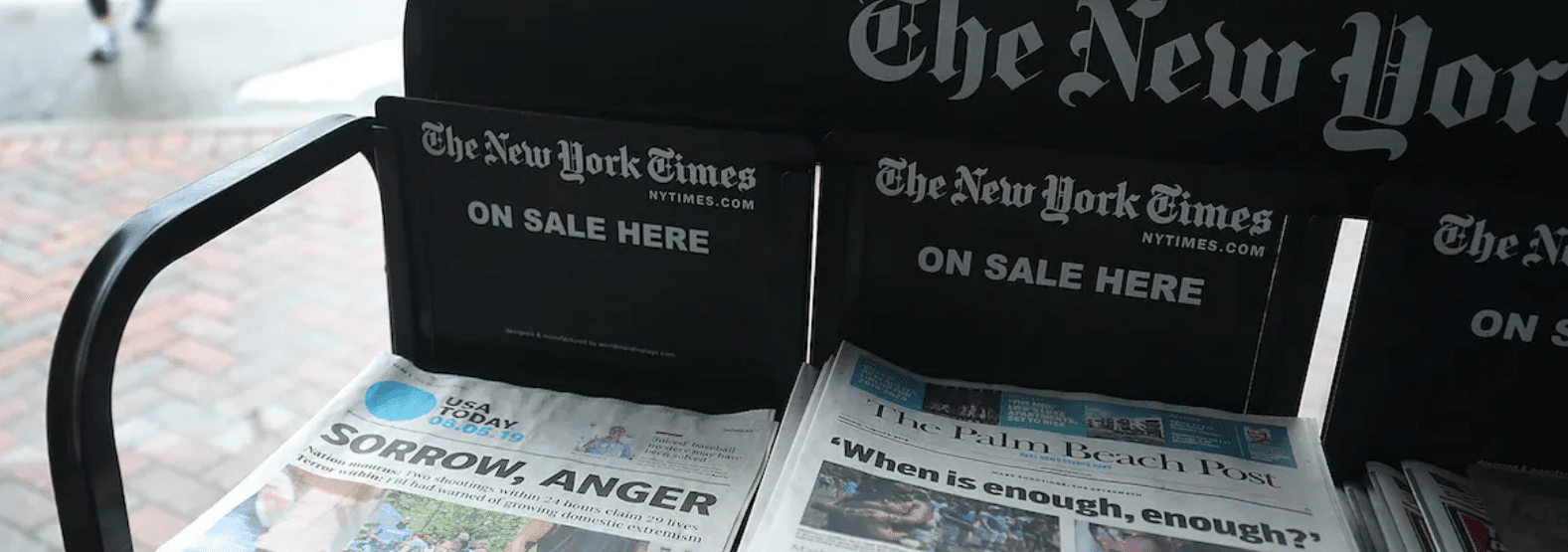
Readers Don’t Always Know How To Distinguish Fact From Opinion | Joe Raedle Getty Images

Readers don’t always know how to distinguish fact from opinion | Joe Raedle Getty Images

FacebookTwitterLinkedInRedditWhatsApp
Advertisement

The New York Times opinion editor James Bennet resigned recently after the paper published a controversial opinion essay by U.S. Sen. Tom Cotton that advocated using the military to put down protests.

The essay sparked outrage among the public as well as among younger reporters at the paper. Many of those staffers participated in a social media campaign aimed at the paper’s leadership, asking for factual corrections and an editor’s note explaining what was wrong with the essay.

Eventually, the staff uprising forced Bennet’s departure.

Cotton’s column was published on the opinion pages – not the news pages. But that’s a distinction often lost to the public, whose criticisms during the recent incident were often directed at the paper as a whole, including its news coverage.

All of which raises a longstanding question: What’s the difference between the news and opinion side of a news organization?

It is a tenet of American journalism that reporters working for the news sections of newspapers remain entirely independent of the opinion sections. But the divide between news and opinion is not as clear to many readers as journalists believe that it is.

ADVERTISEMENT

And because American news consumers have become accustomed to the ideal of objectivity in news, the idea that opinions bleed into the news report potentially leads readers to suspect that reporters have a political agenda, which damages their credibility, and that of their news organizations.
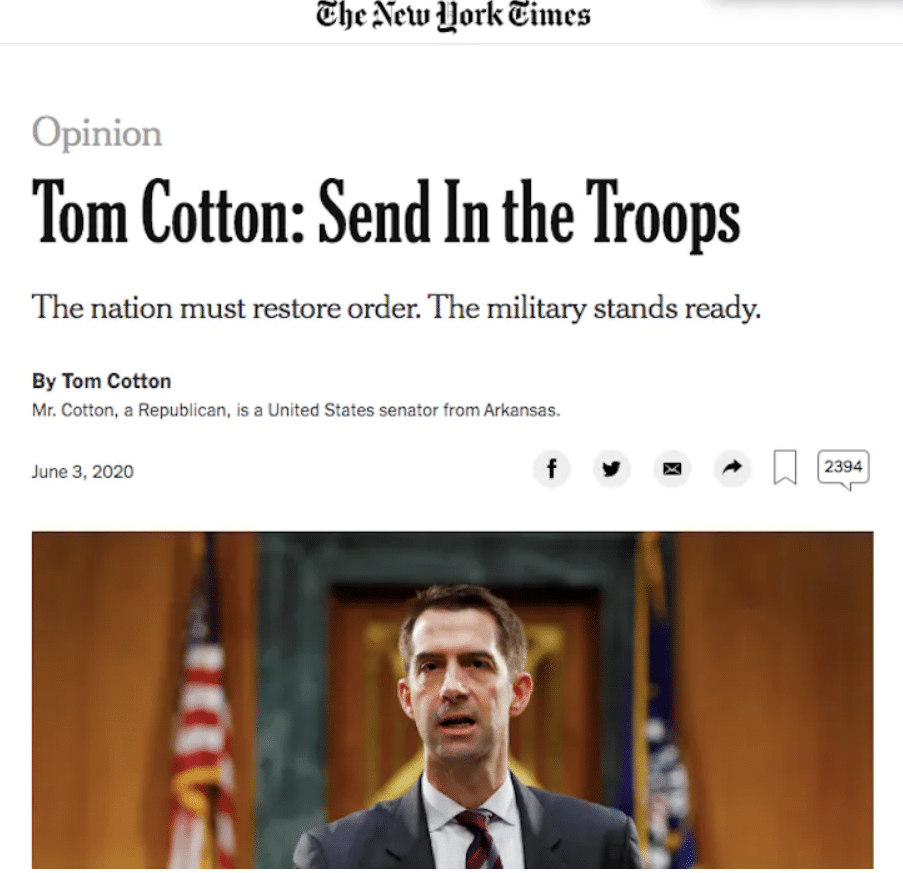
The op-ed column by Sen. Tom Cotton. New York Times screenshot

How news and opinion grew apart

Long before newspapers became institutions for collecting and distributing news, they were instruments for the personal expression of individuals – their owners. There was little thought given to whether or not opinion and fact were intermingled.

Benjamin Franklin ran the Pennsylvania Gazette from 1729 to 1748 as a vehicle for his own political and scientific ideas and even just his day-to-day observations. The Gazette of the United States, first published in 1789, was the most prominent Federalist paper of its time and was funded in part by Alexander Hamilton, whose letters and essays it published anonymously.
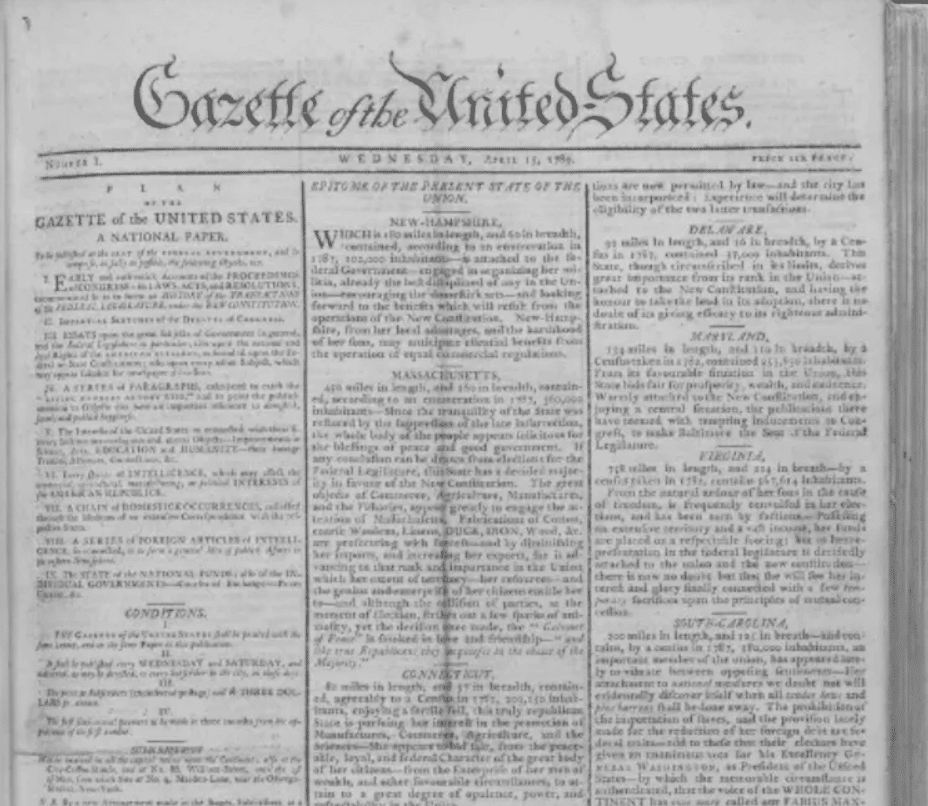
Front page of the inaugural issue of the Gazette of the United States, from April 15, 1789. Library of Congress

In the early 19th century, newspapers were often nakedly partisan, since many of them were funded by political parties.

Over the course of the 19th century, though, newspapers began to seek a popular audience. As they grew in circulation, some began to emphasize their independence from faction.

ADVERTISEMENT

Coupled with the rise of journalism schools and press organizations, this independence enshrined “fact” and “truth” as what scholar Barbie Zelizer calls “God-terms” of journalism by the early 20th century.

Newspaper owners never wanted to give up their influence on public opinion, however. As news became the main product of the newspaper, publishers established editorial pages, where they could continue to endorse their favorite politicians or push for pet causes.

These pages are typically run by editorial boards, which are staffs of writers, often with individual areas of expertise (economics or foreign policy or, in smaller papers, state politics), who draft editorial essays.

They are then voted on by the board, which usually includes the publisher. They’re then published, usually with no author attribution, as the official opinions of the newspaper. There are variations on this process: Often the editorial board will decide on topics and the paper’s opinion before these writers get to work on their drafts.

James Bennet, The New York Times opinion editor who resigned, acknowledged in an article on the paper’s website that was published in January 2020, months before the Cotton essay, that “the role of the editorial board can be confusing, particularly to readers who don’t know The Times well.”

Through most the 20th century, newspapers reassured their readers and their reporters that there was a “wall” between the news and opinion sides of their operations.

Unbiased journalism is a relatively new phenomenon | Angela Weiss/AFP via Getty Images

Publishers relied on this idea of separation to insist that their news reporting was fair and independent, and they believed that readers understood that separation.

This is a particularly American way of operating. Readers in other countries usually expect their newspapers to have a point of view, representing a particular party or ideology. 

The creation of the op-ed page

One way that newspapers found to allow a greater range of opinion in its pages was to create an op-ed page, which publishes opinions by individuals, not those of the editorial board. As journalism historian Michael Socolow recounts, John Oakes, the editorial page editor of The New York Times in 1970, created the first op-ed page because, he felt, “a newspaper most effectively fulfills its social and civic responsibilities by challenging authority, acting independently, and inviting dissent.”

“Op-ed” is short for “opposite the editorial page,” not “opinion and editorial” or opinions that are opposite from those of the editorial page. Literally, the name comes from the fact that it was located across from – opposite – the editorial page in the print newspaper.

The op-ed page of a print newspaper typically includes the newspaper’s opinion columnists. These are employees of the paper who write regularly. The paper also usually publishes a selection of opinion pieces from outside writers. Newspapers around the country emulated the Times after the op-ed page debuted. 

Online opinions, changing norms and blurred lines

With the expansion of opinion pages online, the Times was publishing 120 opinion pieces a week at the time of James Bennet’s resignation.

While the move online allows The New York Times op-ed page to vastly increase its output, it also creates a problem: Opinion stories no longer look clearly different from news stories.

With many readers coming to news sites from social media links, they may not pay attention to the subtle clues that mark a story published by the opinion staff.
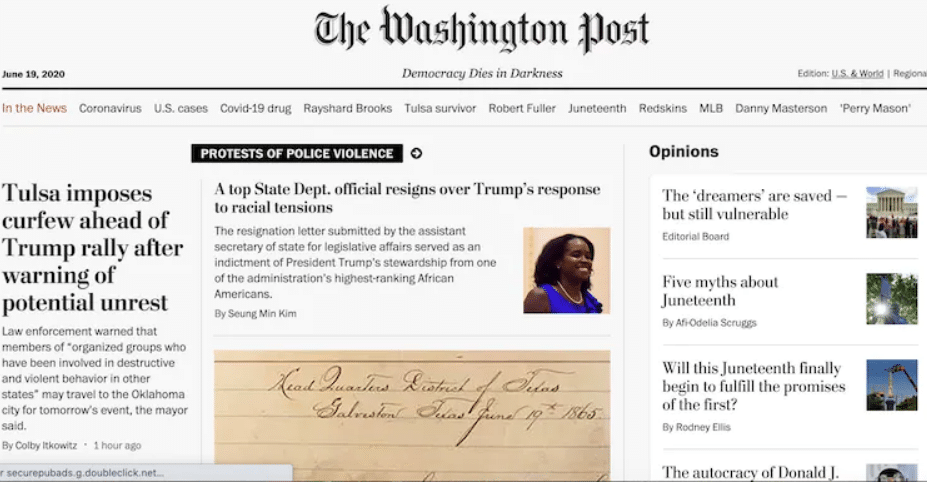
The Washington Post homepage on June 19, 2020. Opinions at top right; reporting to the left.

Add to this the fact that even readers who go to a paper’s homepage are met with news and opinion stories displayed graphically at the same level, connoting the same level of importance. And reporters share analysis and opinion on Twitter, further confusing readers.

The news sections of the paper also increasingly run stories that contain a level of news analysis that casual readers might not be able to distinguish from what The New York Times designates as opinion.

In 1970, when the op-ed page debuted in The New York Times, daily newspaper circulation was equivalent to 98% of U.S. households.

By 2010, that number had dropped below 40% and has continued to dip since then.

Even if readers in 1970 could clearly differentiate between news and opinion, they likely do not have the same level of critical engagement when news exists online and in almost unmanageable volume.

If news organizations such as The New York Times continue to maintain that a robust opinion section, separate from their news reports, serves to further the public conversation, then those institutions will need to do a better job of explaining to news consumers where – or if – the “wall” between news and opinion exists.

Kevin M. Lerner, Assistant Professor of Journalism, Marist College

This article is republished from The Conversation under a Creative Commons license. Read the original article.


Tags: Benjamin FranklinCultureEditorialFactHistoryJournalismJournalistsNew York TimesnewsNewspaperOp-edOpinionPartisanshippolitics
Kevin M Lerner

Kevin M Lerner

Kevin M. Lerner is Associate Professor of Journalism at Marist College. His research focuses on the intellectual history of journalism through press criticism, satire, and magazines. His first book, Provoking the Press: (MORE) Magazine and the Crisis of Confidence in American Journalism was published by the University of Missouri Press in the summer of 2019. He has judged the National Magazine Awards, the ASME Next Awards, and the Columbia Scholastic Press Awards. He earned his Ph.D. from Rutgers University, a master’s in journalism from Columbia University, and a B.A. in nonfiction writing from the University of Pennsylvania. He was the founding editor of the website for Architectural Record magazine—where he was part of a team that won the National Magazine Award—and has published journalism in The New York Times, The Washington Post, New York magazine, Slate, The Columbia Journalism Review, and The Nieman Lab. He edited the Journal of Magazine Media from 2016–2021.

Related Posts

Is Kenya Losing Its Morals? Rising Deviant Behavior And Rampant Crime

Opinion | The Mother Who Hates Her Own Children: Kenya’s Moral Collapse

June 2, 2026
Treasury Invites Applications For Board Recruitment Across 39 State-Owned Enterprises

Opinion | How New Taxes on Bank Card Transactions Charges Will Raise the Costs for Ordinary Kenyans if Adopted by Parliament

June 1, 2026
Artificial Intelligence Esther Muoria Is A Seasoned Manager And Phd Holder Appointed By President William Ruto As The Tvet Principal Secretary.

Opinion | AI Mistakes That Could Destroy Kenya’s Future — Global Lessons Every Leader, Business and Citizen Must See Now

May 31, 2026
Health Cs Aden Duale Denies Claims Sha Will Shut Down. Ebola Storm Rages On

Opinion | Kenya Should Think Before Rejecting the Laikipia Ebola Facility

May 31, 2026
ADVERTISEMENT

The Kenya Times Facebook

LATEST ARTICLES

  • Maurice Ogeta Finally Reveals Raila’s Last Moments and How He Died 
  • Ruto Explains Why He Allowed US to Have Ebola Quarantine at Laikipia Air Base
  • Opinion | The Mother Who Hates Her Own Children: Kenya’s Moral Collapse
  • Bolt Sets the Record Straight on Reports of Shutting Down in Kenya
  • Ex-Catholic Priest Arrested Over Calls to Overthrow Ruto
  • Nairobi Mentioned as Trump Cut Number of Embassies in Africa
  • Why Transgender Troops Can Now Serve in the U.S. Military
  • “I Couldn’t Care Less” Trump Responds After Iran Ends Talks With US
  • Jill Biden Reveals Regret Over Joe Biden’s 2024 Run in New Interview
  • Stars Abroad: Moses Shumah, Kenyan Striker Breaking Records in Zambia
  • Doctors Question Transparency of Trump’s Heart Test Results
  • Corazone Aquino: Kenyan Star Named After Philippines’ Former President
  • KMA Reveals How to Know Licensed Doctors After Deadly Kitale Surgery
  • Iran Ends All Negotiations With US, Vows to “Completely” Block the Strait of Hormuz
  • Wise vs Remitly vs Western Union: Best International Transfer in 2026
ADVERTISEMENT

Company

About Us

Our Authors

Our Experts

Social Media

Policies

Privacy Policy

House Rules

Standards and Policies

Terms and Conditions

Subscription

My Account

Contact Us

Contact Us

Join Our Team

Advertise With Us

© Copyright 2026 | The Kenya Times | All Rights Reserved

Welcome Back!

Sign In with Facebook
Sign In with Google
Sign In with Linked In
OR

Login to your account below

Forgotten Password? Sign Up

Create New Account!

Sign Up with Facebook
Sign Up with Google
Sign Up with Linked In
OR

Fill the forms below to register

All fields are required. Log In

Retrieve your password

Please enter your username or email address to reset your password.

Log In
Your Privacy and Cookies
We use cookies on our website to give you the most relevant experience by remembering your preferences and repeat visits. By clicking “Accept”, you consent to the use of ALL the cookies.
Do not sell my personal information.
Cookie settingsACCEPT
Privacy & Cookies Policy

Privacy Overview

This website uses cookies to improve your experience while you navigate through the website. Out of these cookies, the cookies that are categorized as necessary are stored on your browser as they are essential for the working of basic functionalities of the website. We also use third-party cookies that help us analyze and understand how you use this website. These cookies will be stored in your browser only with your consent. You also have the option to opt-out of these cookies. But opting out of some of these cookies may have an effect on your browsing experience.
Necessary
Always Enabled
Necessary cookies are absolutely essential for the website to function properly. This category only includes cookies that ensures basic functionalities and security features of the website. These cookies do not store any personal information.
Functional
Functional cookies help to perform certain functionalities like sharing the content of the website on social media platforms, collect feedbacks, and other third-party features.
Performance
Performance cookies are used to understand and analyze the key performance indexes of the website which helps in delivering a better user experience for the visitors.
Analytics
Analytical cookies are used to understand how visitors interact with the website. These cookies help provide information on metrics the number of visitors, bounce rate, traffic source, etc.
Advertisement
Advertisement cookies are used to provide visitors with relevant ads and marketing campaigns. These cookies track visitors across websites and collect information to provide customized ads.
Others
Other uncategorized cookies are those that are being analyzed and have not been classified into a category as yet.
SAVE & ACCEPT
LOGIN | REGISTER
  • Login
  • Sign Up
  • Cart
No Result
View All Result
  • News
    • Latest News
    • Breaking News
    • Investigations
    • Explainers
    • Fact Check
  • Politics
    • Global Politics
    • Conflicts & Security
    • Elections
    • Diplomacy
    • Government & Policy
    • Political Analysis
  • Business
    • Global Economy
    • Markets
    • Technology
    • Startups
    • Energy
    • Finance
  • World News
    • Americas
    • Asia
    • Asia Pacific
    • Africa
    • Europe
    • Middle East
  • Africa
    • East Africa
    • West Africa
    • Southern Africa
    • Central Africa
  • Health
    • Global Health
    • Public Health
    • Health Policy
    • Medical Research
    • Diseases & Conditions
    • Mental Health
    • Nutrition
    • Climate & Health
    • Health Explainers
  • Sports
    • Athletics
    • Basketball
    • Boxing
    • Cricket
    • Football
    • Formula 1
    • Golf
    • Rugby
  • Weather
    • Climate Business
    • Climate Change
    • Climate Solutions
    • Living Green
  • Culture
    • Arts
    • Film & TV
    • Food
    • Lifestyle
    • Music
    • Travel
  • Opinion
    • Editorials
    • Letters
  • Behind The Brand
  • Contact Us

Not enough quota to unlock this post
Unlock left : 0
Are you sure want to cancel subscription?