Thursday, October 15, 2026
  • News
    • Latest News
    • Breaking News
    • Fact Check
    • Investigations
    • Explainers
  • Politics
    • Global Politics
    • Elections
    • Government & Policy
    • Diplomacy
    • Conflicts & Security
    • Political Analysis
  • Business
    • Global Economy
    • Markets
    • Technology
    • Startups
    • Energy
    • Finance
  • World News
    • Americas
    • Asia
    • Asia Pacific
    • Africa
    • Europe
    • Middle East
  • Africa
    • Central Africa
    • East Africa
    • West Africa
    • Southern Africa
  • Health
    • Global Health
    • Public Health
    • Health Policy
    • Medical Research
    • Diseases & Conditions
    • Mental Health
    • Nutrition
    • Climate & Health
    • Health Explainers
  • Sports
    • World Cup 2026
    • Athletics
    • Basketball
    • Boxing
    • Cricket
    • Football
    • Formula 1
    • Golf
    • Rugby
  • Weather
    • Climate Business
    • Climate Change
    • Climate Solutions
    • Living Green
  • Culture
    • Arts
    • Film & TV
    • Food and Recipes
    • Music
    • Lifestyle
    • People
    • Travel
  • Opinion
    • Editorials
    • Letters
  • Behind The Brand
REGISTER
LOGIN
No Result
View All Result
The Kenya Times
  • News
    • Latest News
    • Breaking News
    • Fact Check
    • Investigations
    • Explainers
  • Politics
    • Global Politics
    • Elections
    • Government & Policy
    • Diplomacy
    • Conflicts & Security
    • Political Analysis
  • Business
    • Global Economy
    • Markets
    • Technology
    • Startups
    • Energy
    • Finance
  • World News
    • Americas
    • Asia
    • Asia Pacific
    • Africa
    • Europe
    • Middle East
  • Africa
    • Central Africa
    • East Africa
    • West Africa
    • Southern Africa
  • Health
    • Global Health
    • Public Health
    • Health Policy
    • Medical Research
    • Diseases & Conditions
    • Mental Health
    • Nutrition
    • Climate & Health
    • Health Explainers
  • Sports
    • World Cup 2026
    • Athletics
    • Basketball
    • Boxing
    • Cricket
    • Football
    • Formula 1
    • Golf
    • Rugby
  • Weather
    • Climate Business
    • Climate Change
    • Climate Solutions
    • Living Green
  • Culture
    • Arts
    • Film & TV
    • Food and Recipes
    • Music
    • Lifestyle
    • People
    • Travel
  • Opinion
    • Editorials
    • Letters
  • Behind The Brand
  • News
    • Latest News
    • Breaking News
    • Fact Check
    • Investigations
    • Explainers
  • Politics
    • Global Politics
    • Elections
    • Government & Policy
    • Diplomacy
    • Conflicts & Security
    • Political Analysis
  • Business
    • Global Economy
    • Markets
    • Technology
    • Startups
    • Energy
    • Finance
  • World News
    • Americas
    • Asia
    • Asia Pacific
    • Africa
    • Europe
    • Middle East
  • Africa
    • Central Africa
    • East Africa
    • West Africa
    • Southern Africa
  • Health
    • Global Health
    • Public Health
    • Health Policy
    • Medical Research
    • Diseases & Conditions
    • Mental Health
    • Nutrition
    • Climate & Health
    • Health Explainers
  • Sports
    • World Cup 2026
    • Athletics
    • Basketball
    • Boxing
    • Cricket
    • Football
    • Formula 1
    • Golf
    • Rugby
  • Weather
    • Climate Business
    • Climate Change
    • Climate Solutions
    • Living Green
  • Culture
    • Arts
    • Film & TV
    • Food and Recipes
    • Music
    • Lifestyle
    • People
    • Travel
  • Opinion
    • Editorials
    • Letters
  • Behind The Brand
No Result
View All Result
The Kenya Times ~ Trending, Breaking News and Videos
No Result
View All Result
ADVERTISEMENT

Nigeria’s Minimum Wage Has Never Protected Workers From Poverty: Here’s Why

Stephen OnyeiwubyStephen Onyeiwu
May 5, 2024
Reading Time: 8 mins read
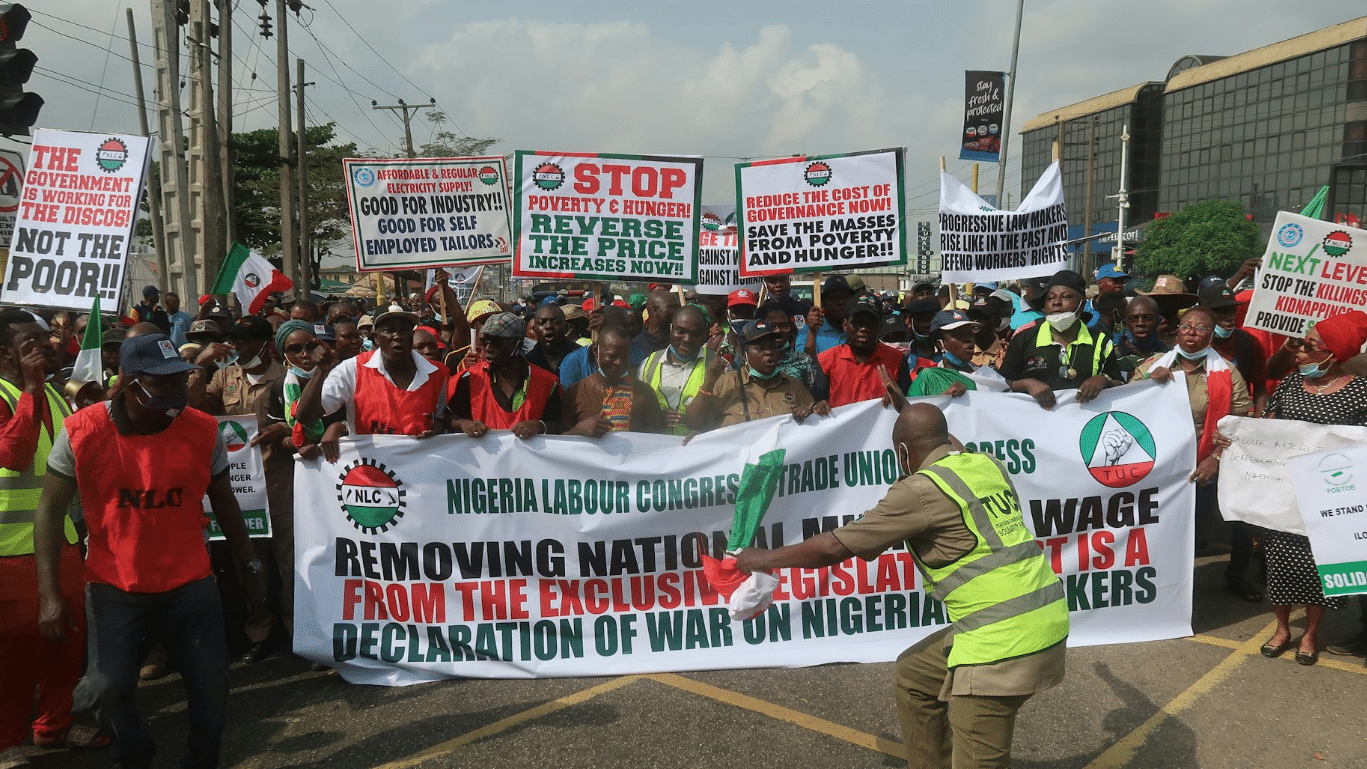
Members Nigeria Labor Unions Protest

Members of Nigeria’s labour unions protesting over the minimum wage in Lagos in 2021. Adekunle Ajayi/NurPhoto via Getty Images

FacebookTwitterLinkedInRedditWhatsApp
Advertisement

Wages have become the top issue for Nigeria’s organized labor movements in the past year. Reacting to recent increases in the cost of living, the labor movement has been calling for an upward review of the national minimum wage, currently N30,000 (US$24) a month. The Conversation’s Adejuwon Soyinka asks economics professor Stephen Onyeiwu if Nigeria’s minimum wage truly protects workers from poverty.

When did Nigeria get a minimum wage and why?

In 1974, the Nigerian government followed the recommendations of the Udoji Commission and increased workers’ wages. But public sector workers were the main beneficiaries. It was not until 3 September 1981 that the first minimum wage law was introduced. The law covered all full-time workers except seasonal workers and those who worked in enterprises employing fewer than 50 workers.

Its introduction was prompted by a number of factors. The Nigerian Labor Congress, an umbrella organization of trade unions then led by Hassan Sunmonu, was vociferous in its demand for improvements in workers’ welfare. It threatened to go on strike if its demand for a minimum wage was not met. As a new government at the time, the last thing the president Shehu Shagari administration wanted was a nationwide strike.


Also Read: Larry Madowo Questions Nigeria’s Visa Charges


The first minimum wage in 1981 was 125 naira per month. At the exchange rate of US$1 = 0.61 naira in 1981, this amounted to about US$204. In 2024, that minimum wage would be equivalent to about 265,000 naira (US$204) per month, going by the current exchange rate of about US$1 = 1,300 naira. So the minimum wage in 1981 was at least eight times more than the current minimum wage.

The minimum wage in Nigeria has been revised a number of times but has not kept pace with the cost of living. It became 250 naira in 1991, 5,500 naira in 2000 and 18,900 naira in 2011. The current 30,000 naira took effect in 2019.

Who is affected by changes to the minimum wage?

The Nigerian labor market has two segments. Public-sector workers are the most affected by increases in the minimum wage. This is because the government cannot violate its own law, and nearly all public-sector workers are unionized.

Most Nigerians, however, are not affected by changes in the minimum wage. This is because 92.3% of the working age employed population work in the informal sector, mostly as farmers, traders or providers of services.

Only about 8% of Nigerians (or 16 million), mainly in the public and “high-end” private sectors, would benefit from a minimum wage increase. This is in contrast to South Africa, where 60% of workers are covered by the minimum wage.

In big corporations, skilled workers are often indifferent to the minimum wage, but sometimes their wages are adjusted upwards when a new minimum is introduced.

Many workers in small and medium-sized companies – part of the 16 million referred to above – are paid the minimum wage. Some of them, especially those in family-owned businesses, are paid less than the minimum wage.

Enforcement of minimum wage laws in Nigeria is at best weak. Consequently, many workers in the private sector, especially in services, hospitality, small private clinics and non-profit organizations, earn below the minimum wage. Most are not unionized and are unlikely to benefit.

Does the minimum wage protect workers from extreme poverty?

It depends on how one measures poverty.

A nation can establish a poverty line (or a minimum income level) below which someone would be considered poor. This minimum amount is deemed adequate to maintain an acceptable living standard, given the cost of living in a given country. The line is usually set very low.

In reality, however, Nigeria’s minimum wage traps workers in a cycle of poverty if a multidimensional measure of poverty is used – one that considers income and access to health, education and living standard indicators. These include sanitation, drinking water, electricity, and housing.


Also Read: Nigerian Tycoon Dragged to Court for Splashing Money at an Event


As of 2021, when the latest data was compiled, 47.3% of Nigerians were multidimensionally poor. That number may have gone up significantly, following the removal of fuel subsidies and a galloping inflation rate of 33%. The subsequent steep increase in the cost of living, without wage adjustments, can only push more Nigerians into poverty.

It is, therefore, possible for someone earning the minimum wage to be regarded as non-poor under the income measure, but poor when the multidimensional measure is used. The current minimum wage of N30,000 (US$24) in Nigeria cannot extricate workers from multidimensional poverty.

The number of poor people in Nigeria has been rising for the past eight years, and will continue to do so until the minimum wage reflects the cost of living and recognizes the salience of social services like health, education and housing.

Another reason the minimum wage does not protect Nigerian workers from poverty is that it is not indexed to inflation. Inflation has been rising faster than wage growth in Nigeria, thereby decreasing the real purchasing power of workers. Their income buys less and less. Inflation rose from about 11% in 2008 to 25% in 2023. The minimum wage has remained the same since then.

What impact has the minimum wage had on the economy?

The current minimum wage has had a negative impact on the Nigerian economy.

To make ends meet, many workers are now doing “side hustles”. Some public-sector workers are hardly available in their places of work.

The low wage has undermined morale and productivity, and created a sense of deprivation among workers.

What would be a better way to combat poverty?

One way is to help people acquire skills and capabilities that are needed in the new global economy. These are skills like information and communication technologies, artificial intelligence, data analytics, biotechnology, bio-informatics, industrial design, 3D printing, digital imaging, design and animation.

Nigerian workers have fallen behind in the acquisition of 21st century skills. In a survey of companies in Nigeria, 81% said they had difficulty finding workers with the relevant skills.The Conversation

Stephen Onyeiwu, Professor of Economics & Business, Allegheny College

This article is republished from The Conversation under a Creative Commons license. Read the original article.


Tags: EconomyLabor DayLabor UnionsMinimum WageNigeriaPoverty
Stephen Onyeiwu

Stephen Onyeiwu

Born and raised in southwestern Nigeria, I was educated at the University of Connecticut, USA; University of Sussex, UK; Obafemi Awolowo University, Nigeria; and University of Port Harcourt, Nigeria. I have taught at Wesleyan University, Trinity College, Rensselaer Polytechnic Institute, State University of New York at Albany, Union College, and Slippery Rock University, all of which are in the United States. Prior to moving to the United States, I was a lecturer in Economics at the University of Port Harcourt Harcourt. I have been a visiting professor at the O.P. Jindal Global University, Sonepat, Indian and led a group of student interns to the Swami Vivekananda Institute of Indian Studies (SVIIS), Mysore, India. I recently served as a Fulbright Visiting Professor of Economics at Covenant University, Ota, Nigeria. The courses I teach include Business Economics, International Business, Economics of Innovation & Technological Change, Microeconomics, and Development Economics. My research interests are: Development Economics, the Technological Strategies of Firms, Small Business Development, Industrial Organization, International Political Economy, and Global Economic Issues.

Related Posts

Binge-Eating Among College Students With Abundant Junk Food, A Common Setting Linked To Binge-Eating Risks.

How Globalization and Food Insecurity Fuel Disordered Eating Behavior in Young Adults

October 14, 2026
From Knowledge To Impact: A New Era Of Kenya–Uk Science Diplomacy

From Knowledge Sharing to Innovation: A New Chapter in Kenya–UK Science Diplomacy

October 10, 2026
Kenyan Teaching And Teachers Received Awards For Outstanding Contributions On October 5, At The Kasarani Indoor Arena During National World Teachers’ Day.

What Would a Truly Professional Teaching Profession Look Like in Kenya?

October 7, 2026
Beyond Borders: Why Science Diplomacy Must Drive The Next Era Of Development

Why Science Diplomacy Must Drive the Next Era of Development

October 5, 2026
ADVERTISEMENT

The Kenya Times Facebook

LATEST NEWS

  • Uhuru Revisits Handshake and Endorsing Raila for President in Emotional Tribute
  • Linda Mwananchi Furious as Natembeya’s Security is Withdrawn
  • Parliament Approves New Fuel Tax Move That Could Affect Kenyans for Six Months
  • 12 Companies Face Charges Over KSh. 3.9 Billion VAT Fraud Scheme
  • Ida Odinga Breaks Silence on Raila’s Final Hours in India
  • Trans Nzoia Power Projects Target Nearly 11,000 Homes
  • Court Clears Path for Dangote’s Lamu Oil Refinery
  • EPRA Announces New Fuel Prices for October-November Cycle
  • Kenya Confirms Second Ebola Case
  • How to Import Milk Buffaloes from India to Kenya: Costs, Licenses and Process
  • KCSE 2026 Timetable: Date and Time Each Paper Will Be Examined
  • Bobby Ogolla: How Gor Mahia’s ‘Six Million Dollar Man’ Made His Name
  • Motorist Jumps Out of Car, Recovers iPhone 15 Pro Max After Police Chase
  • Fastest Routes to Get From JKIA to Nairobi CBD
  • UDA Secretary General Hassan Omar Summoned
ADVERTISEMENT

Company

About Us

Our Authors

Our Experts

Social Media

Policies

Privacy Policy

House Rules

Standards and Policies

Terms and Conditions

Subscription

My Account

Contact Us

Contact Us

Join Our Team

Advertise With Us

© Copyright 2026 | The Kenya Times | All Rights Reserved

Welcome Back!

Sign In with Facebook
Sign In with Google
Sign In with Linked In
OR

Login to your account below

Forgotten Password? Sign Up

Create New Account!

Sign Up with Facebook
Sign Up with Google
Sign Up with Linked In
OR

Fill the forms below to register

All fields are required. Log In

Retrieve your password

Please enter your username or email address to reset your password.

Log In
Your Privacy and Cookies
We use cookies on our website to give you the most relevant experience by remembering your preferences and repeat visits. By clicking “Accept”, you consent to the use of ALL the cookies.
Do not sell my personal information.
Cookie settingsACCEPT
Privacy & Cookies Policy

Privacy Overview

This website uses cookies to improve your experience while you navigate through the website. Out of these cookies, the cookies that are categorized as necessary are stored on your browser as they are essential for the working of basic functionalities of the website. We also use third-party cookies that help us analyze and understand how you use this website. These cookies will be stored in your browser only with your consent. You also have the option to opt-out of these cookies. But opting out of some of these cookies may have an effect on your browsing experience.
Necessary
Always Enabled
Necessary cookies are absolutely essential for the website to function properly. This category only includes cookies that ensures basic functionalities and security features of the website. These cookies do not store any personal information.
Functional
Functional cookies help to perform certain functionalities like sharing the content of the website on social media platforms, collect feedbacks, and other third-party features.
Performance
Performance cookies are used to understand and analyze the key performance indexes of the website which helps in delivering a better user experience for the visitors.
Analytics
Analytical cookies are used to understand how visitors interact with the website. These cookies help provide information on metrics the number of visitors, bounce rate, traffic source, etc.
Advertisement
Advertisement cookies are used to provide visitors with relevant ads and marketing campaigns. These cookies track visitors across websites and collect information to provide customized ads.
Others
Other uncategorized cookies are those that are being analyzed and have not been classified into a category as yet.
SAVE & ACCEPT
LOGIN | REGISTER
  • Login
  • Sign Up
  • Cart
No Result
View All Result
  • News
    • Latest News
    • Breaking News
    • Investigations
    • Explainers
    • Fact Check
  • Politics
    • Global Politics
    • Conflicts & Security
    • Elections
    • Diplomacy
    • Government & Policy
    • Political Analysis
  • Business
    • Global Economy
    • Markets
    • Technology
    • Startups
    • Energy
    • Finance
  • World News
    • Americas
    • Asia
    • Asia Pacific
    • Africa
    • Europe
    • Middle East
  • Africa
    • East Africa
    • West Africa
    • Southern Africa
    • Central Africa
  • Health
    • Global Health
    • Public Health
    • Health Policy
    • Medical Research
    • Diseases & Conditions
    • Mental Health
    • Nutrition
    • Climate & Health
    • Health Explainers
  • Sports
    • World Cup 2026
    • Athletics
    • Basketball
    • Boxing
    • Cricket
    • Football
    • Formula 1
    • Golf
    • Rugby
  • Weather
    • Climate Business
    • Climate Change
    • Climate Solutions
    • Living Green
  • Culture
    • Arts
    • Film & TV
    • Food and Recipes
    • Lifestyle
    • Music
    • People
    • Travel
  • Opinion
    • Editorials
    • Letters
  • Behind The Brand
  • Contact Us

Not enough quota to unlock this post
Unlock left : 0
Are you sure want to cancel subscription?