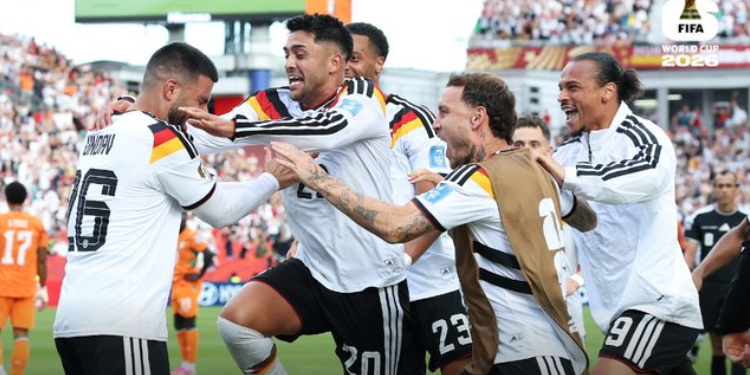
Germany’s hopes of avoiding a shock FIFA World Cup 2026 exit against Paraguay were dashed after a dramatic extra-time goal was ruled out by Video Assistant Referee (VAR).
Germany reached the Round of 32 as Group E winners after winning their opening two matches, hammering Curaçao 7-1 before beating Côte d’Ivoire 2-1.
The four-time world champions thought they had snatched victory in the 102nd minute of their Round of 16 clash in Boston when defender Jonathan Tah headed home from a corner.
However, celebrations were cut short after the VAR instructed Moroccan referee Jalal Jayed to review the goal on the pitch-side monitor.
After watching the replay, Jayed disallowed the goal, ruling that Germany defender Waldemar Anton had pushed Paraguay goalkeeper Orlando Gill moments before the ball was played into the box.
Television replays showed Anton making contact with Gill, causing the goalkeeper to fall to the ground and preventing him from properly challenging for the ball before Tah’s header found the net.
The decision sent the match to a penalty shootout, where Paraguay emerged 4-3 winners, knocking Germany out of the tournament.
Why Was the Goal by Germany Defender Disallowed?
The incident fell under a new clarification to the Laws of the Game approved by the International Football Association Board (IFAB) and adopted by FIFA for the 2026 World Cup.
The new measures allow VAR to intervene when an attacking player clearly commits a foul before the ball is in play during a corner kick or free kick, provided the offence directly results in a goal, a penalty, or a disciplinary sanction.
Previously, such incidents often went unpunished because the ball had not yet been put into play, creating a loophole that teams increasingly exploited during set-pieces.
If VAR identifies a clear offence under the new protocol, the referee can conduct an on-field review and disallow the goal if it is determined that the attacking team gained an unfair advantage.
In Germany’s case, officials concluded that Anton’s push on Gill prevented the goalkeeper from fairly contesting the corner, making Tah’s goal invalid.
Also Read: Africa Makes World Cup History with Record Nine Knockout Teams
FIFA’s Crackdown on Set-Piece Blocking
The rule clarification aims to reduce excessive physical play during corners and free kicks, including deliberate blocking, screening, pushing, and grappling, which are intended to create space for attacking players.
The change has been informally dubbed the “anti-Arsenal law” by some fans and pundits because of the growing use of screening tactics and crowded set-piece routines in modern football.
Former Liverpool manager Jurgen Klopp, working for German television during the World Cup, likened Tah’s disallowed goal to many which Premier League champions Arsenal had scored throughout the season.
Klopp told MagentaTV: “If the goal is illegal, then Arsenal won’t be English champions. They’ve scored 60% of their goals that way.
“We [Germany] win the game when the ball goes in. So, of course, this is brutal.”
Before the tournament, FIFA’s chief refereeing officer, Pierluigi Collina, had warned that goals resulting from such actions would no longer be allowed.
“We are convinced that this goal cannot stand; it is completely unfair,” Collina said while explaining a similar incident involving England in a pre-World Cup friendly against Uruguay.
“If a foul is committed just before the ball is in play, we are convinced that nobody can object to something.”
Also Read: World Cup 2026: Third-Placed Teams on Course to Reach the Round of 32
More Changes for the 2026 World Cup
FIFA’s crackdown on physical play during set-pieces is part of a wider expansion of the VAR system ahead of the 2026 World Cup.
Under changes approved by the International Football Association Board (IFAB), VAR will now be allowed to intervene in several additional situations where there is clear evidence of an error.
The new protocol permits VAR to review red cards arising from a clearly incorrect second yellow card, helping prevent players from being wrongly sent off.
Officials will also be able to correct cases of mistaken identity, where a referee penalizes the wrong player for an offence resulting in a yellow or red card.
In another significant change, competitions may allow VAR to review a wrongly awarded corner kick, provided the review can be completed immediately and does not delay the restart of play.
FIFA has also introduced stricter measures to combat unsporting conduct, including potential sanctions for players who deliberately conceal conversations by covering their mouths.
The IFAB has also agreed to conduct trials aimed at tackling time-wasting by goalkeepers and teams that use tactical injuries to break up play or hold impromptu team talks during matches.
Follow our WhatsApp Channel and X Account for real-time news updates