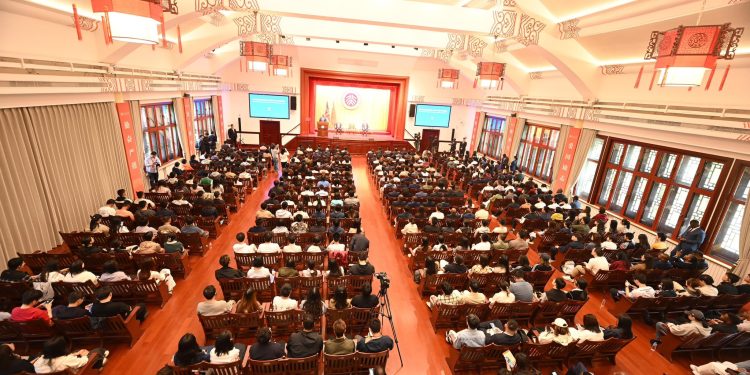
President William Ruto on Tuesday, April 22 arrived in Beijing, China, for a four-day State Visit at the invitation of his host President Xi Jinping. According to Ruto, the visit seeks to bolster historical, economic and cultural ties that have defined the relations between Nairobi and Beijing over the years. On Wednesday April 23, Ruto delivered a public lecture at Peking University in Beijing where he pressed for the urgent need to fashion a new world order, which takes cognisance of present realities. At the same time, he “called for Kenya and China to continue championing the cause of Global South in international fora, especially the need to reform global institutions to be more representative and efficient.” Here is Ruto’s full lecture at Peking University:
- On behalf of the people of Kenya, let me express my deep gratitude for the honour and privilege to address this iconic and top-ranked university, which is not only one of China’s most historic and prestigious universities but also a global citadel of intellectual vibrancy, academic excellence, and groundbreaking research.
- From its founding in 1898 as a symbol of reform to its pivotal role in shaping China’s intellectual and academic identity, Peking University has consistently stood at the vanguard of rigorous scholarship and public service. I commend your leadership, faculty, and the entire community for cultivating a world-class institution that fosters mutual understanding, talent development, and knowledge sharing between China and the world.
- Peking University has played a vital role in China–Africa educational relations, having educated over 4,000 African students since 1956, including many Kenyans. We are proud of our academic collaborations, including the partnership with Kenyatta University in literature and cultural studies.
These exchanges, and the scholarships you provide, are building lifelong people-to-people bonds and transforming lives in tangible ways.
- Indeed, education is a pillar of our diplomatic partnership. As Kenya deepens its focus on science, technology, and innovation, we welcome further partnerships with Chinese institutions, particularly in STEM fields, AI, biotechnology, and the creative economy. Kenya’s “Silicon Savannah” is established at our Konza Technopolis, and our upcoming National AI Strategy (2025–2030) offer a unique platform for cutting-edge collaboration.
Ruto woos China
- We gather at a time of profound and accelerated global change. From regional conflicts, economic shocks and climate disruption, to cyber insecurity and demographic shifts, the challenges we face today are complex, interconnected, and urgent. But within these challenges are opportunities; opportunities for renewed partnership, bold thinking, and reimagined global architecture.
- Africa and China have emerged as pivotal partners in this shifting landscape bound by history, powered by mutual interest, and grounded in a shared future. Two days after Kenya gained independence in December 1963, China opened its embassy in Nairobi, becoming the fourth country to do so. Our ties have only deepened since, culminating in the establishment of a Comprehensive Strategic Co-operative Partnership in 2017.
- China is now Sub-Saharan Africa’s largest trading partner, and Kenya’s largest overall. We export tea, coffee, flowers, and more, and I trust many of you have enjoyed a cup of Kenyan tea or a bouquet of our fresh roses. Over 3,000 Chinese companies operate in Africa, most from the private sector.
Our co-operation under the Belt and Road Initiative has delivered flagship infrastructure projects, including roads, ports, and the Standard Gauge Railway, infrastructure that is reshaping regional connectivity and integration.
- But even as we celebrate these achievements, we must confront a sobering truth: the post-war multilateral system is broken, dysfunctional and no longer fit for purpose, and the escalating trade tariff war may be its final death blow. Allow me to give my perspectives on four aspects, namely, peace and security, the climate crisis, the global financial architecture, and global trade, and suggest possible ideas on the way forward.
UN Security Council concerns
- On the United Nations and UN Security Council, no other circumstance, other than the post-war situation, would have made the current structure of the UN and more particularly the UN Security Council, that is the five permanent members with individual powers, an acceptable peace and security structure.
The Security Council, once a beacon for peace and diplomacy, now has one permanent member invading one country, while another member takes sides in conflict in contradiction to the Council’s own resolutions. Yet today, the permanent members live in denial and resist reform, even as the Security Council becomes less and less legitimate and its relevance being put to question.
- On the other hand, the Global multilateral financial architecture is outdated. The Bretton Woods institutions recently commemorated their 80th anniversary. Eighty years ago, two thirds of the world’s nations did not exist as sovereign states when this architecture came into being. The IMF was established to buttress the “gold standard” fixed exchange rate system, a system that collapsed 50 years ago.
The World Bank was established to rebuild Europe, an assignment now overtaken by events. 11. This financial architecture presents four intertwined challenges.
First, the challenge of liquidity, or financial safety net for the multiple and persistent climate and economic shocks that we face today. Second, inadequate finance for development and climate action. Third, cost of capital, what we are calling the “great financial divide”. Fourth, the problem of recurring debt crises in developing countries, which is a consequence of the first three.
- The climate crisis is perhaps the most urgent and existential challenge of our time. Africa, despite contributing the least to global emissions, bears the greatest burden through floods, droughts, displacement, and food insecurity. We have scientific consensus that these extreme weather events are human induced.
But even if it were, otherwise, decarbonisation of the economy is progress in its own right. Conservation of nature and clean air are desirable ends in and of themselves. But thirty COP conferences later, national interests continue to stand in the way of global collective action, notwithstanding the fact that the atmosphere has no national boundaries. We continue to play dice with nature.
- When the WTO was mooted in 1945, world trade consisted primarily of goods. The wealthy industrialised countries exported manufactured goods, while the less developed countries exported primary products and raw materials. But today, the world of trade has changed dramatically. Trade in services now accounts for a quarter of global trade and is growing three times faster than merchandise trade.
- The business processing outsourcing (BPO) and IT-enabled services, which were inconceivable in 1945, are currently in the order of $300b and projected to grow at 10% annually over the next decade. Trade in services, particularly digitally enabled services, defies the traditional goods logic, as it enables professionals in developing countries to compete with their counterparts in industrialised countries with ease. But this levelling of the playing field goes beyond digital services, for
example, affordable air travel enabled medical tourism to emerge as a growth industry.
- Ladies and Gentlemen, having contextualised the situation as it is now, allow me at this point to suggest my views on where I consider the opportunities for the future lie.
- For the first 45 years of its existence, the post-war multilateral system was shaped by the bipolar ideological divide of the Cold War. This divide, the East-West divide, suggests that we are unable to overcome the bipolarism of that era. Seemingly, there appears to be Cold War warriors that are unable to see a world that is not ideologically polarised and are determined to reinvent a polarised world by other means. In a world where globalization is no longer an option but an existential imperative, any polarisation is unnecessary, undesirable and untenable.
Call for reforms
- Two structural forces have driven globalisation; namely technology and demography. They are irreversible. Until very recently, perhaps no more than a decade ago, it was taken for granted that the industrialised West would maintain a competitive advantage in high technology industries, while the global south would remain in low-tech, labour-intensive and primary goods industries.
Today, disruptive cutting-edge innovation can pop up anywhere in the world. The DeepSeek AI disruption and Kenya’s evolutionary mobile money transfer technology are signs of our times.
- Additionally, there is a saying that demography is destiny. Economic development cannot be divorced from demographics. It is people who produce and consume.
- At the dawn of African independence in 1960, the combined population of the US and EU at 520m (170m and 350m respectively) was double that of Africa at 260m. Six decades on, it is the reverse; Africa’s population of 1.5b is now double the combined US/EU’s population of 800m. The demographic dynamic has an inevitability about it. Ageing societies would want to reverse the trend, but there is little they can do about it. So, inevitably, capital will have to flow to where the workforce is.
Also Read: Four Strategic Goals Kenya Seeks to Achieve in Upcoming Ruto Trip to China
At 19, Africa’s median age is less than half of Europe’s (45 years) and comparable to China’s median age in the mid-70s. By 2050, Africa will account for a quarter of the world’s workforce, the same proportion as China today. If the first half of this Century belongs to China, the second half will belong to Africa.
- We must therefore imagine a new peace and security architecture, one rooted in democracy, equity, transparency and equal regional representation. It is my view that the security architecture of the World as is today should be representative of the five continental blocks, that is, the Americas, Europe, Asia-Pacific and Africa/Middle East, with equal representation for each of the regions.
Seeing as Europe already has three members—France, the UK and Russia—it seems reasonable that the membership for each region be set at three, for a total of 12 permanent members. Such a council would better reflect today’s geopolitical realities and uphold the principle of sovereign equality among nations.
- Global opinion is divided on whether the current international financial institutions can be reformed. My view is that, as difficult as it is, it is still easier to reform than to abolish them, even though the latter would be the better option. At the heart of the Bretton Woods institutions is a fundamental issue: these are
shareholder institutions. At the time they were formed, the shareholders were also the primary stakeholders and beneficiaries.
- Both the World Bank and the IMF have evolved into development finance institutions, but the ownership and power remain with the wealthy countries that they no longer serve. The interests of the shareholders and stakeholders and beneficiaries are at great variance. This anomaly became apparently glaring during the IMF SDR issuance, where 64 per cent of the allocation ended up with wealthy countries that did not need liquidity support. The poorest countries, which needed it most, received only 2.4%.
- There are many reforms required in these institutions, but I believe that the most consequential is governance changes that will transform them into independent, apolitical global institutions, insulated from the national interest of their shareholders.
Surprisingly, this requires no more than adopting modern corporate governance best practice. The shareholders should elect directors, and the directors should appoint and supervise competent, professional management. I believe reform, not abandonment of multilateralism, is the path forward.
- The inaugural Africa Climate Summit held in Nairobi in September 2023 resolved to, and I quote, “urge world leaders to rally behind the proposal for a global carbon taxation regime, including a carbon tax on fossil fuel trade, maritime transport and aviation.” This principle is accepted at the national level, and is implemented through carbon taxes, subsidies to green energy, and national emission trading systems, yet we continue to resist taking this to its logical conclusion, namely a global carbon taxation regime. However, I take note that earlier this month, the International Maritime Organisation adopted a global emissions tax. Kenya generates over 90% of its electricity from renewables and has enshrined climate adaptation in law. Nairobi is now home to the second headquarters of the Global Centre on Adaptation – the first global institution co-located in both the Global North and South.
- I wish to commend China for its leadership in renewable energy technologies, particularly in solar power and electric vehicles. Without China, many of these technologies would remain unaffordable for much of the developing world. Today, solar panels, e-bikes, and electric buses are commonplace in African towns. This is what meaningful South–South co-operation looks like.
International Trade
- As the world’s trade system evolves, we must update our assumptions. While the language of international trade is framed as an issue of trade between countries, much of it now occurs within international supply chains of global corporations. Actual trade flows as captured in export and import data provide a very limited, maybe even distorted, view of international trade.
Let me share some perspectives:
- Apple Corporation reported $391b sales in 2024, of which the Americas contributed $167b and rest of the world $224b. In effect, more than two-thirds of its market is outside the US. Nike reported sales of $49b, $21b in North America and $28b from the rest of the world. By and large, America’s global corporations generate between half and two-thirds of their business abroad.
- The question we have to ask is: how is this value distributed? When Levi’s or Calvin Klein jeans are stitched in Cambodia and Kenya, then sold in China or India, with the profits accruing to the Global North corporations, which share of the value is global trade and which is not?
Also Read: Ruto Offers to Serve as Mediator Between US and China
It stands to reason that when the entire value chain is factored into the trade equation, North America enjoys an even more significant “commercial surplus” from the global trade than is reflected in trade statistics. Indeed, this is the conclusion reached in a study by the European think tank, Centre for Economic Policy Research, published in 2024 titled “Globalisation and Profitability of US firms”, and I quote: “Lower trade barriers allowed North American firms to enter new markets and utilise their intangible assets to boost profitability. Foreign profitability of US firms increased by much more than domestic profitability.”
- Kenya’s response to these realities is rooted in economic diversification and regional integration. Through the African Continental Free Trade Area (AfCFTA), we aim to unlock value chains and markets across our 1.4 billion-strong continent. Nairobi, our capital, serves as a UN headquarters in the Global South and as a hub for environment, finance, media, and innovation.
- We are also a diplomatic hub. Kenya has remained a non-aligned nation committed to peaceful resolution of conflict, sovereignty, and mutual respect. We support the One-China Policy, a two-state solution in the Middle East, and dialogue, not escalation, in the Russia–Ukraine conflict. As we say in Africa, when two bulls fight, the grass suffers. Let us choose understanding over confrontation.
- Kenya’s greatest asset is its people: young, skilled, and entrepreneurial. Over 80% of our population is under 35. We are building institutions and ecosystems that will harness this demographic advantage through education reform, digital innovation, and youth entrepreneurship. Initiatives like our Silicon Savannah at Konza Technopolis and our Big 5 university research clusters are already attracting global partnerships.
- Peking University can play a pivotal role in this future. We encourage deeper collaboration through scholarships, AI research, innovation labs, and student exchanges. We envision a digital future that is Kenyan in location, African in identity, and global in impact.
- Ladies and gentlemen, Kenya and China are not merely trade partners, we are co-architects of a new world order. One that is fair, inclusive, and sustainable. Let us measure our success not just in GDP growth or trade volumes, but in how many lives we uplift, how many futures we secure, and how much dignity we restore.
- This visit, as the first African state visit to China this year, mirrors my 2024 visit to the United States, the first African state visit there in over 15 years. Perhaps, symbolically, Kenya can serve as a bridge between East and West, North and South, in an era of deepening geopolitical tensions.
- Let this be our shared legacy: that China and Africa, through trust, vision, and partnership, helped build the foundation for a 21st-century multilateralism that serves all humanity.
I thank you.
Follow our WhatsApp Channel and X Account for real-time news updates.