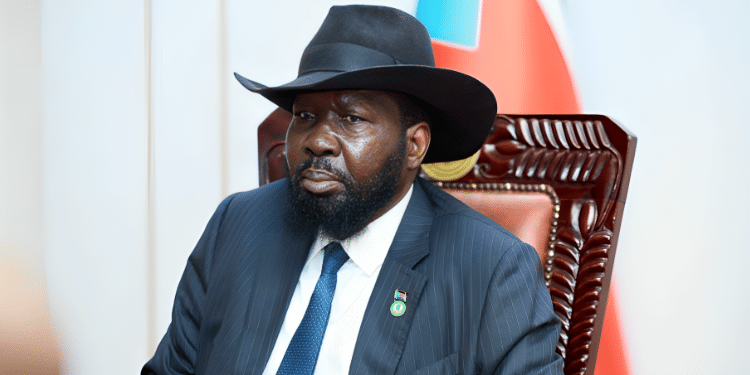
The president of South Sudan, Salva Kiir Mayardit, has sacked two senior officials after he appointed a dead man to serve on the committee responsible for preparing for elections scheduled for December.
The appointment of Steward Soroba Budia was announced in a presidential order dated January 30. However, it later emerged that the opposition United Democratic Party (UDP) member had died five years ago.
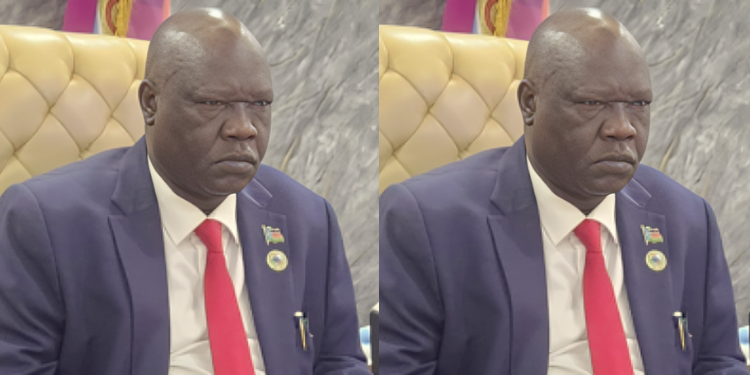
In a notice dated February 3, 2026, the Minister of Presidential Affairs, Africano Mande Gedima, announced that Hon. Valentino Dhel Malueth, Chief Administrator at the Ministry of Presidential Affairs, and Ambassador David Amour Majur, Press Secretary in the Office of the President, had been relieved of their duties.
“The following officials are hereby relieved of their respective positions: Hon. Valentino Dhel Malueth, Chief Administrator, Ministry of Presidential Affairs, and Amb. David Amour Majur, Press Secretary, Office of the President,” read part of the notice.
Gedima further stated that Marik Nanga Marik had been appointed as the new Chief Administrator at the Ministry of Presidential Affairs to fill the vacancy, adding that the appointment of a new press secretary would be announced in due course.
President Kiir thanked the outgoing officials for their dedicated service and contributions to the nation during their tenure and extended his best wishes to the newly appointed official in his new role.
Salva Kiir’s Appointment of Budia as a Member of the Election Committee
Steward Budia was appointed to the committee responsible for preparing for the elections scheduled for December on January 30, 2026, even though he had died five years earlier.
The Republican Order listed Budia as a member of a political party’s leadership body and as a stakeholder in election-related dialogue in Juba.
Also Read: Kenyan Embassy Issues Security Advisory to Citizens in South Sudan
However, his family wrote to the office of President Salva Kiir, demanding cultural and moral reparations after his name was included in a recent government appointment order.
In a letter dated February 2, 2026, the family said they were deeply concerned and distressed by the appointment, which they described as a serious cultural and spiritual violation.
“The appointment of a deceased person is not only an administrative error but also a serious cultural and spiritual violation,” read part of the letter.
“In our culture, it is unacceptable to invoke or awaken the soul and spirit of the deceased without the knowledge, consent or involvement of the family.”
The family argued that the incident had left them and the wider community dismayed, emotionally affected and spiritually disturbed, and demanded appropriate reparations for the disturbance of the soul and spirit of the late politician in line with their traditions.
The office of the president later issued a clarification stating that the inclusion was an unintentional administrative error and that steps were underway to amend the order.
Budia had served as Commissioner for Greater Yei and as Minister of Information and Communication. Until his death, he was head of the United Democratic Party (UDP) and a signatory to South Sudan’s 2018 peace agreement.
The family also requested assurances that similar errors would not be repeated.
Elections in South Sudan
The South Sudan National Election Commission (NEC) says it is ready to conduct general elections, with the 2010 constituency boundaries set to be used and an electoral timeline expected later this month.
Civic education will begin in February, followed by voter registration. The NEC says its offices are operational in most states, while electoral laws are being updated.
South Sudan, the world’s youngest nation, has not held an election since gaining independence from Sudan in 2011. Under the 2018 power-sharing agreement, elections are scheduled for December 2026.
The polls are expected to play a key role in determining the country’s peace process and political stability.`
Also Read: KRA to Auction Tons of Sugar Destined for South Sudan
According to the commission, it will utilise the 2010 constituencies based on the 2008 population census. Civic education will start in February, followed by voter registration, with the NEC noting that offices are operational in most states as electoral laws continue to be updated.
The commission further said there will be 102 national constituencies across the country’s 10 states and three administrative areas. It said this move is mandated by law after parties to the 2018 peace agreement agreed to decouple elections from a pending population count and constitutional review.
In December 2025, the presidency and cabinet approved amendments to key provisions of the 2018 peace agreement, delinking the December 2026 elections from the permanent constitution-making process, a national census, and other institutional reforms. The amendments also removed provisions stating that the peace agreement takes precedence over the transitional constitution.
The 2018 peace deal, signed by President Salva Kiir, opposition leader Riek Machar, and other political leaders, has faced repeated delays, including missed election timelines.
Elections have since been postponed several times and are now scheduled for December 2026, despite objections from Machar loyalists who say presidency-led consultations excluded them.
Salva Kiir, who has led South Sudan since its independence, is 74 years old, and concerns about his capacity are emerging. He has previously fumbled with reading speech and recalling names during high-level meetings.
It is important to note that discussing the President’s health is taboo in South Sudan.
Follow our WhatsApp Channel and X Account for real-time news updates.