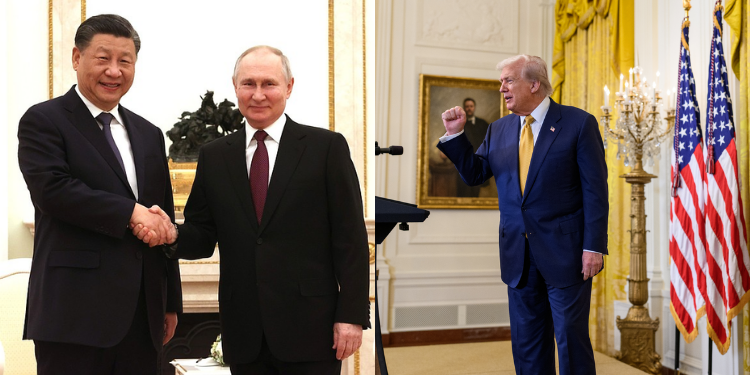
President Donald Trump thanked the leaders of China and Russia on Wednesday, June 17, for staying out of the chaotic conflict with Iran, saying their neutrality helped U.S. forces avoid bigger problems.
Speaking at a media conference following the G7 summit in France, Trump thanked Chinese President Xi Jinping and Russian President Vladimir Putin for what he described as their neutrality throughout the fighting.
Trump Says Xi and Putin Helped Prevent Escalation
He said both men could have made things much harder for American troops if they had chosen to get involved.
“I want to thank China, President Xi. I was with him. He stayed neutral, totally neutral, and I appreciate it,” Trump said. “And I want to thank Vladimir Putin. He was very neutral. They could have made it much more difficult for us.”
Trump’s admission came as the administration works to lock down details of a pending agreement with Iran.
The deal follows weeks of U.S. and Israeli military action that targeted Iranian nuclear sites, military bases, and other facilities.
A fragile ceasefire has held for now, with talks aimed at a longer-term pact set to run for about 60 days. A formal, in-person signing ceremony is scheduled for Friday, June 19, in Switzerland.
How China and Russia Responded During the Iran Conflict
China and Russia largely remained neutral during the fighting period, but both countries have long ties to Iran.
China buys Iranian oil, and Russia has cooperated with Tehran on military matters in the past.
Trump said Xi listened when he asked him not to provide certain weapons to Iran during the fighting.
“He didn’t give or sell any of that stuff to Iran, and you know what, for the most part he didn’t,” Trump added, referring to shoulder-fired weapons that could threaten aircraft.
The president described the restraint from Beijing and Moscow as a practical help that kept the conflict from spreading.
U.S. officials had worried about Iran getting more advanced arms or other support that could complicate naval operations in the Strait of Hormuz or missile defenses.
Also Read: Trump Says U.S. Will Return to ‘Dropping Bombs’ on Iran if Peace Deal Fails, Slams Obama at G7
The war disrupted oil shipments and sent energy prices higher for a time. American forces carried out strikes to degrade Iran’s nuclear program and its ability to threaten shipping lanes.
Iran fired back with missiles and drones, but the exchanges stayed more limited than some had feared.
Post Iran-U.S. War Plans
Trump and his team have discussed a deal that would allow Iran to rebuild if it meets strict conditions. That includes limits on its nuclear work, better inspections, and changes in behavior.
Trump noted that he anticipates Iran’s neighbors coming in and helping by making investments in Iran.
Vice President J.D. Vance had earlier said Iran could have access to a large reconstruction fund; reports put the figure at around $300 billion, but only if it follows through.

Vance described the money as coming mainly from Gulf countries and private investment, not direct U.S. taxpayer dollars.
Trump, however, did not share the view that the U.S. would simply hand over cash.
“We are not investing any money in Iran,” he said at the G7 summit in France. He noted that any unfrozen Iranian assets would have to be handled carefully to protect the credibility of the dollar.
Trump further warned that Iran stands to be hit again if it does go against the deal they have come up with.
Also Read: Trump Invited to Obama Presidential Center as Obama Celebrates Grand Opening in Chicago
Iran would only see those benefits, Trump warned, if it does what is expected. “If they’re not behaving, they get hit again,” he said.
Some lawmakers in Washington want clear guarantees that Iran cannot use new money to rebuild military strength or restart banned nuclear activities.
Others point out that Gulf states have their own reasons to invest if it brings stability to the region.
The agreement also touches on other major issues, such as reopening shipping in the Strait of Hormuz without interference.
Trump has described the initial ceasefire as a win that sets up tougher long-term terms for Tehran.
Trump emphasized monitoring of Iranian sites and the importance of the deal delivering real limits on its nuclear ambitions.