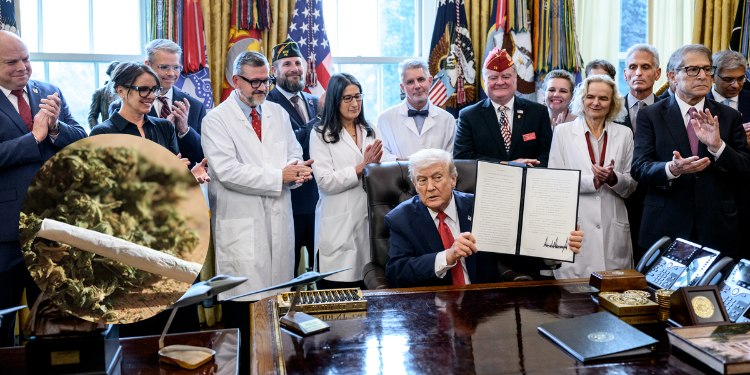

President Donald Trump has signed an executive order reclassifying marijuana from a Schedule I to a Schedule III drug under the Controlled Substances Act.
Marijuana is currently classified by the Drug Enforcement Administration (DEA) as a Schedule I substance, a category reserved for drugs considered to have a high potential for abuse and no accepted medical use. The move to Schedule III places it alongside substances with a lower potential for abuse and recognised, though limited, medical value.
“President Donald J. Trump signs an Executive Order rescheduling marijuana from Schedule I to Schedule III — recognizing legitimate medical uses and expanding medical marijuana and cannabidiol research to better support patients and doctors,” the White House said.
The executive order signed on December 18, 2025, is expected to significantly loosen long-standing federal restrictions that have limited scientific research into marijuana’s safety, efficacy, and therapeutic benefits.
According to the White House, the change follows a 2023 review by the Food and Drug Administration (FDA), which found scientific support for marijuana’s use in treating pain, nausea and vomiting, and anorexia related to certain medical conditions.
The Department of Health and Human Services (HHS) had recommended the reclassification to the DEA in 2023, citing findings that more than 30,000 licensed healthcare practitioners across 43 U.S. jurisdictions are authorised to recommend medical marijuana to over 6 million registered patients. The National Institute on Drug Abuse also concurred with the recommendation to move marijuana to Schedule III.
Also Read: Trump Suspends Green Card Lottery With Immediate Effect
In May 2024, the Department of Justice issued a proposed rule to reschedule marijuana, which received nearly 43,000 public comments and is currently awaiting an administrative law hearing.
Trump approves increasing medical marijuana and cannabidiol research
The White House said decades of federal drug policy had failed to recognize marijuana’s medical uses, limiting research and leaving doctors and patients without adequate guidance. Chronic pain affects nearly one in four U.S. adults and more than one in three seniors, with surveys showing that many medical marijuana users rely on it to manage pain, sometimes reducing their use of opioids.
“The Federal Government’s long delay in recognizing the medical use of marijuana does not serve the Americans who report health benefits from the medical use of marijuana to ease chronic pain and other various medically recognized ailments. Americans who often seek alternative relief from chronic pain symptoms are particularly impacted.”
Under the executive order, the Attorney General has been directed to complete the rulemaking process “in the most expeditious manner” in accordance with federal law.
The order also outlines steps to improve access to and regulation of cannabidiol (CBD) and hemp-derived cannabinoid products, directing federal agencies to develop clearer research standards and regulatory frameworks to address safety, labeling, and dosage concerns.
Rescheduling medical marijuana
The Assistant to the President and Deputy Chief of Staff for Legislative, Political, and Public Affairs shall work with the Congress to update the statutory definition of final hemp-derived cannabinoid products “to allow Americans to benefit from access to appropriate full-spectrum cannabidiol (CBD) products while preserving the Congress’s intent to restrict the sale of products that pose serious health risks.”
This will include consultation with appropriate executive departments and agencies and authorities to develop a regulatory framework for hemp-derived cannabinoid products, including guidance on an upper limit for milligrams of tetrahydrocannabinol (THC) per serving, with considerations for per-container limits and CBD-to-THC ratio requirements.
Also Read: Study Shows Significant Health Impact of marijuana on Fetal Development
In addition, the Secretary of Health and Human Services, the Commissioner of Food and Drugs, the Administrator of the Centers for Medicare and Medicaid Services, and the Director of the National Institutes of Health shall develop research methods and models utilizing real-world evidence to improve access to hemp-derived cannabinoid products in accordance with Federal law and to inform standards of care.
Trump has said the reclassification could unlock expanded research that is currently restricted. “Because a lot of people want to see it, the reclassification, because it leads to tremendous amounts of research that can’t be done unless you reclassify,” he said earlier this week.
The White House emphasized that the move does not legalize marijuana but represents one of the most significant shifts in federal marijuana policy in decades, with potential implications for research, regulation and enforcement nationwide.
Follow our WhatsApp Channel and X Account for real-time news updates.