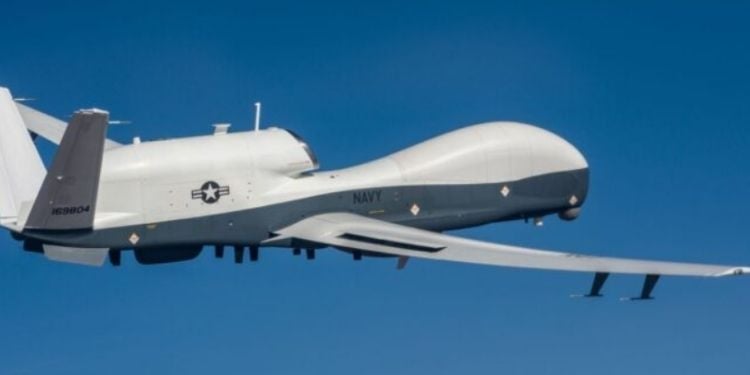
A United States (US) Air Force surveillance drone has been spotted conducting reconnaissance flights near southern Iran, raising concerns about rising tensions in the Middle East and the US going into a new war.
Reports indicate that the drone has been operating over international waters in the Persian Gulf and surrounding airspace, closely monitoring military activities along Iran’s southern coastline.
Security Defence Asia reported that the same surveillance drone was spotted on 5th January 2026.
Reports also show that several US and UK warships are present in the Strait of Hormuz, and the US is likely to occupy the entire southern tip of Iran.
Such reconnaissance missions are carried out to gather intelligence, track naval movements, and assess regional security developments.
This comes after US President Trump said ‘We will take very strong measures’ in support of the ongoing protests in Iran.
While U.S. officials have not publicly commented on the specific mission of the drone, analysts say these flights often increase during periods of heightened geopolitical tension.
Also Read: Iran Issues Warning to Trump as Tensions Escalate
The US MQ-4C Triton Drone and Its Mission
The MQ-4C Triton is a high-altitude, long-endurance (HALE) unmanned aerial system (UAS) drone used by the United States Air Force and Navy for surveillance.
The drone flies very high in the sky and can stay in the air for more than 24 hours without landing.
The Triton is equipped with advanced sensors, including a radar that enables 360-degree surveillance over larger areas.
This technology makes it a crucial asset in the U.S. Navy’s intelligence, surveillance, and reconnaissance operations.
Also Read: Iran Protests Trump’s ‘Locked and Loaded’ Threat in Letter to UN Security Council
Saudi Govt Rejects Use of Its Airspace for Attacks on Iran by US
Saudi Arabia has formally rejected U.S. requests to use its airspace for potential strikes on Iran, as the nation looks to prevent further escalation of the war between Iran and America.
According to top military officials in Riyadh, Saudi Arabia, the country stated its position through formal diplomatic channels, rejecting U.S requests for overflight rights.
The move comes amid heightened U.S. consideration of military options following reports of Iranian activities that Trump’s administration views as destabilizing.
Saudi Arabia’s stance aligns with those of Qatar and Oman. Both states have urged restraint and warned against military action that could destabilize the region.
Gulf governments have emphasized that any strike on Iran would carry severe consequences for regional security and global energy markets.
Saudi Arabia, the world’s largest oil exporter, has cited energy security as a key factor in its decision.
Follow our WhatsApp Channel and X Account for real-time news updates.