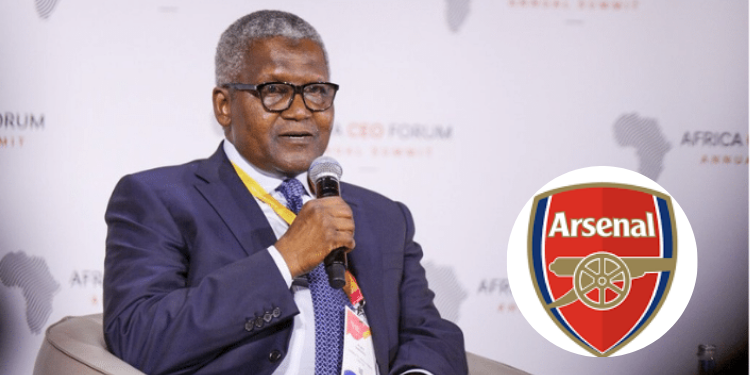
Africa’s richest man, Aliko Dangote, has opened up on why he abandoned plans to buy Arsenal F.C. in order to focus on building Africa’s largest oil refinery.
Speaking on the In Good Company podcast with Nicolai Tangen, Dangote said the opportunity to acquire the English Premier League club came at a time when he was heavily invested in industrial expansion projects across Africa.
Dangote said he had at one point seriously considered buying the English Premier League club, but the timing of the opportunity clashed with a critical phase in the development of his multi-billion-dollar industrial expansion, including cement, petrochemicals, fertilizer, and the massive Dangote Refinery.
Dangote Explains Why He Chose His Mega Oil Refinery Dream Over Buying Arsenal
He explained that while Arsenal was an attractive investment, his long-term vision demanded total commitment, as it involved complex engineering, logistics, and financing challenges.
“When I was really very focused on buying Arsenal F.C., I was also facing the challenge of ensuring that the refinery, the fertilizer, and the petrochemical projects were completed,” he said.
“At that time, I looked at the situation and thought: I had needs for funds. Arsenal was worth just about $2 billion. Should I put my $2 billion into Arsenal and let the business suffer, or should I first complete the business and then remain a very big supporter of Arsenal?”
He added, “So I decided that I would continue to support them, watch their games, go there, and remain an Arsenal fan, rather than invest in the club at that time, and currently it is worth billions.”
Dangote said he chose to channel his resources into what would become Africa’s largest oil refinery, a project valued at around $20 billion and designed to reduce the continent’s dependence on imported fuel products.
Also Read: Ruto Gives Greenlight to Dangote’s Proposal on East African Refinery in Mombasa
Dangote further said the refinery journey required him to sell off personal assets abroad, including properties in the United States and the United Kingdom, to fully commit to his industrial vision in Nigeria.
He described the refinery as a “once-in-a-generation” project that would reshape Africa’s energy landscape by refining crude oil locally, reducing imports, and boosting foreign exchange earnings.
The billionaire also highlighted that his broader strategy is rooted in backward integration—producing locally what Africa consumes daily, including cement, sugar, fertilizer, and petroleum products.
Dangote Reveals How He Built Mega Oil Refinery Amid Asset Sales, Delays and Funding Struggles
He explained that the refinery project began in 2013 but faced major delays in land acquisition, with parts of the site taking up to five years to secure, which slowed early development.
Dangote said the scale of the project required building an entire supporting infrastructure from scratch, including a private port, because existing Nigerian ports could not handle the heavy equipment needed for construction.
He revealed that some of the equipment used in the refinery construction weighed up to 3,000 tons, forcing the company to design and build specialized logistics systems, including transport routes and lifting infrastructure.
The billionaire said the project involved managing about 67,000 workers on site, making it one of the largest industrial construction efforts ever undertaken in Africa.
He also disclosed that the refinery required massive utility systems, including a dedicated water treatment facility handling hundreds of millions of litres, alongside extensive power and processing infrastructure.
Also Read: Kenya Emerges as Dangote’s Next Big Energy Gamble
According to him, financing initially came from internal company resources, but later required support from African and international banks due to currency fluctuations and rising costs.
Dangote named institutions such as the African Export-Import Bank, Access Bank, UBA, and Standard Bank as key financiers supporting the project.
He admitted that the project faced resistance and delays, including what he described as pushback from entrenched interests in the oil sector, but said the company remained focused on completion.
Dangote said the project was also affected by currency volatility, which significantly increased costs as the Nigerian naira depreciated over the construction period.