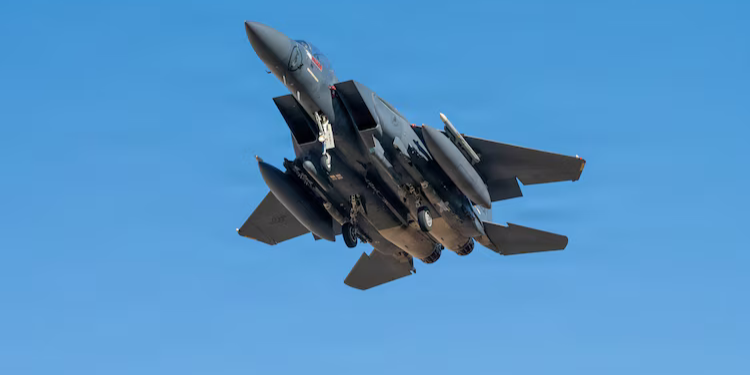
The Israeli Air Force extended the limits of its reach deeper into Iranian territory Monday, March 30, announcing a precision airstrike on a hidden air defense site situated within a forested area along the Caspian Sea coast, more than 1,600 kilometers from Israeli airspace.
The Israel Defense Forces described the target as a concealed position where Iranian forces had deployed surface-to-air systems, part of a wider campaign to dismantle the Islamic Republic’s ability to challenge Israeli jets operating over its airspace.
“STRUCK 1,600+ KM FROM ISRAEL: A site where the Iranian regime had deployed air defense systems near the Caspian Sea in northern Iran.
“It was concealed within a forested area, at a distance of 1,600+ km from Israel, further expanding the IAF’s aerial control over Iranian airspace,” the IDF stated on social media.
The strike shows the Jewish state’s growing freedom of maneuver in Iranian airspace after weeks of sustained attacks that have eroded Tehran’s layered defenses.
This latest operation takes place in the midst of a month-long campaign by the United States and Israel against Iran that started in late February with massive initial strikes intended to destroy command structures, nuclear sites, and missile production facilities.
Also Read: Iran Now Threatens Strikes on American, Israeli Universities if This is Not Done
Israeli officials say their pilots now operate with significant air control over large portions of Iran, including areas near Tehran, after knocking out hundreds of air defense batteries.
The Caspian Sea region, far from Israel’s usual strike corridors, has hosted Iranian naval assets and supply lines linked to Russia.
Earlier this month, Israeli fighter jets attacked the Iranian port of Bandar Anzali, hitting missile boats, a frigate, and supporting vessels that are part of Iran’s small Caspian Sea fleet. The attack, it appears, targeted arms smuggling routes between Iran and Russia.
Monday’s forested target suggests Iranian commanders continue trying to hide remaining mobile air defenses in rough terrain, hoping to preserve some deterrent against Israeli and American incursions.
The IAF’s ability to detect and destroy it at such extreme ranges is an indication of its intelligence and technology superiority. This is especially true regarding its standoff weapons and refueling capabilities, which enable it to conduct missions without flying over enemy territory for extended periods.
Iranian state media has remained largely silent on the specific incident, consistent with a pattern of downplaying individual losses while issuing general vows of retaliation.
Tehran has accused Israel and the United States of waging an unprovoked war, pointing to civilian casualties and harm to infrastructure.
Iranian officials insist their forces retain the ability to strike back, though repeated missile barrages toward Israel have been largely intercepted.
Strikes by Israel spark mixed reactions.
Pro-Israel accounts on social media have celebrated another demonstration of military reach. Others denounced what they called violations of sovereignty.
The Israeli Air Force has carried out thousands of sorties since the start of the campaign, attacking not only immobile targets but also mobile launchers and underground installations.
Also Read: Another Senior Iranian Military Commander Eliminated by the IDF
U.S. military support has taken the form of long-range bombers and intelligence sharing, which have helped secure “local air superiority” over key Iranian areas, according to American military commanders.
Satellite images and open-source reports show considerable damage in several provinces in Iran, including missile production facilities in central Iran and naval bases in the north.
However, Tehran has been known to be resilient in the past, with its assets dispersed and its use of asymmetric warfare through proxy forces.
Monday’s strike on the Caspian forest implies distance is no longer a shield or a problem for the Israeli fighter jets. With air superiority expanding, the IAF appears prepared to dictate the tempo of operations deep inside enemy territory for the foreseeable future.
Meanwhile, talks between Iran and the U.S. are ongoing, as widely reported. President Trump has indicated that the talks are going on positively. Trump has threatened to strike Iran’s power plants if a proper deal is not sealed before or on April 6, 2026.