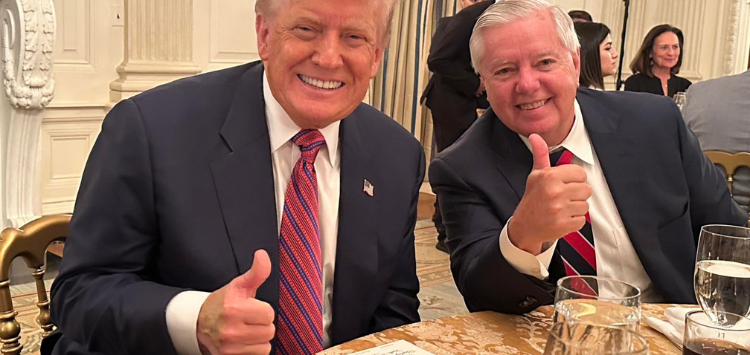
Senator Lindsey Graham has spoken of a fiery phone call he had with the president, in which Trump allegedly displayed unprecedented rage at Europe’s failure to provide military support to help protect the Strait of Hormuz as tensions between Iran and the US escalate.
Taking to social media on Tuesday, March 17, the Senator, who is a staunch ally of President Donald Trump, said he had “never heard him so angry in my life” during the call.
The South Carolina Republican pointed to what he called Europe’s “unwillingness” to step up as the source of Trump’s frustration, noting that the critical waterway — through which roughly one-fifth of the world’s oil passes — remains vulnerable despite U.S. strikes that Graham credits with preventing a full Iranian blockade.
The comments come as the war, now in its second week, has seen intense U.S. airstrikes targeting Iranian military infrastructure, including the strategic Kharg Island export terminal.
Administration officials have argued the moves were essential to halt Tehran’s path to a nuclear weapon and protect global energy markets.
Trump ordered the preemptive actions after Iran threatened to close the Strait in response to American and allied pressure over its nuclear program. But still, Iran went ahead and started targeting commercial ships.
This made President Trump contact key European allies, urging them to deploy their warships and hinder Iran from targeting commercial ships, and restore normal oil supply to the rest of the world.
However, most of the nations have not responded as Trump expected, including France and Germany, which seem not ready to take any military action over the matter.
Growing pressure against Trump
Critics in Europe and at home accuse the Trump administration of risking a wider regional war without adequate consultation.
Supporters, including Graham, counter that hesitation from traditional allies left Washington with few options after years of failed negotiations.
Graham has repeatedly argued that Europe, far more dependent on Middle Eastern oil than the United States, benefits disproportionately from the United States’ efforts to keep shipping lanes open.
“They sit back while we do the heavy lifting,” Graham has said in recent interviews, a theme he reiterated in describing Trump’s reaction.
Graham has been one of the most vocal congressional backers of aggressive action against Iran, long supporting regime change and stronger actions to curb its nuclear ambitions.
His close ties to Trump have cast him as a key defender of the president’s strategy, even as the war draws mixed reviews inside the Republican Party.
Some MAGA-aligned voices have questioned the cost and scope of U.S. involvement, while others praise the firm actions as a departure from past administrations’ perceived weakness.
Also Read: Trump Reveals Possible U.S. Intelligence Gaps, Narrates How Iran Caught America by Surprise
The White House has not commented directly on the reported call, but officials have stressed that coalition-building efforts persist, including outreach to Gulf partners such as Saudi Arabia and the UAE.
Graham himself has pushed for those nations to join more actively, warning of “consequences” for those who stay on the sidelines.
Amid mounting war casualties and volatile oil prices, Graham has portrayed Trump’s anger not as fleeting irritation but as deep exasperation with allies who, in his view, fail to acknowledge the shared stakes in preventing a nuclear-armed Iran.
For now, the senator stays steadfast in his support. He opines that it is time the U.S. reevaluates the type of allies it has and the level of reliability they offer in return.
”I consider myself very forward-leaning on supporting alliances. At a time like this, it makes me second-guess the value of these alliances. I am certain I am not the only senator who feels this way,” he concluded.