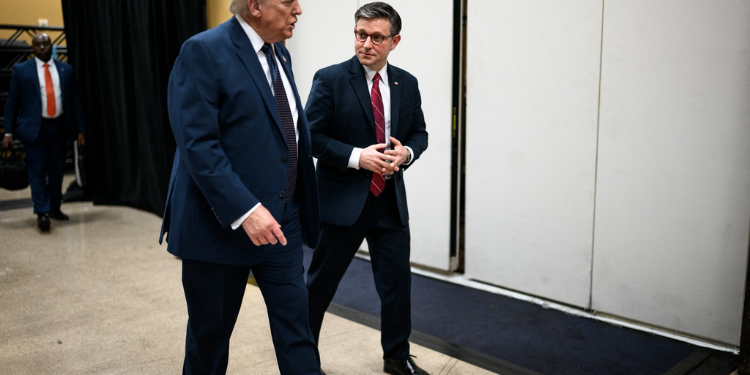
Rep. Mary Gay Scanlon, a Democrat from Pennsylvania, has urged House Speaker Mike Johnson to recall Congress into session as soon as possible after President Donald Trump threatened to bomb Iranian bridges and power plants, which could amount to war crimes.
On Tuesday, April 7, Scanlon shared the message on X shortly after a reporter asked the Justice Department about the legal implications of targeting such infrastructure.
“@SpeakerJohnson, Congress needs to be back in Washington NOW. We cannot sit passively while the President commits war crimes, endangering the lives of millions,” she wrote.
The comments come as Trump has repeatedly warned Iran to reopen the Strait of Hormuz by Tuesday evening or face strikes on civilian infrastructure.
In a Truth Social post on Easter Sunday, Trump wrote: “Tuesday will be Power Plant Day, and Bridge Day, all combined into one, in Iran. There will be nothing like it!!! Open the Strait, or you’ll be living in Hell, just watch.”
He later told reporters that every bridge in Iran would be “decimated” and every power plant would be “out of business, burning, exploding and never to be used again” by midnight if the deadline passed.
Early Tuesday, Trump repeated his threat after he shared another warning on Truth Social, saying Iran’s civilization will die tonight.
Also Read: 7 Republicans Call for Trump’s Immediate Removal from Office
“A whole civilization will die tonight, never to be brought back again. I don’t want that to happen, but it probably will. However, now that we have Complete and Total Regime Change, where different, smarter, and less radicalized minds prevail, possibly something revolutionarily wonderful can happen,” Trump said.
The Strait of Hormuz has been largely closed since the U.S. and Israel launched military operations against Iran in late February. The route carries about one-fifth of the world’s oil supply, and its blockage has driven up global energy prices.
Is Trump set to commit a war crime?
The Geneva Conventions and their additional protocols protect civilian objects from attack unless they qualify as military objectives that confer a clear military advantage to the opponent, in this case, Iran.
Attacks on objects and items linked to civilian survival, for example, drinking water installations or power sources essential to hospitals and food distribution, are generally prohibited if intended to deprive the civilian population of them.
International humanitarian law requires parties to distinguish between civilian and military targets.
Bridges and power plants often serve both civilian and potential military purposes, but broad threats to destroy all such infrastructure across a country have raised eyebrows, with some saying they risk violating the principles of proportionality and distinction.
Also Read: Pakistan Reveals Israel Disrupted US‑Iran Talks at Crucial Stage
The Justice Department has not publicly released an analysis of the threats in response to the reporter’s question.
The White House has defended the president’s statements as essential pressure to reopen the vital shipping lane and protect U.S. interests in the region.
Speaker Johnson supports Trump’s ‘limited’ operation against Iran.
Speaker Johnson has not yet responded directly to Scanlon’s call for a recall, but in the past, he sided with Trump’s view of this conflict.
Johnson has maintained that the U.S. military actions against Iran do not constitute a full-scale war requiring new congressional authorization.
He has described operations as limited, focused on degrading Iran’s ballistic missile capabilities and naval threats.
Congress is currently in recess. A recall would require coordination between House and Senate leadership. Democrats have pushed for greater congressional oversight of the Iran conflict, including votes on war powers resolutions, which have so far failed to pass.
The conflict began escalating after initial U.S. and Israeli strikes aimed at Iran’s nuclear and missile programs. Trump has said the core objectives of neutralizing those threats are nearly complete, but has tied any wind-down to the reopening of the Strait of Hormuz.
Iran has warned it will target U.S. interests if civilian sites are hit.