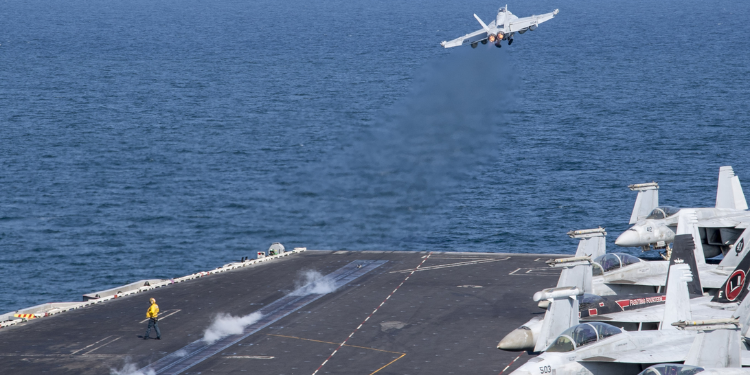
President Donald Trump has signalled that the United States may step back from protecting the Strait of Hormuz once Iran’s military threat is neutralized.
Trump, in a statement on Friday, March 20, suggested that this could leave the critical waterway’s protection to other nations that depend on it for oil shipments.
According to the president, the U.S. does not rely on this particular waterway for its fuel, so it is not the U.S.’s main responsibility to secure it. Trump wants other nations to secure the Strait of Hormuz, and requests help only from the USA, not the other way around.
Lately, it has been the U.S. urging NATO allies to come in, join forces, and secure the Strait. So far, most of the allies have rejected the call.
“The Hormuz Strait will have to be guarded and policed, as necessary, by other Nations who use it — The United States does not!” Trump posted on Truth Social.
“If asked, we will help these Countries in their Hormuz efforts, but it shouldn’t be necessary once Iran’s threat is eradicated. Importantly, it will be an easy Military Operation for them.”
The statement came as part of a wider post in which Trump claimed the U.S. is “getting very close” to achieving its objectives in the current conflict with Iran, now in its fourth week.
Trump lists objectives
President Trump also listed “Never allowing Iran to get even close to Nuclear Capability, and always being in a position where the U.S.A. can quickly and powerfully react to such a situation, should it take place.”
He also highlighted that the protection of America’s Middle Eastern allies, including Israel, Saudi Arabia, Qatar, the United Arab Emirates, Bahrain, Kuwait, and others, was a major objective.
Trump’s remarks have triggered questions about whether Trump is seeking an offramp from a war that has driven global oil prices sharply higher and strained alliances, or simply deflecting responsibility for reopening the strait after failing to rally international support for a U.S.-led effort.
For weeks, Trump has pressed NATO allies, Japan, South Korea, China, and others to contribute warships to secure the narrow chokepoint through which roughly 20% of the world’s oil flows.
Also Read: Trump Weighs in On Removing U.S. Bases From Two European Countries
He repeatedly demanded that oil-dependent nations “protect their own territory” and warned that the U.S. would “remember” those who refused.
Yet responses have been tepid at best, with several countries citing reluctance to join what critics call an American-initiated conflict.
In recent days, the president has grown clearly frustrated, labeling some NATO members “cowards” and insisting the U.S. could handle the task alone if necessary.
His latest comments appear to reverse course, framing the Strait as someone else’s problem while offering only conditional American backup.
Iran has maintained a partial blockade despite heavy U.S. and Israeli strikes, and reopening the strait would require a sustained naval presence, a costly commitment at a time when domestic pressure is mounting to de-escalate.
Oil markets remain volatile, with prices elevated amid fears of prolonged disruption.
Also Read: Hormuz Strait Crisis Warning to Trump Before Iran War Resurfaces as Oil Prices Surge
The U.S., now a net energy exporter, imports far less Middle Eastern oil than in past decades, giving Washington less direct stake in the strait’s daily operations.
Quick change of plan
Just hours earlier on Friday, Trump had told reporters he had “no interest” in a ceasefire with Iran. The rapid pivot to considering a “winding down” of operations raised eyebrows.
Meanwhile, Gulf states, major users of the strait, have remained largely silent on Trump’s proposal, leaving unclear who may step forward to fill any U.S. vacuum.