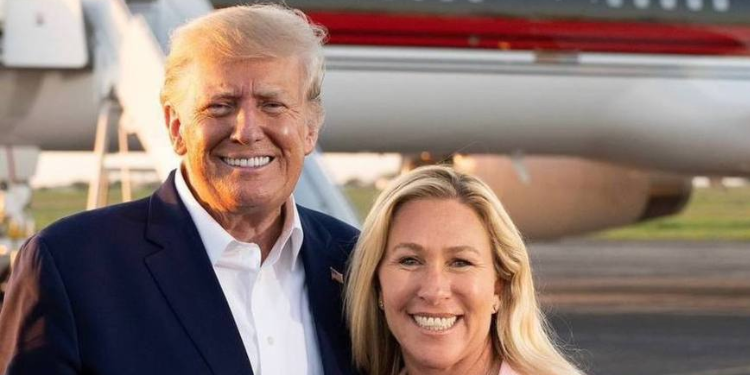
President Donald Trump’s past take on U.S. military action in the Middle East has resurfaced at a delicate moment, as one of his former top allies questions the change in his approach during the ongoing war with Iran.
On Oct. 9, 2019, President Trump posted on Twitter (now X) that entering the Middle East was the worst decision in American history.
He noted the U.S. had spent $8 trillion on wars and policing in the region, with thousands of American troops killed or wounded and millions dead on the other side.
“Going into the Middle East is the worst decision ever made in the history of our country,” he wrote. He was talking about the 2003 Iraq invasion launched on claims of weapons of mass destruction that later proved unfounded.
Now in his second term, Trump finds himself defending U.S. involvement in fresh strikes and troop deployments against Iran.
Former Rep. Marjorie Taylor Greene of Georgia reposted the old tweet on Saturday, April 4, alongside sharp criticism of the current conflict.
She noted that she personally supported Trump because of what he had stood for in the past, particularly his stance on military actions in the Middle East and other parts of the world.
Also Read: Trump Warns Iran Has 48 Hours to Reopen Strait of Hormuz or Face U.S. Strikes
“This was one of the reasons many of us supported Donald Trump. Where has this man gone?” she wrote. “Now he’s sending US troops into another Middle East war that will cost us trillions more and precious lives.”
Greene is raising these concerns amid the ongoing U.S. military operation dubbed Epic Fury, the joint U.S.-Israeli campaign against Iran that kicked off on Feb. 28, 2026.
The initial wave of strikes hit Iranian missile sites, air defenses, nuclear facilities, and leadership targets.
In those early days of the operations, U.S. officials confirmed that Supreme Leader Ali Khamenei had been eliminated. It was reported that Israel’s fighter jets took him out of action after receiving intel from the U.S.
Since then, the Pentagon has sent hundreds of special operations forces to the Middle East, with sources saying there are possibilities of U.S. soldiers hitting the ground in Iran if the war does not end soon.
Why it matters
The Trump administration has maintained that the operation aims to dismantle Iran’s nuclear program, degrade its missile and drone capabilities, and keep the Strait of Hormuz open for oil shipments after Iranian disruptions.
So far, strikes have damaged naval assets, steel plants, and other infrastructure. U.S. commanders say Iran’s air force and navy have been largely neutralized, though the fighting has produced civilian casualties and displaced large numbers of people across the region.
Greene left Congress earlier this year after a very public split with Trump. The break widened when she requested the full release of Justice Department files on Jeffrey Epstein, the convicted sex offender.
Also Read: Marjorie Taylor Greene Breaks Silence, Reveals Why Trump Withdrew His Support
She worked across party lines to push the documents into the open. Trump fired back on social media, calling her a traitor and a disgrace.
Greene has described the episode as a turning point that exposed what she sees as unkept promises on government transparency.
In her latest post, Greene linked the two issues directly, reminding his followers that opposition to endless foreign wars helped drive Trump’s support in 2016 and 2024.
“No wonder he turned his back on me for fighting him to release the Epstein files,” she added. “What would cause a man to change so much?”
MTG’s take on Trump sparks mixed reactions.
Hundreds of replies echoed isolationist worries about another costly entanglement far from home. Some users pointed to Trump’s first-term record, including the 2020 strike that killed Iranian Gen. Qasem Soleimani, as evidence he has always taken a hard line on Tehran.
Others defended the current moves as necessary after years of Iranian attacks on U.S. forces and allies through proxy groups.
Trump built much of his appeal on ending what he called stupid, endless wars.
The 2026 buildup has drawn fresh scrutiny. Reports indicate plans for possible limited ground raids to secure enriched uranium or other sensitive sites if needed.
Trump has told audiences that core goals could wrap up in weeks, yet he has left room for more action if Iran fails to meet demands on the Strait of Hormuz and its nuclear work.
Defense Secretary Pete Hegseth has described the coming period as decisive, with American air power holding the edge.
The conflict has already pushed up global oil prices and sparked fears of wider escalation. U.S. forces have taken casualties in initial fighting and Iranian retaliatory attacks on bases and allies. Iranian missile and drone strikes have hit targets across the region.