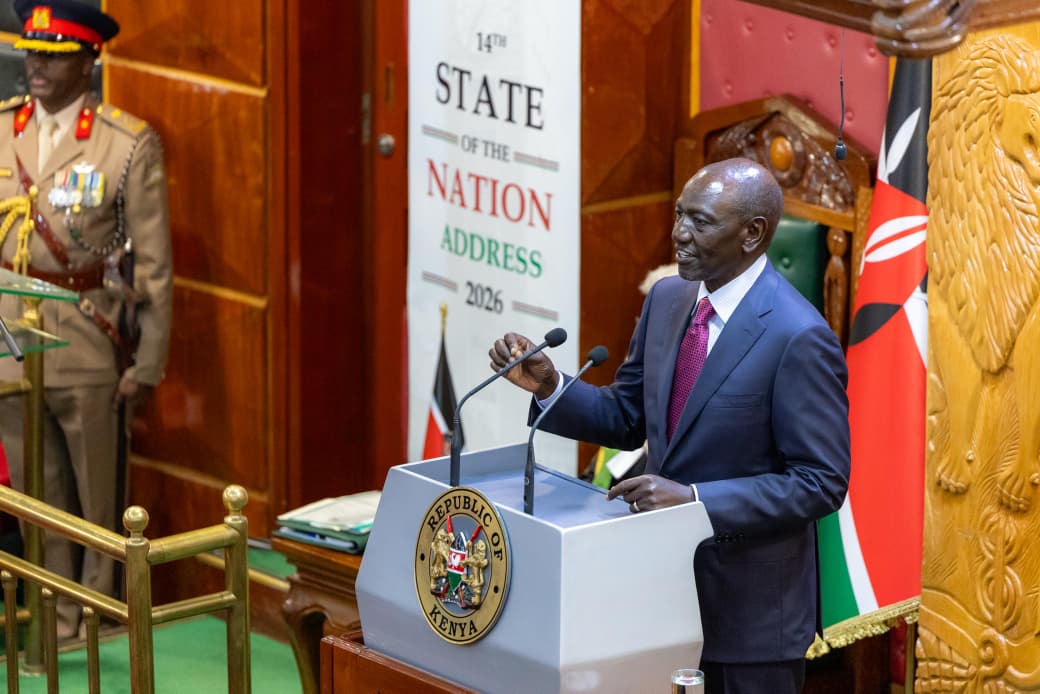
President William Ruto delivered his fourth State of the Nation Address to a joint sitting of the National Assembly and Senate on November 18, 2026. In his nearly two-hour address, Ruto presented a detailed account of his administration’s progress under the Bottom-Up Economic Transformation Agenda and the principle of Usawa. He highlighted economic stabilisation and gains in agriculture, education, healthcare, and affordable housing, while outlining the path toward greater equity and First World ambitions. Here is the full text of the speech:
“Mr Speaker of the National Assembly, Mr Speaker of the Senate, Honourable Members of Parliament, Fellow Citizens,
For the fourth time, I stand before this House to discharge my constitutional duty to report on the state of our nation and to take stock of what we have collectively accomplished as Kenyans.
And let me say, I have never been prouder to be Kenyan. I have never been prouder of the privilege of serving as President of the Republic of Kenya.
Our nation is making a powerful comeback. Our economy is recovering its strength, our infrastructure is expanding, our education system is being revitalised, healthcare is reaching more citizens, and new opportunities are opening for our young people to work, earn, and prosper.
Above all, my greatest ambition, the dream of building a Kenya where every citizen counts, every community belongs and no Kenyan is left behind, is steadily taking shape. That Kenya, where opportunity is not determined by where you were born, who you know or how much you have, is coming to be.
At the heart of this vision is a simple belief, a principle that should unite us regardless of our differences: Usawa.
This progress has not happened by chance. It is the result of deliberate choices, difficult decisions, sustained reforms and the extraordinary resilience and enterprise of the Kenyan people. It is the product of the Bottom-Up Economic Transformation Agenda.
Bottom-Up tells us where to begin: With the work, enterprise, and aspirations of ordinary Kenyans. Our First World ambition sets the standard we must attain: A productive economy, dependable services, and a dignified life. Usawa affirms who must share in that achievement: Every county, every community, and every citizen.
Together, these commitments define our national undertaking: Building prosperity from the household upwards, expanding our economy and extending opportunity across every corner of our Republic.
Kenya’s Historical Context: From Independence to Persistent Inequalities
Mr Speaker, Honourable Members,
At independence in 1963, our founding generation declared war on ignorance, disease, and poverty. They understood that political freedom would only find its fullest meaning when every Kenyan could access education, healthcare, and the opportunity to build a better life.
Two years later, Sessional Paper No. 10 on African Socialism and its Application to Planning in Kenya confronted the difficult question of how to allocate scarce resources against immense development needs. It prioritised investment in areas where immediate economic returns were expected to be greatest.
Fertile land attracted agricultural investment. Existing roads attracted factories. Established production centres strengthened the case for electricity and further infrastructure. But communities without those advantages were caught in a vicious circle: They needed investment to unlock their potential, yet lacked the means to attract it.
Over time, this approach contributed to reinforcing existing inequalities. A child born near a tarmac road was more likely to find a school, a clinic and opportunity within reach. Another, born beyond its end, faced longer journeys and fewer prospects.
The difference was never one of human worth, ability, or ambition. Talent existed everywhere. Enterprise existed all over. Ambition was abundant across Kenya. But opportunity was not.
The loss occasioned was borne by the whole country. A child denied education was potential lost to Kenya. A road not built was trade not undertaken. When one part of our Republic was held back, our entire nation lost.
Successive generations sought to change this reality. Under President Mwai Kibaki, Vision 2030 established the ambition of a newly industrialising, middle-income country offering a high quality of life to all its citizens. In 2010, Kenyans adopted a Constitution that made equity, inclusion and social justice binding principles of governance, and devolved power and resources to 47 counties.
Yet deep inequalities remained. A smallholder farmer struggled to afford fertiliser. A Jua Kali artisan lacked equipment. Mama Mboga could not obtain affordable credit. An educated young Kenyan searched, sometimes for years, for the first opportunity to earn a living.
Kenyans sustained our economy through their labour, ingenuity, and enterprise. What each one needed was the means to make that effort count. In 2022, they entrusted this administration with the responsibility to remove the barriers that constrained them and expand their participation in the creation of national wealth.
The Bottom-Up Economic Transformation Agenda
Through the Bottom-Up Economic Transformation Agenda, we set out to stabilise the economy, raise agricultural productivity, expand affordable healthcare and housing, reform education, support small enterprises, create employment, and build the infrastructure necessary for a more productive economy.
Our economic proposition was simple: Reduce the cost for families and increase the income from what they do. More affordable food, healthcare, housing, education, and transport would ease pressure on household expenditure. More productive farms, growing businesses and new employment opportunities would expand household earnings. Both were necessary then, and both remain necessary today.
This undertaking is firmly grounded in our Constitution. Article 10 establishes equity, inclusion, and social justice as national values. Article 43 guarantees economic and social rights, including healthcare, housing, food, water, education, and social security. And Article 201 requires fairness in the sharing of public resources and the benefits of development.
Today, I will account for the foundation we have laid in the lives of our people, how we are extending the benefits of development to every corner of our Republic, the greater prosperity we are preparing to build, and the responsibilities we must discharge to secure our collective future.
Addressing the Cost of Living
Honourable Members, Fellow Citizens,
I begin with the question that matters most in the daily lives of millions of Kenyans: The cost of living.
For a Kenyan balancing the cost of food, rent, transport, school expenses and medical bills, economic progress must mean something practical. It must mean that money goes further, that work earns more, that essential services become affordable and that the future offers greater certainty.
We have never regarded the cost of living as a problem that can be solved by one intervention, one subsidy or one announcement. Its causes are interconnected, and its solution must be comprehensive.
Food becomes expensive when production costs are high, and supply is inadequate. Healthcare becomes a burden when illness forces families to borrow or sell their property. Education becomes elusive when parents must pay for teachers and classrooms that should be publicly provided. Transport costs rise when roads are poor or non-existent. And even where prices fall, life remains difficult for a citizen who has no income.
That is why our interventions have addressed both sides of the household economy: What Kenyans spend and what Kenyans earn. We have worked to lower the cost of essential goods and services while increasing productivity, creating employment and expanding opportunities for enterprise.
Restoring Economic Stability
To sustain these gains, our first responsibility was to restore economic stability. In 2022, our economy faced serious pressures, including elevated inflation, a weakening currency, rising borrowing costs and concerns over our capacity to meet external debt obligations.
We confronted those challenges through extensive but necessary reforms. Despite global uncertainty and disruptions to international trade, our economy has been expanding.
The Kenyan shilling has remained broadly stable around KSh129 to the United States dollar, having recovered from nearly KSh162. Average commercial bank lending rates declined from
17.2 per cent in November 2024 to approximately 14.4 per cent in September this year.
Inflation, which reached 9.6 per cent in 2022, averaged 4.1 per cent in 2025. Although renewed food and energy pressures pushed inflation higher in October, the stability we have restored provides a stronger basis for confronting these challenges.
Our foreign exchange reserves increased from US$7.37 billion in 2022 to a peak of US$15.3 billion this year. We also honoured the US$2 billion Eurobond obligation that fell due in June 2024, protecting our country’s financial standing and restoring confidence in our economy.
These achievements matter not because they make impressive financial statistics, but because a stable currency, manageable inflation and more affordable credit help businesses plan, farmers produce, investors create jobs and families protect their purchasing power.
Agricultural Transformation: Lowering Costs and Raising Incomes
Mr Speaker,
Nowhere is the connection between production costs, household expenditure, and income more direct than in agriculture. Agriculture supports the livelihoods of millions of citizens, directly and indirectly. Food accounts for a substantial share of household expenditure. We therefore approached agricultural transformation from three directions: Reducing the cost of production for farmers, increasing the supply of food for consumers, and ensuring that farmers receive better returns from their work.
We reduced the price of a 50-kilogram bag of fertiliser from KSh7,500 in 2022 to KSh2,000 this year. We have distributed
38.5 million bags of subsidised fertiliser, registered nearly nine million farmers, and expanded access to improved seeds, soil testing, and extension services.
Consider Laban Cheptarus, a maize farmer in Rongai, Nakuru County. Through access to affordable fertiliser, improved seeds and better extension services, his harvest on five acres increased from 75 bags in 2022 to 125 bags last year. He nearly doubled his production without acquiring another acre.
The benefit begins before planting, when the farmer spends less on inputs. It continues at harvest, when greater productivity increases the earnings per acre of produce and increases the volume available for consumers, thereby reducing prices of commodities.
National maize production increased from 44.3 million bags in 2022 to 71 million bags last year, while imports declined from 9.9 million to 3.3 million bags.
The national average price of two kilogrammes of sifted unga declined from a high of KSh 230 in September 2022 to an average of KSh 152 in September this year. Our determination is to sustain increased production so that food becomes more affordable and farmers continue earning better returns.
Gains Across Key Value Chains
But agricultural transformation is not only about maize. It is also about putting more money into the pockets of the millions of Kenyans who depend on tea, coffee, milk, sugarcane, livestock, fisheries, and other agricultural enterprises.
In Bungoma, Rosemary Wepukhulu’s coffee earnings rose from KSh62,642 to KSh226,836; more than three times what she previously earned from her crop. For a smallholder farmer, this is the difference between coffee being a modest source of income and it becoming a meaningful foundation for household prosperity. Across the coffee sector, average cherry prices have risen from KSh69 up to KSh130 per kilogramme, while national coffee export earnings have doubled from KSh26 billion to KSh52.1 billion.
Through reforms in governance, marketing, and payment systems, we are ensuring that more of the value created by coffee reaches the farmer. The Cherry Advance Revolving Fund has disbursed KSh15.07 billion to 684,000 farmers, helping them meet immediate financial needs as they await payment.
In tea, export earnings increased from KSh163 billion in 2022 to KSh187 billion in 2025. Improved factory governance, greater auction transparency, and reforms to deductions translated to stronger sector performance and better returns for smallholder farmers.
In dairy, national milk production increased from 4.5 billion to 5.52 billion litres, while export earnings more than doubled to KSh 11.2 billion. Average earnings increased from KShs 32 per litre to a high of KShs 60 per litre last month. Subsidised fertiliser contributed significantly to increased silage production for livestock.
The recovery of our sugar industry is well underway. Between January and October this year, cane crushed increased by 57%, while sugar production rose by 60%. The industry is now projected to produce more than 900,000 tonnes by the end of the year, the highest annual production in Kenya’s history.
But the true measure of this recovery is what it delivers to the farmer. To fulfil our commitment that sugarcane farmers should share in the industry’s improving fortunes, a bonus package of KSh1.2 billion will be paid to farmers this year, and disbursement will begin next week.
These payments will give practical meaning to our promise: that reviving factories must restore livelihoods, put money in the pockets of our farmers, reward hard work, and bring prosperity back to our sugar-growing communities.
For pastoral communities, livestock insurance is protecting household assets against drought. More than 245,000 pastoralists have accessed insurance and savings incentives under the DRIVE programme, protecting over 3.3 million animals.
In our blue economy, investments in landing sites, cold storage, markets, and fishing equipment are helping communities preserve more of their catch and obtain better prices. In Lamu, improved preservation equipment enabled members of the Shanga Ishakani Fishers Women Group to double their average octopus selling price.
We are also bringing markets and processing closer to producers through modern market infrastructure and County Aggregation and Industrial Parks. The National Government has invested KSh8.5 billion in 34 counties, with 15 parks complete, and allocated additional resources for common-user manufacturing equipment. We are developing 600 modern markets across the nation at a cost of Kshs 57 billion to provide trading space, storage, and cold room facilities.
These investments will enable farmers to sell processed products rather than raw produce, reduce post-harvest losses, support local manufacturing, and create employment within their counties.
From the maize farmer to the coffee grower, from the dairy cooperative to the fishing community, our approach has been consistent: Lower production costs, increase productivity, improve market access, and enable producers to retain more of the value they create.
The result we seek is equally clear: More affordable food for consumers and higher incomes for producers. These are two sides of the same national undertaking: Managing the cost of living.
Healthcare Reforms and the Social Health Authority
Honourable Members,
Just as high food prices strain a household, a serious illness can wipe out years of savings and productive effort.
For too many Kenyan families, falling ill has meant borrowing, selling livestock, disposing of land, or abandoning treatment altogether. A medical emergency could turn a family that was getting ahead into one struggling to survive.
That is the burden we set out to lift through our healthcare reforms: To ensure that the cost of treatment is increasingly met through a system of shared health financing, rather than falling entirely on individuals and their family.
Today, 33.7 million Kenyans are registered with the Social Health Authority, compared with approximately eight million registered under NHIF in 2022. But the significance of this reform goes beyond registration. It lies in the treatment families can access and the medical bills they no longer have to bear alone.
Across the country, 53,465 patients are receiving cancer treatment, 24,468 are receiving dialysis and 89 have undergone kidney transplants, all under SHA. These are among the most expensive forms of medical care, often beyond the financial reach of ordinary households.
Through SHA, covered treatment costs are being financed on behalf of patients, reducing the amounts that families would otherwise have to raise from their savings, seek or borrow from relatives, or obtain through the sale of their assets.
The transition to SHA had initial challenges, and we recognised the legitimate concerns of Kenyans. We have consistently addressed those concerns because health protection must be experienced by citizens in practice, as promised in policy.
Our undertaking is to progressively and eventually remove the crushing burden of medical expenses from Kenyan households, protect family savings and ensure that illness does not become a sentence to poverty. This is how we are conntributing significantly to reduction in the cost of healthcare and cost of living together.
Investments in Education
Mr Speaker,
Education is another major household expense, and another area in which public investment must relieve the burden on Kenyans. When we assumed office, Kenya faced a teacher shortage estimated at 116,000. Parents in many schools were paying for teachers employed through Boards of Management, while also meeting additional demands for classrooms and learning facilities.
In four years, we have employed 100,000 teachers and are preparing to recruit another 20,000. This investment improves the quality of education while progressively reducing the need for Kenyans to finance teaching.
We have built 23,000 classrooms and are constructing and equipping 1,600 laboratories. These facilities expand access to learning and reduce pressure on communities to finance essential school infrastructure.
Our annual education allocation has increased from KSh521 billion in 2022/23 to KSh784 billion this financial year. These resources must reach schools promptly and be managed responsibly. Parents should not be required to carry public obligations through unauthorised charges. The purpose is to make education accessible and affordable today while preparing our children to earn better incomes tomorrow. Every child who remains in school to learn; trains to acquire useful skills and enters productive employment, strengthens both the household and the nation. Our investment in education has lifted a heavy burden on our parents and helped reduce financial obligations, thereby reducing the cost of delivery.
And by the way, this week, we are concluding national examinations for the largest cohort in our history: 3.6 million learners sitting KPSEA, KJSEA and KCSE. For the first time in 65 years, examination papers were printed here in Kenya. The examinations have been conducted in a calm and orderly atmosphere, free from the anxiety, tension and intimidating security deployments of the past. This is how it should be. Examinations are a normal part of learning, not a security operation or a matter of life and death. They should assess our children’s progress, not instil fear about their future.
Affordable Housing Programme
Honourable Members,
Housing presents a similar opportunity to reduce household burdens while creating employment income on a national scale.
For millions of Kenyans, rent consumes a substantial share of monthly earnings while only conferring temporary shelter. The Affordable Housing Programme is opening a new pathway through which families can obtain decent homes and progressively build an asset for their ownership.
Under social housing arrangements, households can begin the journey towards homeownership for as little as KSh4,000 a month. A payment that previously secured only temporary occupation can, under this programme, contribute towards lasting ownership.
Across all 47 counties, more than 313,000 homes are at various stages of construction, with some already completed. Over 1.37 million Kenyans have registered on Boma Yangu, and more than 18,000 have been allocated homes.
In Mukuru, Rossina Mbithe has moved from unsafe and inadequate housing into a more secure home. In Machakos, Faith Mueni Kioko, a young woman living with a disability, has obtained a home she once doubted she could own.
Yet housing is not only about the family that receives the keys. It is also about the thousands of Kenyans who earn an income building that home. The programme has generated more than
1.1 million employment opportunities. Engineers, architects, masons, plumbers, electricians, painters, welders, carpenters, and transporters are earning from construction activity across the country.
In Bungoma, Moses Wasike, who once struggled to find regular work, now supervises more than 150 workers. In Mukuru, Diana Mwange has moved from irregular domestic employment into predictable earning as a painter.
We have also reserved more than KSh61 billion in orders for Jua Kali artisans. These orders create business for workshops, support apprenticeships and expand local manufacturing.
In Eldoret, Fanuel Anyanga Temba secured subcontracts worth KSh30 million, expanded his workshop from three machines to 20 and increased his workforce to more than 25 young Kenyans.
The housing programme therefore serves two purposes simultaneously: It creates more affordable and dignified homes while expanding the number of Kenyans earning an income.
Job Creation, Enterprise and the Digital Economy
The employment opportunities created through affordable housing are part of our wider effort to enable more Kenyans to earn an income and improve their livelihoods.
Hon Members,
A family without income cannot overcome the cost of living through lower prices alone. The young person who has completed education but cannot find work, the artisan whose skills remain idle and the entrepreneur without capital all need an opportunity to earn.
That is why job creation and enterprise development has been central to our economic transformation. We are creating opportunities through housing and infrastructure, agriculture and manufacturing, small enterprise, the digital economy and international labour mobility.
Through our digital economy programme, we are expanding connectivity, digital skills and access to online work. Already, 350,000 Kenyans have secured work in the digital economy, earning incomes through opportunities that extend beyond their immediate communities and our national borders.
Through international labour mobility, 707,000 Kenyans have secured jobs abroad, acquiring valuable experience, supporting their families and contributing to our economy through remittances.
At home, the Hustler Fund is expanding access to credit for Kenyans previously excluded by collateral requirements and limited borrowing histories. More than 7 million Kenyans have established credit records, and are regular borrowers with cumulative borrowing of KSh94 billion. 700,000 are now established borrowers with a limit as high as Kshs 150,000 without any collateral.
For young Kenyans with skills and ideas but insufficient capital, NYOTA provides an opportunity to begin. More than 133,000 young entrepreneurs have received training, mentorship and KSh50,000 each in start-up capital.
Javan Simiyu from Bungoma county used his grant to acquire welding equipment and now earns more than KSh30,000 a month. His story demonstrates the difference between possessing a skill and having the means to turn that skill into an income. To expand opportunity for more entrepreneurs in Nyota business support, we are working with partners to support another 200,000 beneficiaries with Kshs 50,000 each.
But our ambition cannot end with start-up grants. We must enable these young enterprises to grow, secure markets, employ others and become sustainable businesses.
That is why we are now linking NYOTA beneficiaries to government procurement opportunities through the NYOTA–AGPO Digital Training Programme, a free 10-week initiative that equips young entrepreneurs, women and persons with disabilities with digital and business skills, awards proficiency certificates, and facilitates business registration and AGPO certification. This will enable 600,000 Kenyans to qualify for government contracts, grow their enterprises and have an income.
Additional Measures to Ease Household Burdens
Honourable Members,
These are not isolated interventions, but parts of one comprehensive undertaking. Affordable fertiliser and increased production lower farming costs and improve food supply, while better returns from coffee, tea, milk and sugarcane raise farmers’ incomes. SHA relieves families of medical expenses, while more teachers and classrooms ease the burden on parents.
Housing, digital jobs, overseas employment and support for small enterprises create opportunities to earn, while better roads and digital services reduce the cost of doing business. This is how we are addressing the cost of living: Lowering household expenses, increasing incomes and enabling more Kenyans to earn a living.
Our task is far from complete, but our purpose remains clear: To make everyday life more affordable and productive effort more rewarding.
That is why we have also announced further measures to ease the burden on households, support businesses and put more money in the pockets of Kenyans.
These include proposals to exempt workers earning KSh32,333 a month or less from PAYE, remove stamp duty on land transactions valued at KSh1 million or less, and eliminate the 25 per cent import duty on mobile phones.
We have also approved the settlement of 28,726 verified pending bills amounting to KSh27.8 billion, dating back to 2005 and covering claims of KSh50 million and below. We have also approved the payment of Kshs 18 billion owed to our public universities and another Kshs 16 billion owed to both public and private hospitals under the former NHIF. These payments are undergoing due process in the national treasury for payment in the coming weeks.
Together, these measures will increase incomes, make property ownership and digital access more affordable, restore cash flow to businesses, protect jobs and sustain livelihoods.
Usawa in Practice: Who Benefits from Development?
Mr Speaker, Honourable Members,
There is a second question by which our transformation must be judged. It is not enough that the economy grows, that incomes rise or that public services improve. We must also ask: Who is benefiting? Where is development taking place? How is opportunity accessed?
For too long, national development was concentrated in places that already possessed the infrastructure, institutions and markets necessary to attract further investment.
Our responsibility is to change that pattern. A Kenyan living in Mandera must have the same claim to national development as one living in Nairobi. A child in Turkana must have the same opportunity to fulfil their potential as one in Eldoret. A trader in Migori, a farmer in Taita Taveta and a young entrepreneur in Wajir must all have a fair chance to participate in our economy.
This is the practical meaning of Equity – Usawa ni Sawa: Not that every part of Kenya has identical needs, but that every Kenyan deserves equal consideration, equal chance and a fair opportunity to advance.
In healthcare, Under the former NHIF, only 8 million Kenyans were registered. Today, under SHA, that number stands at 33.7 million. That is 25.7 million more Kenyans brought into the national health financing system. Millions who were previously outside its protection, for whom illness could mean selling their land, exhausting their savings or sinking into debt.
Consider Veronica Wambui, a mother of three and small-scale farmer from Gatundu, Kiambu County. When her kidneys failed, Veronica faced two battles; one for her life, and another the cost of staying alive. She needed dialysis twice every week. And like any mother, she had a family to care for, even as she fought for her own health.
In May 2025, she underwent a kidney transplant at Kenyatta University Teaching, Referral and Research Hospital.
Veronica contributes KSh840 a month to SHA. Yet the cost of her investigations, transplant and medication exceeded KSh966,000, excluding dialysis. SHA covered that bill in full.
Imagine what nearly a million shillings in medical expenses would mean to a small-scale farmer raising three children. For Veronica, pooled health financing meant access to life-saving treatment without having to meet that enormous bill alone. For her family, it meant that her illness did not have to consume the resources on which their livelihood depended.
Honourable Members, think about it. You and I, through our contributions, each according to our incomes, have helped Veronica get the treatment she needed. A mother of three. A small-scale farmer. Someone most of us have never met.
Yet, in her hour of need, we were there for her. And today, 25.7 million more of our brothers and sisters are part of this same system. People we may never meet. Families whose names we may never know. But when illness comes to their door, they should not have to face it alone.
Is that not a beautiful thing? That we can help save the life of someone we have never met? That a mother can return to her children because we chose to look after one another?
Honourable Members, is that not the least we owe each other as Kenyans?
The same spirit of shared responsibility guides our affordable housing programme. Today, affordable housing projects are being implemented across all 47 counties, hostels for students in universities, Tvets and KMTC’s are being built, while modern markets are being developed throughout the country to bring better trading spaces closer to small enterprises.
Through the Housing Levy, you and I contribute according to our earnings, a fellow Kenyan, perhaps someone we have never met, can move from a life of squalor, leaking roofs, open sewers and indignity into a decent home.
Think of a mother who no longer has to worry about rain pouring onto her children’s bed. A father who can finally raise his family in a safe, dignified environment.
That another Kenyan’s children can grow up in conditions we would want for our own. That is what equity in housing means. That is Usawa in reality and practise.
Our programme of 600 modern markets is especially important to traders who have worked for years in rain, dust and inadequate conditions. These facilities provide shelter, sanitation, storage, cold rooms and a more dignified environment in which to conduct business.
A modern market is not merely a building. It is an investment in people whose work sustains local economies but whose needs have too often been overlooked, and have no means of their own.
We are also constructing hostels with a capacity of 170,000 students across our universities, TVET institutions and Kenya Medical Training Colleges (KMTCs), providing our young people with decent, safe and dignified accommodation, conducive to learning, and freeing them from squalid living conditions.
Infrastructure, Credit and Opening Opportunity
Hon Members,
Equity also means opening economic opportunities to Kenyans who have historically been excluded from formal financial services.
Through the Hustler Fund, we are widening access to affordable credit for small traders and entrepreneurs who have the ambition and capacity to build enterprises but lack the collateral or financial history traditionally required by lenders.
The principle is simple: A Kenyan’s opportunity to succeed should not depend solely on their existing economic circumstances or access to conventional banking.
Equally, our wider infrastructure programme reflects the same commitment. Roads are being constructed and rehabilitated in regions that have waited decades for dependable connections to markets, schools, hospitals and the wider national economy.
Take the 750-kilometre Northern Kenya Gateway Corridor, linking Isiolo, Wajir and Mandera.
Ile barabara ya kutoka Isiolo kwenda Modogashe, iteremke iende Samatar, iteremke mpaka Wajir, iende Tarbaj, itoke Tarbaj, ipitie Kotulo, iende Kobo, iende El-Wak, iende Garre, iende Rhamu, ifike Mandera.
When I first spoke about this road and named all the towns it would pass through, Kenyans had a field day. The jokes and parodies were everywhere. I saw some of them myself, and I must admit, some were quite hilarious.
But Honourable Members, beyond the humour, there is something we must reflect on. In those towns live Kenyans like you and me. Mothers raising children. Traders trying to make a living. Young people with dreams no different from those of your children and mine.
And yet, some have lived their entire lives without a single tarmacked road reaching their communities. Their entire lives. What many of us take for granted has remained a distant hope for other citizens. That is the inequality we are correcting. That is the Usawa they deserve.
Education Equity and Tertiary Funding
Honourable Members,
Education remains one of the most powerful instruments for equalising opportunity. Through teacher recruitment, classroom construction and expanded student accommodation, we are addressing inequalities in access to quality education across the country.
In higher education, we initially reformed funding to provide greater support to students from less privileged families. But we recognised that even with this support, tuition costs still remained a barrier for many.
We have therefore gone further. Under the Tertiary Education, Placement and Funding Bill, 2026 before this parliament, we are proposing that going forward, no student admitted to our universities, TVET institutions or Kenya Medical Training Colleges will miss class on account of inability of their parents to pay.
A child’s future should be determined by their ability and effort, not their family’s income or the county in which they were born. Talent is found in every corner of Kenya. Opportunity must be too. That is Usawa.
Through programmes targeting young people, women and persons with disabilities, we are working to remove barriers to skills, finance, enterprise and public procurement opportunities.
Programmes such as NYOTA and AGPO are intended to ensure that groups historically excluded from economic opportunity have practical pathways to participate, compete and succeed.
We are applying the same approach in agriculture. Our interventions are reaching smallholder farmers, pastoralists and fishing communities in arid and semi-arid regions, alongside producers in our traditional agricultural heartlands.
Land Rights, Citizenship and Belonging
But equity is not only about services and economic opportunity. It is also about rights, recognition and belonging. We are therefore addressing historical injustices in land ownership and security of tenure.
Since August 2022, nearly 1.8 million title deeds have been issued across the country, including more than 400,000 at the Coast. In Taita Taveta, Kilifi and Lamu, community titles have secured land rights for families who waited generations for formal recognition of their ownership.
A title deed provides more than proof of ownership. It offers security, encourages investment, protects inheritance and gives families greater certainty about their future. For communities that have lived with unresolved land claims for decades, it is also an affirmation that their rights deserve the same protection as those of every other Kenyan.
Equally, citizenship must likewise be reflected in how Government treats its people. That is why we ended discriminatory identification requirements in Northern Kenya and other border counties. A Kenyan should never spend a lifetime proving that they belong. Citizenship must be verified with diligence, but the process must be fair, lawful and free from discrimination.
No Kenyan should face additional barriers to recognition or access to public services simply because of their name, community or place of origin.
Devolution and the Equalisation Fund
Honourable Members,
Our Constitution recognises that equal opportunity also requires addressing the historical imbalance in the distribution of national resources.
Article 174 establishes equitable sharing of national and local resources as one of the objects of devolution. Article 204 provides for the Equalisation Fund to support basic services in marginalised areas.
Over the past four financial years, we have disbursed KSh1.55 trillion in equitable share to county governments, with a further KSh428 billion allocated this financial year.
Through the Equalisation Fund, KSh16.8 billion was appropriated this year for projects in marginalised areas.
These resources are intended to improve access to essential services and infrastructure, including water, roads, healthcare and electricity, so that communities previously left behind can progressively attain standards enjoyed elsewhere. We are therefore changing not only the scale of national development, but also its geography and its reach.
That is the promise of Bottom-Up finding expression in Usawa ni Sawa: A Republic in which opportunity is not the privilege of a few regions, communities or families, but the rightful expectation of every Kenyan.
Raising Ambition: Towards First World Standards
Fellow Citizens,
The foundation we have laid in economic stability, productive livelihoods and wider access to opportunity now gives us the ability to aim higher.
We must move beyond stabilising the economy to transforming its productive capacity. Beyond creating individual opportunities to building an economy capable of sustaining millions of productive jobs. Beyond extending existing services to attaining standards of infrastructure, education, healthcare and prosperity comparable with the world’s most advanced economies. That is the ambition of attaining First World standards of prosperity within a generation.
We cannot achieve this ambition through ordinary expenditure alone. The infrastructure required to transform our economy demands substantial, sustained and carefully structured investment.
Our transformation programme is estimated to require KSh5 trillion over the next 10 years. We must therefore mobilise long-term capital in ways that protect debt sustainability, safeguard public resources and avoid placing an unsustainable burden on taxpayers.
An important foundation for this ambition is the growth of our national savings. Article 43 of our Constitution guarantees every Kenyan the right to social security. To give practical effect to this right, we mobilized NSSF savings from employees, matched by their employers. We have set out to secure dignified retirement, build a stronger savings culture and mobilise domestic resources for national development.
Since 2023, monthly NSSF contributions have increased sixfold, from KSh1.4 billion to over KSh8.5 billion. The Fund’s value has grown from KSh288 billion in 2022 to KSh850 billion this month, putting us on course to reach KSh1 trillion by June 2027. For the 2024/2025 financial year, members earned interest of 17 per cent on their savings.
Through digitisation, NSSF has reduced benefit processing time from 82 days to seven days, with a target of processing claims within 24 hours. Over the past three years, the Fund has paid KSh40.1 billion to approximately 400,000 beneficiaries.
Our ambition is a nation that saves more, invests more and creates more opportunities for its people. By investing workers’ savings prudently and productively, we can secure their future while financing the infrastructure and enterprises that build a more productive country.
In my State of the Nation Address last year, I proposed the establishment of the National Infrastructure Fund. I commend this House for swiftly passing the enabling legislation, which I signed into law on 9 March 2026. The Fund has since been capitalised with KSh340 billion, turning that commitment into a platform for financing our nation’s transformation.
Built from proceeds of divestiture of mature public assets, the NIF provides a framework for mobilising investment from pension funds, institutional investors, development finance institutions and other partners.
The purpose is to convert existing national assets and available investment capital into the next generation of productive infrastructure: Roads, airports, railways, energy, water, irrigation and other strategic investments that expand the capacity of our economy.
Alongside this, the Sovereign Wealth Fund will provide a framework for saving, investing and preserving national wealth for future generations. We must leave those who come after us productive assets, national savings and manageable obligations.
These financing instruments must operate under transparent governance, rigorous project appraisal and clear accountability. Every investment must be justified by the economic and social value it creates.
Transport Infrastructure Priorities
Mr Speaker,
Our first priority is transport infrastructure. Approximately 7,000 kilometres of roads are under construction, including projects that had stalled for years. Over the next decade, our ambition is to tarmac 28,000 kilometres of roads and dual 2,500 kilometres of highways.
These are not merely engineering targets. Better roads reduce the cost of moving agricultural produce, transporting manufactured goods and accessing markets. They connect workers to employment, patients to hospitals and learners to educational institutions.
We are constructing the more than 750-kilometre Isiolo–Wajir-Mandera corridor through Modogashe, Wajir, El Wak and Rhamu, opening Northern Kenya to wider trade and investment.
We are working towards completion of the 700 km Mau Mau roads and the Kenol–Marua dual carriageway, while advancing the Lake Victoria Ring Road connecting communities and economic centres across the lake region from Busia, to Siaya, to Kisumu, to Homa Bay and Migori.
We are prioritising the Rironi–Naivasha–Nakuru–Mau Summit highway, the Kamandura–Maai Mahiu–Naivasha road, and arrangements are at an advanced stage for the dualling of the Nairobi–Mombasa highway.
Other strategic corridors on course include Mau Summit–Kericho–Kisii- Awendo- Kisumu, Kisumu–Busia road, and Mau Summit–Eldoret–Malaba.
We are also prioritising the dualling of the Bomas–Ongata Rongai–Ngong–Karen, Kitengela–Isinya, Pangani– Muthaiga–Ndumberi, Makutano–Embu–Chuka–Maua, Marua–Nanyuki–Isiolo, Malindi–Mtwapa, and Likoni–Ukunda–Msambweni–Lunga Lunga roads. Construction of the Nithi Bridge is ongoing. Together, these projects will ease the movement of people and goods, connect regional markets and strengthen our economy.
We are also advancing the extension of the Standard Gauge Railway from Naivasha through Narok and Bomet to Kisumu and onwards to Bugoma and Malaba, alongside modernisation of the ports of Mombasa and Lamu.
At Jomo Kenyatta International Airport, the ongoing KSh154.2 billion development and modernisation programme will expand passenger and operational capacity, strengthen our position as a regional aviation hub and support tourism, horticulture, logistics and international business.
Roads, railways, ports and airports must function as one integrated transport network, reducing logistics costs and positioning Kenya as a preferred destination for production, trade and investment.
Energy Security and Expansion
Honourable Members,
Our second priority is energy. No modern economy can prosper without reliable, affordable electricity. Factories require dependable power. Irrigation systems need energy. Digital enterprises depend on uninterrupted connectivity. Hospitals, schools and households all require electricity that is accessible, competitively priced, and reliable.
Using NIF, we are mobilising investment towards an additional 10,000 megawatts of generation capacity, drawing on our geothermal, hydro, wind and solar resources. This expansion must be matched by investment in transmission, substations and distribution so that additional generation translates into reliable supply for industry, businesses and households.
The objective is not simply to generate more electricity. It is to make power more dependable and affordable, lower production costs, attract investment and enable Kenyan enterprises to compete in regional and international markets.
Water Security and Irrigation
Mr Speaker,
Our third priority is water security and irrigation. We have demonstrated through agricultural reforms that Kenyan farmers can produce more when they have access to affordable inputs, better technology and dependable markets.
But our agricultural potential will remain constrained for as long as production depends solely on rainfall. We must make water available for agriculture, industry and households throughout the year.
Our programme envisages at least 50 mega dams, 200 medium and small dams, and thousands of water-harvesting structures, supporting an ambition of at least 2.5 million acres under irrigation.
Roads will connect producers to markets. Energy will power production. Water will secure agriculture and industry. Together, these investments will create the conditions for a more productive, competitive and resilient economy.
Service Economy, Tourism and Sports
Honourable Members,
The service economy presents significantly important opportunities for our country. Kenya possesses extraordinary natural beauty, rich cultural heritage, globally recognised sporting talent and a strategic position as a regional centre for business, diplomacy and international conferences.
We must convert these advantages into more visitors, greater foreign exchange earnings, expanded investment and more employment for our people. The Raila Odinga International Stadium at Talanta Sports City, alongside the upgrading of Nyayo, Kasarani and stadia across the country, is part of our ambition to make Kenya a leading destination for international sporting events.
Our preparations to co-host AFCON 2027 with Uganda and Tanzania provide an opportunity to showcase our country, develop sporting talent and expand demand for hotels, transport, hospitality, entertainment and other services.
The Bomas International Convention Complex will strengthen our capacity to host international conferences, exhibitions and major business events.
Together with modern airports, improved roads, hospitality investment and our creative industries, these facilities will position Kenya as a premier destination for tourism, sports, culture and international business.
The value of these investments must be measured not only in visitor numbers, but in the jobs they create, the businesses they support, the incomes they generate and the opportunities they open for our young people.
We must ensure that the farmer supplying a hotel, the artisan producing cultural artifacts, the musician entertaining visitors, the transporter moving guests and the young professional working in hospitality all participate in the value created by a growing service industry.
Human Capital Development
Mr Speaker, Honourable Members,
The transformation I have described requires more than capital and infrastructure. It requires three indispensable enablers: Strategic human capital development; a robust peace, stability and security architecture; and unwavering integrity and fidelity to the national interests. These are not secondary considerations. They are the conditions that will determine the success of our national ambition.
Our greatest national resource is not only the land beneath our feet or the infrastructure we construct. It is also the knowledge, innovation, discipline and productive capacity of the Kenyan people.
We cannot build a First World economy without preparing Kenyans to design, construct, operate, manage and continually improve the systems on which such an economy depends.
Our education reforms must therefore connect learning to the skills required by a modern economy. Universities must produce knowledge and innovation. Technical institutions must prepare skilled professionals and artisans. Research institutions must develop solutions to the challenges facing agriculture, industry, healthcare and public administration.
We are advancing reforms to tertiary education placement and financing to make access more equitable, support institutional sustainability and ensure that financial circumstances do not unnecessarily prevent deserving Kenyans from pursuing higher education.
This Parliament is considering the Tertiary Education, Placement and Funding Bill, 2026. I urge this House to give the proposals the scrutiny and public participation necessary to establish a fair, sustainable and effective framework.
Our ambition is to expand access to university education, strengthen Technical and Vocational Education and Training institutions and increase opportunities through Kenya Medical Training Colleges and other specialised institutions.
This law will give every young Kenyan a realistic pathway to acquire the knowledge and develop the skills needed to participate productively in the economy we are building.
The legislation provides for deliberate investment in research, science, technology and innovation. Our universities and research institutions will be at the forefront of improving agricultural productivity, developing industrial technologies, strengthening healthcare and solving national development challenges.
Our ambition is to develop not only a workforce capable of filling existing jobs, but a generation capable of creating new industries, developing new technologies and opening new frontiers of national prosperity.
Peace, Stability and Security
Fellow Citizens,
The second indispensable enabler is a robust architecture of peace, stability and security. Investment does not thrive where lives are unsafe, property is insecure and economic activity can be disrupted without consequence. Families cannot build lasting prosperity in fear. Enterprises cannot create dependable employment where years of investment can be destroyed in a single incident.
The protection of life, property, constitutional rights and public order is therefore fundamental to our national transformation. We must confront the painful events of June 2024 and subsequent protests with honesty, compassion and a clear determination to learn from them.
Kenyans lost their lives. Others suffered serious injuries and lasting trauma. Families were devastated. Parliament was breached, public institutions including the judiciary, were attacked, businesses were looted and livelihoods destroyed. These events reminded us that the stability on which economic progress depends cannot be taken for granted.
Our security agencies have a constitutional mandate to secure human life and property. This mandate is constitutional and lawful. And in the discharchge of this cardinal duty, respect for authority of the police to act independently is also constitutinal and lawful.
But we must also be unequivocal about the responsibility of the State. Where security officers use unlawful force or exceed their authority, wrongdoing must be acknowledged and those responsible must be held accountable in accordance with the law.
Article 37 of our Constitution guarantees the right of every person, peaceably and unarmed, to assemble, demonstrate, picket and present petitions to public authorities. We must alway protect that right. Kenyans must remain free to express disagreement and criticise their Government.
As an administration, we have taken the important step of acknowledging wrongdoing where it occurred and committed public resources towards redress for victims of protest-related violations, including those dating back to 2017.
We allocated KSh 2 billion for this purpose. By July this year, the Compensation Panel had reported payments totalling KSh 1.2 billion to 1,476 verified beneficiaries, including families of those who lost their lives and survivors who sustained serious injuries. The beneficiaries comprised 1,036 civilian victims of protests and 356 police officers who were injured in the noble discharge of their duties.
For both the demonstrators and police, no compensation can restore a lost life or erase the suffering of a family. But acknowledging harm and providing lawful redress are important responsibilities of a State that respects its citizens. Equally, compensation does not replace accountability. Investigations must continue, and prosecutions must follow for violations of the law, wherever the evidence warrants.
We are now strengthening the systems through which public order is managed. This includes improved training, professional standards, officer welfare, appropriate equipment, clear operational command, de-escalation procedures and stronger oversight.
Our goal is to have a professional security service capable of preventing violence, protecting life and property, while safeguarding constitutional freedoms and maintaining public order.
The lesson of our experience is clear. Security and liberty are not opposing national objectives. They are complementary constitutional responsibilities and obligations.
This is the stability we must protect: A Republic in which disagreement is lawful, public installations are secure, businesses are safe, investors have confidence, and citizens can pursue their aspirations without fear.
Patriotism, Integrity and Anti-Corruption
Honourable Members,
The third indispensable enabler of our national transformation is patriotism and integrity. Patriotism must be more than the pride we express in our flag or the affection we profess for our country. It must be demonstrated in how we exercise public responsibility, protect national resources and place Kenya above tribe, clan, political affiliation or personal advantage.
Corruption increases the cost of doing business, discourages investment and denies honest citizens a fair opportunity to succeed.
To combat corruption and eliminate pilferage, we have digitised government services and payments through the eCitizen platform, eliminating middlemen, sealing loopholes and making public transactions transparent, accountable and traceable. Through the Electronic Government Procurement (e-GP) system, we are enhancing transparency in public procurement by making suppliers, prices and government contracts open, traceable and accountable. The Conflict of Interest Act, which I commend this House for passing, will strengthen accountability, prevent abuse of public office for private gain and reinforce integrity in public service.
The implementation of the Treasury Single Account will strengthen payroll controls and improve public financial management to safeguard taxpayers’ money and ensure greater value for every shilling.
We enacted the Government Owned Eneterprises law making appointments to public boards more transparent and guided by competence, integrity and the capacity to deliver, not political patronage. This Parliament passed this law where politicians can no longer sit on these boards. Board positions will no longer be political rewards to be distributed. They are positions of trust to serve.
Honourable Members,
For those entrusted with public office, patriotism demands a higher standard: to exercise authority fairly, protect public resources, act on audit findings and accept scrutiny as a duty of service.
Our national transformation will endure only if Kenyans can trust that the institutions responsible for delivering it are competent, accountable and faithful to the national interest.
Leadership, Public Debate and the Future Beyond 2030
Mr Speaker, Honourable Members, Fellow Citizens,
The transformation we are undertaking also demands a higher standard of national leadership and public debate. A country seeking to attain First World status deserves a serious contest of ideas about production, employment, education, healthcare, infrastructure and national opportunity.
Let us debate how to lower the cost of electricity, finance infrastructure, expand employment, improve healthcare and make education more accessible. Let us test proposals against evidence, commitments against resources and promises against results.
No community should be reduced to a voting bloc. No region should be asked to surrender its judgement to a personality. Every citizen is entitled to know what those seeking public responsibility propose, how they intend to deliver it and how progress will be measured.
That standard applies first to those of us entrusted with Government. We must account for our commitments and our record. Those who offer alternatives must explain their proposals. All of us must respect the people’s right to question, scrutinise and choose.
As Vision 2030 approaches the end of its horizon, we must also begin defining the next chapter of Kenya’s development.
In August 2026, we launched a national conversation on our country’s future beyond 2030. I invite our young people, workers, farmers, entrepreneurs, professionals, scholars, political leaders, religious leaders and communities across all 47 counties to participate.
We must forge a national development charter that reflects our shared aspirations, identifies the investments required to achieve them and establishes commitments capable of enduring beyond electoral cycles.
Our political choices will differ, as they should in a democracy. But our determination to build a prosperous, equitable and secure Republic must remain a common national purpose.
Closing
Mr Speaker, Honourable Members, Fellow Citizens,
Four years ago, we began an undertaking to transform our economy from the bottom up, remove the barriers that constrained millions of hardworking Kenyans and create the conditions for shared prosperity.
Today, I report a nation whose economic foundations are stronger, whose productive capacity is expanding and whose opportunities are reaching more citizens and communities.
To those of us in leadership, let us bring to this national task the same discipline, sacrifice and determination that millions of Kenyans bring to their work every day.
Let us honour effort with opportunity, public trust with integrity and national ambition with delivery. The foundation has been laid. The direction is clear. The opportunity before us is immense.
This generational assignment, this most important work of building a prosperous, equitable and united Kenya, must go on uninterrupted. Usawa ni Sawa. Mbele Pamoja.
Honourable Speakers,
I am now pleased to submit to Parliament the following three reports as required by the Constitution:
Report on All Measures Taken and Progress Achieved in the Realisation of National Values;
Report on Progress made in fulfilling the International Obligations of the Republic; and
Report on The State of Security.
Now, therefore, I hand over the Reports to the Speaker of the Senate and to the Speaker of the National Assembly. I thank you. God bless you. God bless Kenya.”
Follow our WhatsApp Channel and X Account for real-time news updates and subscribe to our YouTube Channel for in-depth interviews.