The Government of Kenya has formally exited the COMESA Sugar Safeguard regime after 24 years, marking a policy shift for the country’s sugar industry.
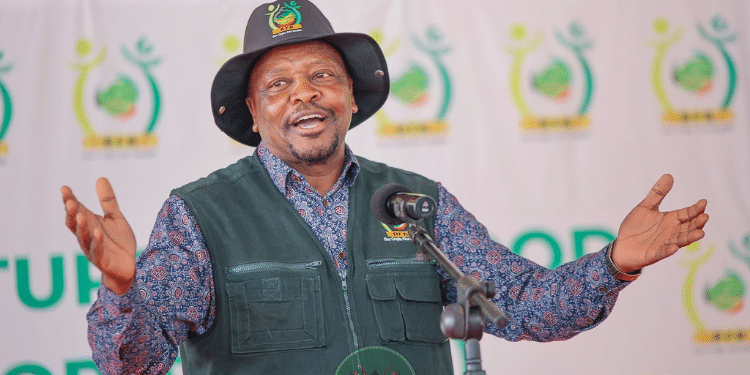
In a statement on January 4, Cabinet Secretary for Agriculture Mutahi Kagwe stated the exit reflects the strength and stability of Kenya’s sugar industry, noting that the sector is well-managed and supported by clear policy direction.
“The Government of Kenya has formally exited the COMESA Sugar Safeguard regime after 24 years, marking a decisive and confident transition for the country’s sugar industry,” read part of the statement.
He reassured Farmers, millers, workers, and investors that the move does not expose the industry to disruption but instead signals readiness to compete in a structured and fair regional market.
The safeguard, which lapsed on November 30, 2025, was introduced as a temporary measure to stabilize and restructure the sector and has now fully achieved its objectives.
Kenya Exits COMESA Sugar Safeguard After 24 Years
The Kenya Sugar Board stated that, under the Ministry of Agriculture and Livestock Development, it has shifted its policy focus from protection to competitiveness, stressing value addition, efficiency, and diversification.
It added that globally, sugarcane is increasingly treated as an industrial raw material, with value derived from ethanol production, electricity generation from bagasse, industrial alcohols, and paper manufacturing—practices that significantly reduce production costs.
In return, Kenya adopted this approach, with the Sugar Board supporting millers in diversifying by-products to improve financial stability and ensure timely payments to farmers, thereby reducing reliance on table sugar alone.
Why the Govt Exited
The exit from the safeguard follows deep structural reforms in the sector, including the transition of former state-owned sugar mills to long-term private leasing to restore efficiency, professionalism, and accountability.
The board stated that the leasing framework was designed to support sustained investment while maintaining regulatory oversight and farmer protection.
Kenya first sought the Sugar Safeguard in 2001 under Article 61 of the COMESA Treaty following the launch of the COMESA Free Trade Area.
Over eight extensions, the safeguard was governed by strict benchmarks on productivity, infrastructure investment, restructuring, and performance monitoring, all of which have now been met.
The government said the conclusion of the safeguard marks the successful completion of a reform cycle and the beginning of a new phase focused on competitiveness, value addition, regional integration, and sustainable growth within the COMESA Free Trade Area.
Also Read: KRA to Auction Tons of Sugar Destined for South Sudan
Importation of Sugar Will Be Minimal
In the medium term, the government projects that Kenya will meet and eventually surpass domestic sugar demand as mill capacity expands and farm productivity improves.
The government said that the framework is necessary to ensure price stability, food security, and market certainty, noting that surplus availability within the COMESA region is not always predictable.
Importation from both COMESA and non-COMESA sources will be managed transparently to avoid undermining local production.
The sugar board noted that the sector remains sensitive to climatic conditions, with dry spells likely to temporarily reduce output while favourable rainfall is expected to boost production significantly.
These factors have been incorporated into ongoing planning and market coordination measures.
Also Read: Govt Ordered to Disclose Deal of Leasing of 4 Sugar Companies with Immediate Effect
Recovery of Sugar Sector
According to the board, the subsector has recorded recovery, with sugarcane acreage expanding by 19.4 per cent, from 242,508 hectares to 289,631 hectares.
The recovery is driven by favourable rainfall, improved access to certified seed cane, and fertilizer subsidy programmes.
Sugar production rose by 76 per cent, from 472,773 metric tonnes in 2022 to 815,454 metric tonnes, reflecting gains in farm productivity and factory efficiency.
Kenya’s annual sugar demand stands at about 1.1 million metric tonnes. At the same time, domestic production has improved significantly.
The government said that mill capacity expansion, factory rehabilitation, and newly leased mills will take time to optimize operations fully.
As a result, Kenya will continue to supplement local supply through controlled imports from the COMESA region and other approved sources.
Follow our WhatsApp Channel and X Account for real-time news updates.