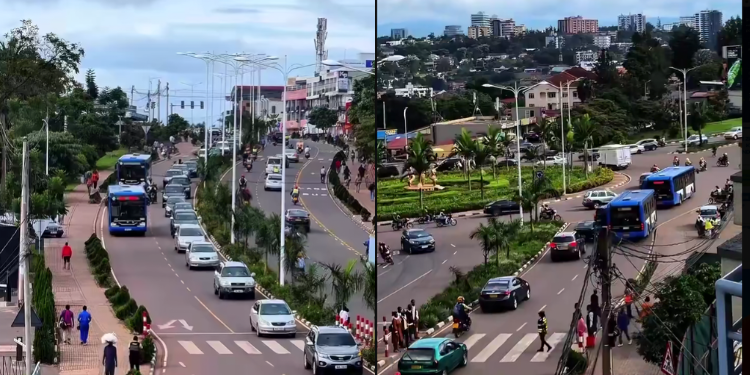
Kigali has rolled out a new system of continuous dedicated bus lanes on several major roads, marking a significant upgrade to public transport in the city.
The lanes became fully operational on Friday, April 24, 2026, marking a departure from earlier pilot projects that only gave buses short priority at junctions, roundabouts, and traffic lights.
The new system is designed to make public transport faster, more reliable, and more attractive during peak hours, while easing congestion across the city, and it is part of the transport reforms being implemented by the state‑owned company Ecofleet Solutions.
By April 27 and April 28, the City of Kigali said buses were moving more smoothly and predictably, describing the change as a step toward a more modern, organized, and people-centered transport system.
Kigali Maps Out Four Priority Corridors for New Bus Lanes
In the first phase of the rollout, Kigali has introduced dedicated bus lanes on four of the city’s busiest transport corridors, covering routes that link major residential neighborhoods, business districts, and key transport hubs:
- Downtown to Remera, via Payage, Kanogo, Rwandex, and Sonatube, continuing toward Cyamitsingi/Giporoso.
- Sonatube to Kicukiro Centre, extending to Nyanza Bus Park.
- Downtown to Nyabugogo Bus Park, passing through the City Centre Roundabout and the former 1930 Prison/Yamaha area.
- Hotel Gloria and City Plaza area to Downtown, via Quartier Commercial and Nyarugenge Market.
These corridors were selected because of their heavy traffic during peak hours and their importance to daily commuting across the city.
Also Read: Kenya Mortgage Refinance Company Plc Rolls Out Second Tranche Issuance
How the Bus Lanes Work
The dedicated bus lanes are time‑restricted, operating only during peak traffic periods:
- Morning: 6:00 a.m. to 10:00 a.m.
- Evening: 5:00 p.m. to 9:00 p.m.
Outside these hours, the lanes are open to general traffic and operate like normal road lanes.
During operating hours, the lanes are reserved mainly for public buses and high‑occupancy vehicles carrying at least 8 passengers, as well as emergency and other priority vehicles. The approach is intended to move more people using fewer vehicles and to encourage carpooling.
Clear road markings, signage, and, in some locations, traffic‑light priority help guide road users and ensure buses can move without interruption. Rwanda National Police have been supporting the rollout through monitoring and public education as drivers adjust to the new system.
Faster Bus Movement and Better Scheduling Transform Peak‑Hour Travel
The dedicated lanes are being introduced alongside major operational changes to the Kigali bus system.
Under Ecofleet Solutions, buses now run on fixed departure schedules, replacing the previous practice of waiting until they were full before leaving.
On the affected routes, buses now operate every 5 minutes during peak hours and approximately every 15 minutes during off-peak periods, significantly reducing waiting times for commuters.
Also Read: Law, Nursing Among 10 Most Sought-After Degree Courses in Kenya
Kigali also deployed 20 new electric buses on the same corridors when the lanes launched on April 24.
The plan is to expand the electric fleet to around 50 buses by May 2026, reach about 190 buses by the end of 2026, and grow to roughly 300 buses by June 2027.
The aim is to build a strong, largely state‑owned fleet while reducing reliance on private operators.
Public transport usage has already risen by 30 percent following earlier reforms introduced in late 2025.
Feedback as Commuters Adjust to New Bus Lanes
City of Kigali spokesperson Emma Claudine has actively engaged with residents online, responding to questions about how the lanes work, including their operation on weekends and holidays for now, and indicating that clearer route information will continue to be shared as the system stabilizes.
In a statement on April 28, Emma Claudine said the early impact of the new bus lanes was already visible, noting that buses are moving faster and traffic across the city is flowing more smoothly.
Emma recognized the changes as a sign of a modern, organized, and people-centered Kigali, adding that the rollout marks only the beginning, with more bus lanes and continued improvements to public transport expected in the coming months.
A video seen by The Kenya Times shows buses moving smoothly in their dedicated lanes, while general traffic flows as usual alongside them.
Users have praised the faster bus journeys and compared the system favorably with other regional cities where similar projects have faced long delays.
One user, Allan, responding to the post, wrote: “Rwanda seems to get it right all the time.”When the software of leadership is configured right, everyone feels heard, seen, and accommodated. Another example of proactive problem-solving that prioritizes the needs of Rwandans.”