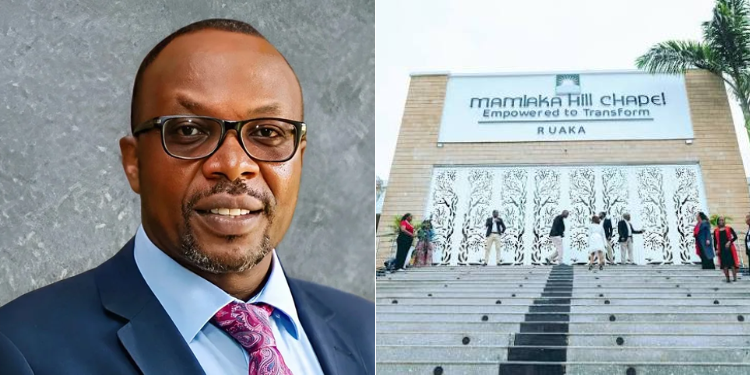

The government is considering a major overhaul of higher education financing that would see a shift from direct budgetary support for universities and TVET institutions to a system of government-guaranteed student loans.
Speaking at the 49th Annual Conference of the Kenya Secondary School Heads Association (KESSHA), economist and presidential adviser David Ndii said the current model of financing tertiary education is becoming increasingly unsustainable due to the rapidly growing number of students seeking higher education.
David Ndii Reveals Plan to Replace University and TVET Funding With Guaranteed Student Loans
Under the proposed model, banks and other financial institutions would provide loans to students pursuing university and TVET education, while the government would guarantee the loans and implement mechanisms to recover the funds once graduates begin earning income.
“Our thinking, and indeed the work we are already undertaking, is that the solution is to enable every student who pursues tertiary education to access financing as an entitlement. However, the money must be repaid,” Ndii said.
“We need to move from direct budget financing to a system where the government guarantees student loans. Under this arrangement, financial institutions would provide financing to students, while the government would guarantee repayment and ensure that the money is eventually recovered,” he added.
Ndii argued that the government is well placed to recover the loans because the vast majority of beneficiaries—about 95 percent—will remain in the country after completing their studies.
“We believe they will either secure employment or create employment for themselves and earn an income. Therefore, we should be able to trace them and recover the loans,” he said.
Also Read: Ruto Defends Education Budget, Cites South Korea and Japan
He further argued that removing university and TVET funding from the national budget would create fiscal space and preserve resources that could be redirected to other priorities, particularly the growing demand for secondary education.
The proposal comes amid mounting concerns over the rising cost of financing higher education and the growing number of students seeking tertiary education.
According to Ndii, the government spent about Ksh600 billion on education last year, while households contributed another Ksh300 billion, underscoring the increasing burden on both taxpayers and families.
He noted that household spending on education has tripled, while overall spending has doubled.
Tertiary Enrolment Surge to Push Financing Needs Higher
Kenya is also projected to witness a sharp rise in tertiary education enrolment in the coming years.
By 2030, the country is expected to have about 600,000 students in universities and another 600,000 in Technical and Vocational Education and Training (TVET) institutions, bringing the total to around 1.2 million learners.
Beyond 2030, the number of students in tertiary education is projected to rise to about two million, significantly increasing the demand for financing.
The public financing requirement for tertiary education is projected to reach about KSh140 billion and could nearly double to KSh230 billion within the next four to five years.
Also Read: More Students Choose Medicine, ICT and Education Courses as University Enrollment Hits 670,000
Why Govt Wants University and TVET Funding Shifted to Student Loans
Ndii warned that government revenues and household incomes are not growing at the same pace as education costs, meaning education spending will continue to take up a larger share of both public and private resources.
He argued that the current financing model is unsustainable and could eventually crowd out spending on other government priorities if left unchanged.
The economist further maintained that higher education should be viewed as an investment with substantial private returns, making it suitable for financing through credit markets rather than relying entirely on taxpayer funding.
He said moving university and TVET financing away from direct budgetary support would create additional fiscal space and free up billions of shillings for other priorities, including accommodating the growing number of students entering secondary schools.
Ndii also cautioned that increasing access to higher education without creating enough jobs for graduates could pose significant social and economic risks.
Education Budget
In the 2026/27 budget, the education sector remained the largest beneficiary, with Ksh781.4 billion allocated to basic, tertiary, and university education programmes.
Of this amount, Ksh4.9 billion has been set aside to convert 20,000 intern teachers to permanent and pensionable terms.
Higher education has also received a significant boost, with Ksh56.7 billion allocated to the Higher Education Loans Board (HELB) to support access to university education for needy students.
Follow our WhatsApp Channel and X Account for real-time news updates.