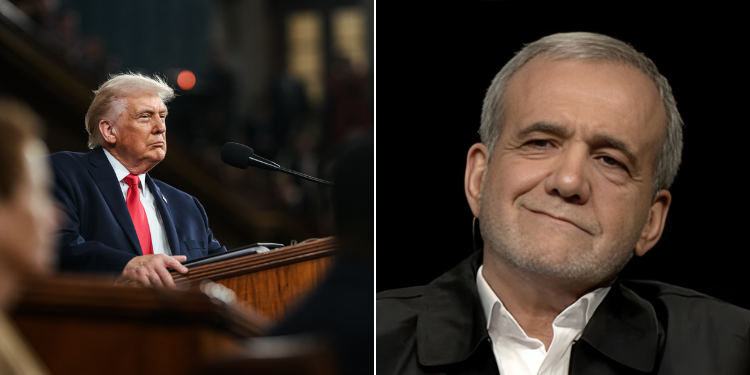
Iran rejected President Donald Trump’s assertion Tuesday that it had agreed to comprehensive nuclear inspections, exposing immediate friction in the memorandum of understanding signed last week between the two countries.
Trump said Iran “fully and completely” consented to high-level IAEA access at sites damaged by prior U.S. and Israeli strikes.
He added there was “no rush” for inspectors to return. Vice President JD Vance had stated Monday that inspectors could arrive as soon as this week.
Iran’s Foreign Ministry spokesman Esmaeil Baqaei said there were no plans for IAEA teams to inspect the bombed enrichment facilities, including the Isfahan site believed to hold roughly 900 pounds of uranium enriched to 60 percent purity.
“We have not had a meeting with the director general of the International Atomic Energy Agency, nor do we have any plans for the agency to inspect Iran’s nuclear facilities damaged by the U.S. and Zionist military aggression,” Baqaei told reporters in Tehran.
The dispute centers on the first round of direct talks held in Switzerland on Sunday. Technical discussions concluded with plans for four working groups covering sanctions relief, nuclear affairs, reconstruction, and implementation monitoring.
Iran insists nuclear negotiations cannot begin until other commitments, particularly a full halt to hostilities, are met.
Also Read: Panic in Tehran as Iran Reaches Out to Trump During Heavy U.S. Missile Strikes
Lebanon Ceasefire Tested by Ground Incidents
Tensions on the ground in Lebanon further complicated the agreement, which calls for permanent termination of military operations on all fronts, including Lebanon.
The Israeli military reported two separate incidents Tuesday in southern Lebanon. In one, Israeli forces killed two “armed terrorists” north of the security zone.
In the second, troops fired on four Hezbollah members approaching on a bulldozer and motorcycle. Lebanon’s civil defense reported two killed and one wounded in related strikes.
Lebanese President Joseph Aoun told Israeli officials his government would accept “nothing less” than full Israeli withdrawal from the roughly six-mile-deep security zone along the border.
Aoun held a call with Vance and Secretary of State Marco Rubio on Tuesday to discuss a proposed joint U.S.-Lebanon-Iran cell to monitor the ceasefire. U.S. officials said arrangements for the cell remain under review.
At least 4,192 people have been killed and 12,171 wounded in Lebanon since the Israel-Hezbollah war began in March, according to the Lebanese Ministry of Health. Some 1.2 million have been displaced.
Control of Strait of Hormuz Remains Contentious
Iran made clear it intends to maintain dominance over the Strait of Hormuz, the narrow waterway through which about one-fifth of global oil and gas exports normally pass.
Also Read: U.S.-Iran Negotiations Resume as JD Vance Meets Senior Iranian Officials
Chief negotiator Mohammad Bagher Ghalibaf said the strait “will never return to its pre-war conditions” and will be administered by Iran in line with international law.
Joint statements with Oman indicated future management services would involve “costs associated” for commercial shipping.
Maritime data showed Monday recorded the highest number of transits since the war started, with at least 35 vessels crossing, still only about one-third of normal volume.
The United Nations’ International Maritime Organization announced plans to evacuate more than 11,000 stranded sailors from the Persian Gulf in coordination with Iran, Oman, and other parties.
Sanctions, Assets and Domestic Pushback
Trump posted on Truth Social that any released Iranian assets would be used exclusively to purchase U.S. food and medical supplies from American producers. Iran dismissed that claim. Foreign ministry officials said Tehran alone would decide how to spend unfrozen funds based on price and quality, with no external oversight.
Iranian President Masoud Pezeshkian, visiting Pakistan on Tuesday, pushed for a “new regional security architecture” among Islamic nations and defended Iran’s missile program. “If it was not for Iran’s missile capabilities, our country would have been plundered and destroyed,” he said.