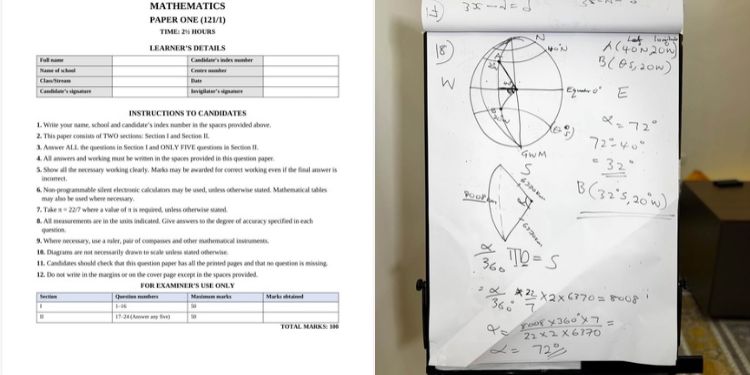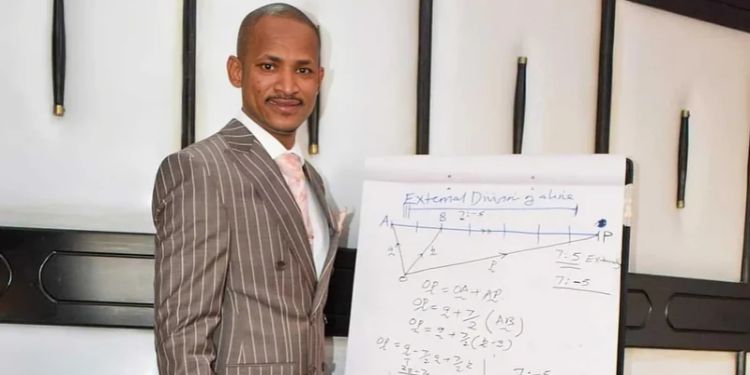
Embakasi East Member of Parliament Babu Owino has defended his KCSE revision lessons amid concerns that some politicians could be accessing examination papers and later presenting the questions as predictions.
Owino maintained that 90 percent of the topics covered in his free online revision sessions appeared in the 2026 Kenya Certificate of Secondary Education (KCSE) examinations, adding that his predictions were 90 percent accurate.
“90% of what we revised was tested, and our predictions were 90% accurate. If you followed everything I taught you, you should get an A plain, even without attending a single class. Preparation pays!” Babu Owino stated on November 4.
Former Nairobi County Chief Officer Geoffrey Mosiria raised concerns over alleged access to examination papers by politicians.
Mosiria called on the Ministry of Education to stop examination leakages, saying it was disturbing that some politicians allegedly accessed and revised the same papers used to assess students before claiming to have predicted the questions.
In response, Owino defended his KCSE prediction, calling out Mosiria for the inability to understand how predictions work during his revision sessions.
“I know you have ice cream brain cells that melt under pressure. No wonder you struggle to understand predictions,” Babu responded to Mosiria’s allegations.
Online Revision Ahead of 2026 KCSE
On October 23, 2026, Owino announced a free online Mathematics revision session for KCSE candidates.
Revision for the candidates started on October 25 at 7:30 pm for lessons covering Mathematics Paper 1 and Paper 2.
The sessions formed part of his continued efforts to offer free academic support through online platforms, particularly in Mathematics and Chemistry.
His revision lessons have covered topics including algebra, matrices, differentiation, binomial expansion, trigonometry, logarithms, and Chemistry practicals.
Owino’s online teaching initiative dates back to 2020, when school closures during the COVID-19 pandemic disrupted learning across the country.
Also Read: KCSE 2026: Reasons KNEC May Withhold Candidates’ Results
Robert Alai Questions Examination Predictions
Nairobi politician Robert Alai also questioned whether politicians sharing examination predictions online were any different from schools purchasing examination papers.
“What’s the difference between this and schools purchasing exams? We now might just have politicians getting access to exams and then sharing with everyone online,” Alai stated.
He also questioned whether a single examination should determine a student’s future, suggesting that a learner’s performance throughout their school years should be considered.
Owino hit back at Alai, suggesting that the difference between them lay in their intellectual abilities rather than their public statements.
Mixed Reactions to Babu Owino’s KCSE Predictions
Many social media users have defended Babu Owino’s revision sessions and dismissed claims of examination leakage.
Some argued that experienced teachers could predict likely Mathematics questions by studying the syllabus and repetitive examination patterns in topics such as matrices, navigation, circles, and profit and loss.
Others maintained that teaching students how to tackle examination questions was different from accessing confidential papers before the tests.
Several users also praised the MP for offering free lessons, while others turned the debate into politics and targeted his critics.
However, some commenters questioned how Owino could achieve such high prediction accuracy, saying the claims warranted scrutiny.
Also Read: KCSE 2026: Number of Candidates Who Have Died Rises as CS Ogamba Gives Update
Penalties for KCSE Examination Leakage
The Kenya National Examinations Council (KNEC) Act provides for criminal penalties for people found guilty of examination-related offences, including unauthorised possession or disclosure of examination papers.
Under Section 27 of the Act, a person found guilty of unlawfully possessing examination papers or information about their contents can face a prison term of up to 10 years, a fine of up to KSh2 million, or both.
Section 28 provides for a prison term of up to five years, a fine of up to KSh1 million, or both, for offences including unlawfully disclosing examination questions.
KNEC can also take administrative action against candidates involved in examination irregularities, including canceling affected results or withholding them pending investigations.
Follow our WhatsApp Channel and X Account for real-time news updates and subscribe to our YouTube Channel for in-depth interviews.