The Central Intelligence Agency (CIA) station in Saudi Arabia was reportedly hit by a suspected Iranian drone strike amid an escalation in Iran’s targeting of U.S. facilities across the Middle East. According to a report by The Washington Post, the station is located inside the U.S. Embassy complex in Riyadh.
The report, by Ellen Nakashima and John Hudson, cited sources who said the CIA’s station was struck during the Monday, March 2, drone attack on the U.S. diplomatic compound in Saudi Arabia.
The Post reported that the U.S. and Saudi governments confirmed that two drones hit the U.S. Embassy complex in Riyadh but did not publicly disclose that the CIA station inside the compound had been struck.
According to an internal State Department alert obtained by The Post, the attack “collapsed” part of the embassy’s roof and “contaminated” the interior with smoke.
The notice said the embassy sustained “structural damage” and that personnel “continue to shelter in place.” No casualty figures were disclosed in the report.
U.S. Embassy closures across the region
The reported strike in Riyadh comes as U.S. diplomatic missions across the Middle East face drone attacks amid escalating conflict between Iran, the United States, and Israel.
U.S. embassies in Saudi Arabia, Kuwait, and Beirut were shut as drone attacks unfolded across the region. The United States also urged Americans in the area to “DEPART NOW!” and ordered nonemergency personnel in six Gulf states to leave.
Also Read: Tensions Escalate as UAE Declares ‘Full Right’ to Respond After Iranian Attack
Secretary of State Marco Rubio said Tuesday, March 3, that approximately 9,000 Americans have evacuated the Middle East since the start of U.S.-Israeli strikes on Iran. He said approximately 1,500 Americans are still requesting assistance with departure.
“We have identified and continue to identify charter flights, military flight options, and expanded commercial flight options,” the secretary said.
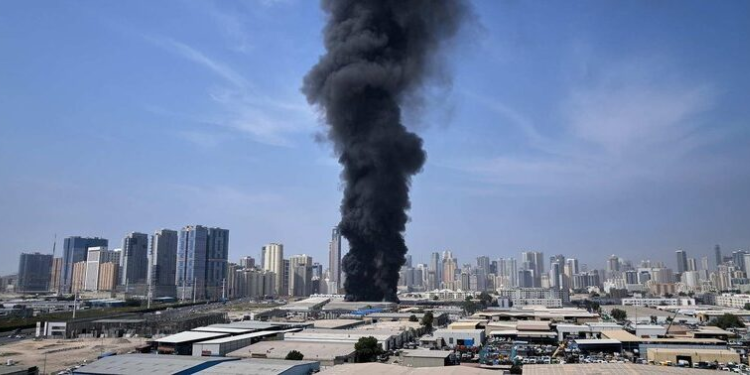
In the United Arab Emirates, a drone struck near the U.S. consulate in Dubai. Secretary Rubio told reporters that a drone hit a parking lot adjacent to the chancellery building.
The strike “set off a fire in that place,” Rubio said, adding that “All personnel are accounted for.”
Dubai’s government media office said authorities extinguished a fire resulting from a drone-related incident near the U.S. Consulate and confirmed that no injuries were reported. In a follow-up statement, officials said the fire had been fully extinguished.
Iranian strike target Saudi Arabia, Kuwait and Qatar
Video shared on social media showed black smoke rising near the consulate. Iran’s state broadcaster IRIB reported that an Iranian drone had hit the U.S. consulate in Dubai.
In Saudi Arabia, the Ministry of Defense said two drones struck the U.S. Embassy on Monday, resulting in a limited fire and minor material damage to the building. The embassy urged Americans in Jeddah, Riyadh, and Dhahran to shelter in place.
The U.S. Embassy in Kuwait announced Tuesday that it would be closed “until further notice.”
On March 4, Qatar announced that two ballistic missiles had been launched at it from Iran. One missile was intercepted, while the other struck the Al Udeid airbase, which hosts US forces.
The Defence Ministry announcement comes after a series of blasts were heard near the capital Doha several hours ago.
“Our armed forces possess full capabilities to protect and preserve the sovereignty of the state and its territory, and to firmly confront any threat,” it said in a statement.
Qatar’s security agencies have since arrested two cells of operatives associated with the Iran’s Revolutionary Guards, according to the state-run Qatar News Agency.
These are the first known arrests of this kind in Qatar since Israel and the U.S. launched their bombing campaign against Iran on Saturday, February 28, and since Iran responded by attacking its Gulf neighbors with missiles and drones.
Military escalation
The reported strike on the CIA station comes as the Israeli military said its forces are operating on the ground in neighboring Lebanon and would “advance and seize additional” territory as part of its campaign against the Iran-backed Hezbollah militant group. Israel has also launched new airstrikes on Beirut and Tehran.
President Donald Trump earlier this week said the conflict could last weeks and noted that wars can be fought “forever” with America’s stock of munitions.
On his part, Department of War Secretary Pete Hegseth has stated that the conflict would not be “endless.”
A source familiar with the campaign told NBC News that U.S. operations would unfold in phases, beginning at the edge of the country and moving inward.
According to figures released by Iranian authorities and regional reporting, hundreds have died across the Middle East.
Iran’s Red Crescent said nearly 800 people were killed in Israeli and American strikes. Six U.S. service members have died in action, and 11 people were killed in Israel as Iran fired missiles in retaliation.
Naval preparations
Amid the conflict, stock futures have fallen, and energy prices have surged amid fears of prolonged disruption.
Oil prices rose after Iran announced the closure of the Strait of Hormuz, a major maritime route linking the Persian Gulf, Gulf of Oman, and Arabian Sea.
Also Read: US Navy Ready to Escort Tankers Through Key Oil Shipping Route After Iran Warning
Iranian Revolutionary Guards senior official General Sardar Jabbari said the strait was closed and warned that Iran would fire on ships attempting to pass as reported by Iranian media.
“We will burn any ship that tries to pass through the Strait of Hormuz.”
He also warned that Iran would attack oil pipelines and prevent exports from leaving the region.
In response, Trump on Tuesday ordered the United States International Development Finance Corporation (DFC) to provide political risk insurance and financial guarantees for maritime trade traveling through the Gulf.
“Effective immediately,” Trump wrote on Truth Social, the DFC would provide insurance and guarantees for “all maritime trade, especially energy.”
He added that, if necessary, the U.S. Navy would begin escorting tankers through the Strait of Hormuz “as soon as possible.”
Follow our WhatsApp Channel and X Account for real-time news updates.