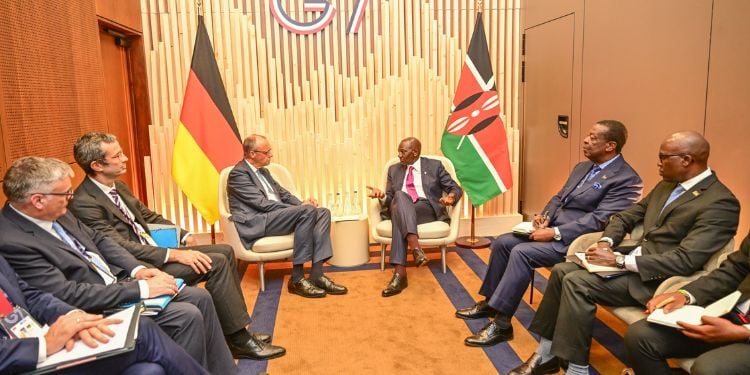
President William Ruto joined fellow world leaders in France on June 16 as the G7 Summit endorsed three new declarations, a development that could shape Kenya’s international cooperation with global partners on a range of cross-border issues.
The declarations were adopted following high-level discussions involving G7 member states and invited partner countries, including Kenya. Their endorsement signals a renewed commitment to coordinated action on emerging global challenges affecting multiple regions.
Ruto’s participation in the summit placed Kenya among countries contributing to conversations on international policy, security and economic cooperation.
G7 Leaders’ Declaration on the Tackling Migrant Smuggling
The G7 Leaders, during the meeting, set out joint actions to prevent and dismantle criminal networks involved in migrant smuggling and human trafficking.
According to the issued statement, Kenya is listed among the partner countries supporting the declaration, alongside the Republic of Korea.
“Partner countries of the G7, Kenya and the Republic of Korea, also support this declaration,” the statement confirmed.
The declaration described migrant smuggling and human trafficking as serious cross-border crimes that expose migrants, including refugees and displaced persons, to dangerous conditions and undermine state control of borders, emphasizing protection of vulnerable groups.
It noted that member states committed to strengthening action under the G7 plan to prevent and counter migrant smuggling, including coordinated efforts with partner countries such as Kenya to dismantle criminal networks and disrupt their operations.
Further, the declaration supported targeted sanctions and cooperation with online platforms to detect and remove content linked to smuggling, while also calling for cooperation with countries of origin and transit and safe, dignified return processes for migrants without legal status.
Fight Against Drug Trafficking
Also Read: Trump Spotted with New Mark on Hand During G7 Summit, Fueling Online Buzz
The G7 Leaders’ Declaration on the Fight Against Drug Trafficking set out a joint commitment to intensify global action against drug trafficking, with Brazil and the Republic of Korea listed as supporting partner countries.
The statement noted that drug trafficking had increased due to higher production, adaptable criminal networks and rising global demand, posing a growing threat to security, governance and economies through corruption and violence.
“These sophisticated illegal networks recognize no borders. They exploit international vulnerabilities – siphoning vital resources from our economies and weakening the democratic institutions upon which our free societies depend,” the release read.
It stated that G7 members agreed to strengthen coordinated efforts to disrupt trafficking networks, improve investigations and prosecutions, and reinforce anti-money laundering systems in line with international standards.
It further highlighted plans to enhance maritime and port security and establish a G7+ Ports Network to improve cooperation and information sharing against drug and precursor chemical trafficking, with implementation targeted for November 2026.
Also Read: Why President Ruto Is Representing Africa at the G7 Summit
Leaders Back Ukraine, Middle East Diplomacy and Indo-Pacific Security
The G7 Leaders’ Statement on Geopolitical Issues reaffirmed unified support for Ukraine, with commitments to increase air defense systems, strengthen sanctions on Russia, and support Ukraine’s energy needs ahead of winter.
On the Middle East, leaders welcomed a reported US–Iran deal and said it offered an opportunity to address nuclear and regional security concerns. They backed efforts to secure maritime stability in the Strait of Hormuz and supported diplomatic follow-up talks aimed at preventing Iran from acquiring nuclear weapons.
The statement also addressed Lebanon and Gaza, calling for a ceasefire, reconstruction efforts and measures to restore stability, while urging an end to violence in the West Bank. It further emphasized the need to protect international shipping routes and reduce energy supply risks linked to the Strait of Hormuz.
On the Indo-Pacific, the G7 reiterated support for a free and open region, opposed unilateral changes to the status quo, raised concerns over North Korea’s nuclear program and cyber activities, and called for continued cooperation on global economic and security issues.
Follow our WhatsApp Channel and X Account for real-time news updates.
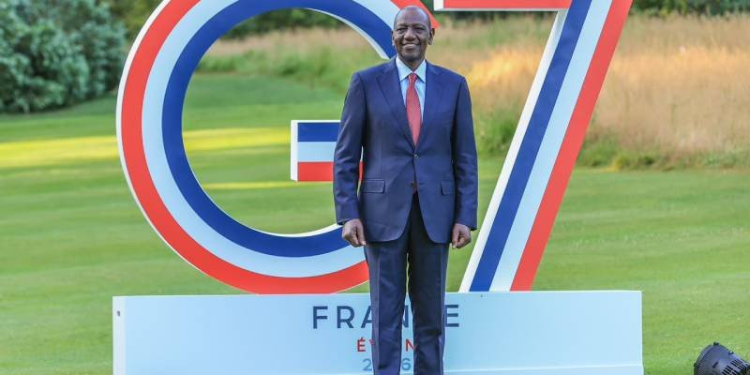
President William Ruto attending the G7 summit in France on June 16, 2026/PCS