
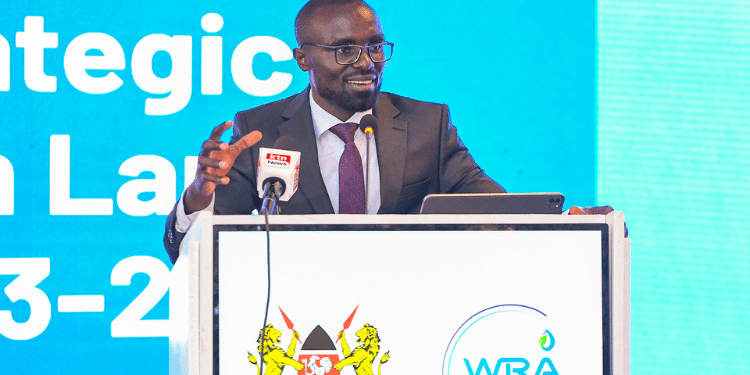
The government has proposed sweeping changes to Kenya’s water sector, merging the National Water Harvesting and Storage Authority with the National Irrigation Authority to streamline operations and eliminate overlapping mandates.
The proposal is in the Water (Amendment) Bill, 2026, which Parliament has published for consideration.
If approved, the legislation will effectively bring to an end the existence of the National Water Harvesting and Storage Authority as a standalone state agency, with its functions transferred to the National Irrigation Authority.
The government says the merger is intended to harmonize the responsibilities of the two institutions and improve the efficiency of water storage and harvesting across the country.
The proposed law seeks to amend the Water Act by deleting provisions that establish and govern the National Water Harvesting and Storage Authority.
Govt Proposes Merger of Water Agencies as Authority Faces Abolition
The changes include removing references to the “Water Storage Authority” and “Water Storage Board” from the Act.
The Bill also proposes deleting the section of the law dedicated to the National Water Harvesting and Storage Authority.
Also Read: Kenya School of Law Opens 2027 ATP Intake With 3 Routes for Law Graduates
Under the Bill, Sections 30, 31, 32, 33, 34 and 35 of the Water Act would be repealed.
These provisions currently provide the legal framework for the establishment, governance, and operations of the National Water Harvesting and Storage Authority.
Their repeal would pave the way for the transfer of the authority’s responsibilities to the National Irrigation Authority.
According to the memorandum accompanying the Bill, the principal objective is to enhance the efficiency of water storage and harvesting in Kenya.
The government argues that consolidating the functions of the two agencies under a single institution will improve coordination and management of water infrastructure projects while reducing duplication of roles.
The proposed merger comes as the country invests heavily in irrigation schemes, dams and water harvesting projects to boost food production, strengthen climate resilience and improve access to water.
If enacted, the changes would mark one of the most significant institutional restructurings in Kenya’s water sector in recent years.
The proposed restructuring comes as the government continues to make appointments to institutions that could be affected by the reforms.
In a notice published in the latest Kenya Gazette, Eric Murithi Mugaa, the Cabinet Secretary for Water, Sanitation and Irrigation, appointed Lilian Anyango Yonga as a member of the National Water Harvesting and Storage Authority for a three-year term effective September 18, 2026.
The Cabinet Secretary also appointed Silas Tochim as a member of the Governing Council of the Kenya Water Institute for a three-year term.
Staff Restructuring Worries
The proposed merger has raised concerns about the future of employees at the National Water Harvesting and Storage Authority, with workers facing uncertainty over their roles, reporting structures and long-term job security if the reforms are approved.
Also Read: Kenyan Missing Man Found After Trekking 750km From Kiambu to Turkana
The merger would bring the authority together with the National Irrigation Authority under a single institution, a move that could trigger organizational restructuring as overlapping functions are reviewed.
Although the proposed legislation provides for the transfer of employees to the successor agency, questions remain over how positions will be aligned, whether some roles could become redundant and what the new staffing structure will look like.
Similar state corporation mergers in the past have been accompanied by redeployments, reviews of organizational structures and changes in reporting lines.
The uncertainty is particularly significant because the Bill seeks to repeal the legal provisions establishing the National Water Harvesting and Storage Authority, including provisions relating to its governance and employment framework.
This has fuelled concerns among workers about how the transition will affect their careers once the authority ceases to exist as an independent entity.
Follow our WhatsApp Channel and X Account for real-time news updates.