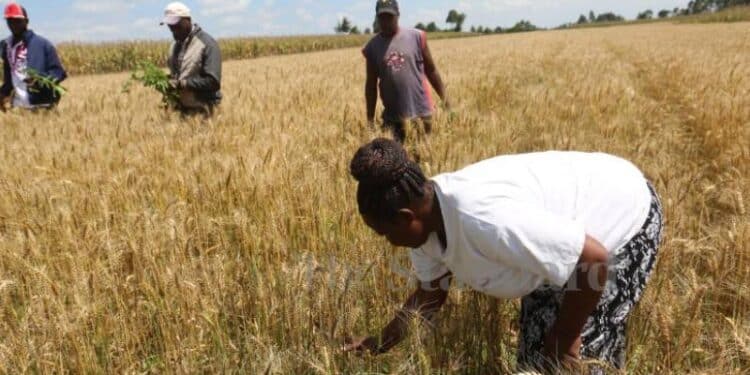
Wheat farmers across Kenya are set to benefit from higher earnings after the government increased the producer price of locally grown wheat.
In a press release dated August 7, the Ministry of Agriculture and Livestock Development announced a price increment from KSh 4,750 to KSh 5,100 per 90-kilogram bag.
According to the Cabinet Secretary of the Ministry of Agriculture and Livestock Development, Mutahi Kagwe, the buying price of wheat will improve profitability for local farmers and support the government’s goal of reducing dependence on imported grain.
“The government has approved a producer price of KSh 5,100 per 90-kilogram bag for locally produced wheat for the 2026 season, up from KSh 4,750 last year,” the press release stated.
Further, Mutahi Kagwe emphasized that the new price was agreed upon following consultations involving the Agriculture and Food Authority (AFA), the Cereal Growers Association (CGA), wheat farmers, and cereal millers.
The new producer price partly reverses the decline in the previous season when the minimum price was reduced to KSh 4,750 per bag from KSh 5,300 per bag during the 2024/25 season.
More than 2,000 wheat farmers from Narok, Nakuru, Meru, Laikipia, Nyandarua, Uasin Gishu, among other wheat-growing counties, are set to benefit from the price increase.
Also Read: Russia’s Delo Group Eyes Oman Grain Hub to Supply Kenya’s Wheat Markets
Government on Local Wheat Farmers
In addition to raising the buying price, CS Mutahi Kagwe announced that the government has already commenced the annual wheat mop-up exercise ahead of wheat importation.
Through the government exercise locally, harvested wheat will be purchased before imported grain is allowed into the market, providing farmers with a guaranteed market for their produce.
According to the ministry, Kenya is projected to harvest about one million 90-kilogram bags this season compared to approximately 1.7 million bags in the previous season.
Wheat production growth in the 2026 season is currently projected at about 5 percent compared to the earlier 10 percent government projection, according to Mutahi Kagwe.
The Ministry of Agriculture and Livestock Development has also set measures to maintain affordable consumer prices while maximizing the profit from wheat sales.
Among the measures are expansion of crop-specific fertilizer subsidies to both small-scale and large-scale wheat farmers.
Additionally, the ministry is planning to accelerate research and disseminate high-yielding and climate-resilient wheat varieties through the KALRO and private seed companies.
Further, the ministry will promote land commercialization initiatives, particularly in Laikipia, to promote climate-smart agriculture.
Also Read: Why Sukuma Wiki Prices Could Drop Even as Flour and Sugar Costs Rise
Wheat Prices 2024/2025 Season
In July 2025, the Agriculture and Food Authority (AFA) concluded a review of the Wheat Purchase Program (WPP) for the 2024/2025 season. It announced new import quotas and grading guidelines for the 2025/2026 period.
“Minimum prices have been determined based on a study of the average cost of production, an established pricing formula and negotiations. The goal is to offer farmers fair compensation and encourage increased production,” read part of the AFA statement.
Following the AFA review, minimum wheat prices for the 2025/2026 season were set, with grade 1 wheat that has a bushel weight of 78 and above priced at KSh 4,450 per 90 kg bag.
Grade 2 wheat price was set at KSh 4,650, while the price for grade 3 was set to be determined through the seller-buyer agreement.
Additionally, the AFA set rules on the allocation of wheat import quotas under the Duty Remission Scheme (DRS).
Follow our WhatsApp Channel and X Account for real-time news updates.