

The graduation of over 3,000 students from Matili Technical Training Institute (TTI) in Bungoma County has spotlighted the government’s intensifying policy focus on Technical and Vocational Education and Training (TVET) as a cornerstone of Kenya’s economic transformation.
Beyond the ceremony, the event reflects a broader shift in policy, one that places skills development, industry alignment, and workforce readiness at the centre of national planning under the Bottom-Up Economic Transformation Agenda (BETA).
Deputy President Kithure Kindiki, who is spearheading TVET reforms, has outlined an ambitious expansion plan aimed at increasing enrolment to one million trainees by 2026 and two million by 2027.
The strategy includes building at least one vocational training centre in every constituency, recruiting 5,800 additional trainers, and rolling out Competency-Based Education and Training (CBET) across institutions.
Speaking at a previous function, Kindiki underscored the importance of aligning training with real-world demands.
“We must build a generation that values excellence and integrity. These are the foundations that will define Kenya’s future workforce,” he said.
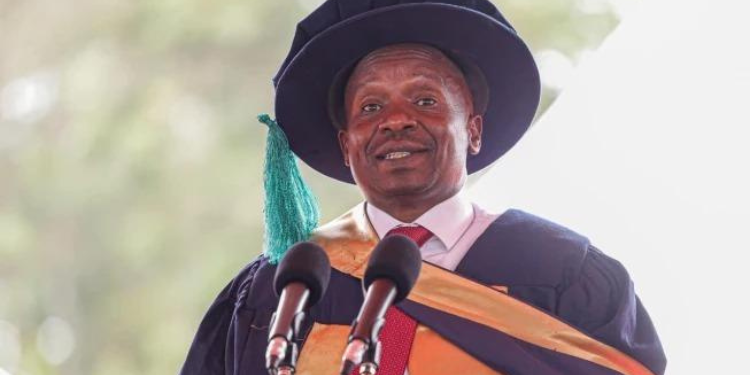
A key pillar of the reforms is the introduction of a dual training system that integrates classroom learning with industry exposure, ensuring that graduates leave institutions with practical, job-ready skills.
Interior Cabinet Secretary Kipchumba Murkomen, speaking at the graduation, said the government’s focus on TVET is anchored in a long-standing commitment to skills development.

“It is something that is personal and dear to the Head of State as it is very close to his heart,” he said.
Murkomen noted that the reforms go beyond increasing enrolment, focusing instead on transforming how education prepares young people for life and work.
“This education is just not about papers. It starts by first liking your job for you to be able to do your job,” he said.
He further emphasised the need for integrity and professionalism in technical fields, warning that poor workmanship could have serious consequences.
“Your job has integrity, you will be entrusted with jobs that people’s lives depend on,” he said.
At the policy level, the government is also undertaking curriculum reviews to align TVET programmes with dynamic labour market needs, both locally and internationally.
Principal Secretary for TVET Esther Muoria said the reforms are designed to empower graduates to thrive beyond the classroom.
“The expectation of you is to go there and prosper. I wish you every success as you step into your next phase. Go out, work hard and be busy, volunteer, God words with busy people,” she said.
“Work hard, be disciplined and work tirelessly, as you step into this new phase,” she added.
The impact of these policy shifts is already visible. Enrolment in TVET institutions has grown from 297,000 trainees in 2022 to 718,000 in 2025, representing a 142 per cent increase.
This surge has been driven by an aggressive outreach campaign, as well as expanded access through the Kenya Universities and Colleges Central Placement Service (KUCCPS) and Higher Education Loans Board (HELB). financing.
At the same time, the number of trainers has increased from 6,000 to 9,500, while national polytechnics have tripled from 10 to 30, significantly enhancing institutional capacity.
The government is also encouraging institutions to commercialise their production units, allowing students to gain hands-on experience while generating income to sustain training programmes.
As Matili TTI graduates thousands into the workforce, its growing stature has intensified calls for its elevation to national polytechnic status, an upgrade that would align with the government’s broader policy direction of expanding high-quality technical training institutions across the country.
The graduation, therefore, is not just an academic milestone, but a reflection of a deliberate policy shift, one that seeks to redefine education as a tool for productivity, innovation, and inclusive economic growth.