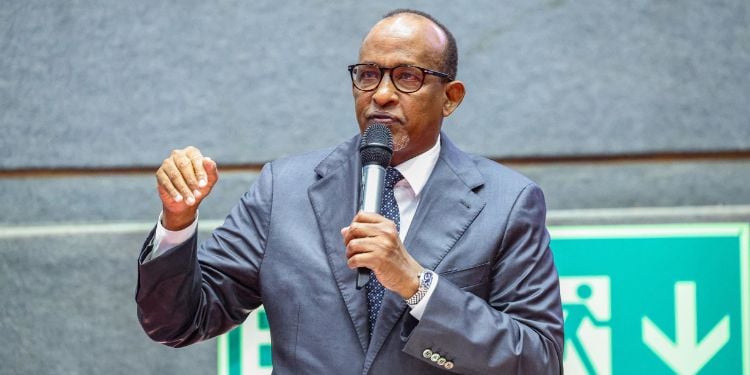
The Ministry of Health has confirmed Kenya’s first imported case of Ebola, Health Cabinet Secretary Aden Duale has said.
In a statement on Tuesday, October 6, 2026, Duale said the patient is a Kenyan citizen who has lived in the Democratic Republic of Congo (DRC) for the past seven years.
According to Duale, the patient fell ill about a month ago and received treatment at several hospitals while still in the DRC.
He later traveled from the DRC to Kampala by road before boarding a Jambojet flight to Nairobi.
“The Ministry of Health, Kenya wishes to inform members of the public that it has confirmed the first imported case of Ebola, Bundibugyo virus disease. This patient is a Kenyan citizen who has been living in DRC for the past seven years. He fell ill about a month ago and was treated in several hospitals while still in DRC,” stated Duale.
Ebola Patient Dies After Isolation at Nairobi Hospital as Ministry Traces 28 Contacts
Duale said the patient arrived at Jomo Kenyatta International Airport (JKIA) on Saturday, October 3, 2026, at 1:10 p.m., where he underwent the normal public health screening at the Port Health facility.
Also Read: Duale Breaks Silence on Ebola-Exposed Americans Being Quarantined in Kenya
The patient then passed through the immigration desk and was transported from JKIA directly to Nairobi Hospital by a relative and a friend.
At the hospital, staff quickly isolated him in a separate room in the Accident and Emergency area before transferring him to the East Wing Isolation Facility.
Duale said the isolation facility was constructed during the COVID-19 pandemic and is equipped with critical care infrastructure, including an Intensive Care Unit (ICU), a High Dependency Unit (HDU) and more than 145 beds.
The patient developed fever, chills, extreme fatigue, weakness, muscle pain, difficulty swallowing, and bleeding beneath the skin while receiving care at the isolation facility.
Duale said the symptoms, together with the patient’s travel history, initially led doctors to suspect a viral fever. Samples were collected and sent for laboratory testing, with the results later confirming Ebola infection.
The samples underwent testing at the National Virology Reference Laboratory, run by the National Public Health Institute, and at the Kenya Medical Research Institute (KEMRI). Both facilities confirmed that the patient had Ebola.
The patient was put on supportive treatment but died on Monday, October 5, at around 11:30 p.m.
Duale said preparations for the deceased’s safe and dignified burial were underway, with the burial expected to take place later on Tuesday, October 6, under Ebola-safe burial protocols.
The Ministry has identified 28 people who came into contact with the deceased, among them family members and healthcare workers who cared for him during his treatment.
“We are also pursuing a further 23 passengers and four crew members who were on the same flight with the deceased,” Duale added.
The Health Ministry is now planning a safe burial for the patient, with the ceremony scheduled for Tuesday, October 6, according to Duale.
Also Read: Duale Halts Construction of Nanyuki Ebola Facility
DRC Ebola Outbreak Fuels Regional Concern as Cases Surge
The current Ebola outbreak in the Democratic Republic of Congo (DRC) was officially declared on May 15, after laboratory testing confirmed Bundibugyo virus disease in Ituri Province.
The World Health Organization (WHO) had been alerted to an unexplained illness with high mortality in the Mongbwalu health zone on May 5.
WHO said the first known suspected case had developed symptoms on April 24 and the patient, a health worker, later died at a medical centre in Bunia. Investigations indicated that the outbreak was initially centred in Mongbwalu, a busy mining area in Ituri, before cases spread to neighbouring health zones.
The Bundibugyo virus, a species of Ebola, is causing the outbreak. WHO has described it as the largest Ebola outbreak ever recorded in the DRC, surpassing the 2018–2020 outbreak, which recorded 3,317 cases.
By September 23, the DRC had reported 7,890 confirmed cases and 3,799 deaths, with cases recorded across 63 health zones in seven provinces. Ituri remained the epicentre, accounting for 6,032 confirmed cases.
The outbreak also crossed into Uganda after authorities detected imported cases from the DRC in May. Uganda reported 20 cases and two deaths before declaring itself Ebola-free on July 28, following the completion of its response measures and the discharge of its last confirmed patient on June 16.
WHO has warned that the continued transmission in the DRC poses a risk of further cross-border spread, particularly because of population movement and trade between affected areas and neighbouring countries.
Follow our WhatsApp Channel and X Account for real-time news updates