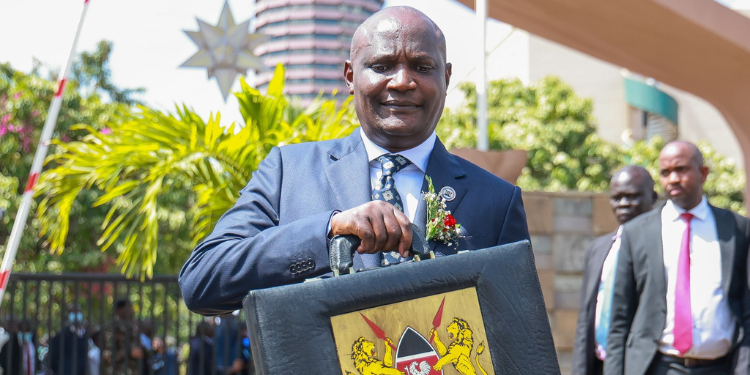
Kenya is set to face a challenging 2026 after President William Ruto’s government reduced the development budget by KSh9.6 billion.
The 2026/27 national budget, approved by Cabinet, totals KSh4.7 trillion, with projected revenues of KSh3.53 trillion.
Of the expenditure, KSh3.46 trillion is earmarked for recurrent spending, KSh749.5 billion for development, and KSh2 billion for the Contingency Fund.
Under the Division of Revenue Bill, 2026, county governments are set to receive KSh420 billion as their equitable share, representing 21.9 percent of the most recent audited revenue, while KSh15.2 billion is allocated to the Equalisation Fund.
An additional KSh75.7 billion is proposed under the County Governments Additional Allocation Bill, 2026, bringing total county transfers to KSh495.7 billion.
How Ruto’s Govt Seeks to Finance Developments
According to the 2026 Budgetary Policy, the government is now entering a more targeted phase of transformation, stressing the scaling of capital, talent, technology, and infrastructure.
Over the medium term, the government will focus on education and skills development, boosting exports of agricultural and manufactured goods, ensuring reliable energy, and improving transport and logistics to support trade and connectivity.
Also Read: Budget Cuts Threaten to Cripple Delivery in Key Govt Departments
To finance these initiatives, the government has approved the establishment of the National Infrastructure Fund and the Sovereign Wealth Fund, expected to mobilize KSh 5 trillion through domestic resources, asset monetization, and private sector participation, leveraging up to KSh 10 for every shilling invested.
“To sustainably finance this transformation agenda, the Government has approved the establishment of the National Infrastructure Fund and the Sovereign Wealth Fund,” read part of the statement.
Proceeds from privatization will be directed to food security, infrastructure expansion, and energy-driven industrialization, alongside continued investments in BETA pillars to ensure inclusive, sustainable growth anchored in job creation.
Also Read: Why Kenya Plans to Borrow More at Home in 2026 Budget
Projected Economic Growth
The 2026 Budget Policy Statement noted that it is framed within the context of a resilient yet uncertain global economic environment.
Global growth is projected at 3.3 percent in 2026, easing slightly to 3.2 percent in 2027 due to trade policy uncertainty, tighter financial conditions, and geopolitical tensions.
It also added that despite the challenges of trade policy uncertainty, Kenya’s economy has demonstrated resilience, consistently outperforming global and regional averages.
Growth in 2025 was sustained at 4.9 percent, 5.0 percent, and 4.9 percent in the first three quarters, supported by a strong agricultural sector, industrial recovery, and dynamic services.
The economy is projected to expand by 5.0 percent in 2025 and 5.3 percent in 2026, underpinned by favourable conditions, improved agricultural productivity, climate-smart investments, and continued implementation of the Bottom-Up Economic Transformation Agenda (BETA) interventions.
Follow our WhatsApp Channel and X Account for real-time news updates.