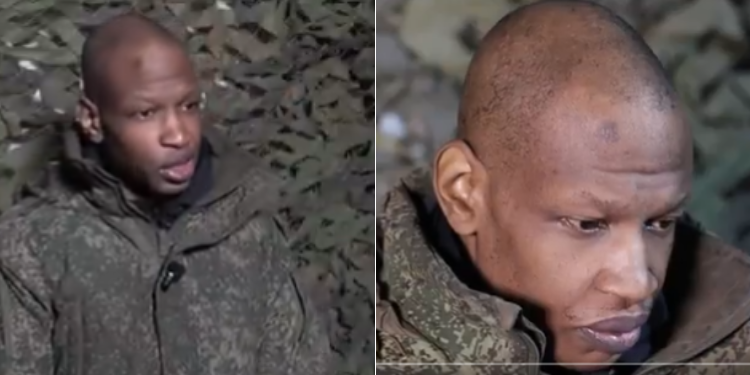
The Ukrainian 425th Assault Regiment has captured a Kenyan national who was fighting alongside the Russian Armed Forces during ongoing hostilities.
The man, identified as Joseph Kabugi, 41, is said to have been fraudulently recruited into the Russian military. According to accounts, he was initially promised a job but was instead deployed to the front lines upon arrival.
Kabugi said the recruitment information reached him while he was struggling to find work back home.
“People responded, and the message went through like news. It was a “tell a friend to tell a friend” situation. That is how the information got to me,” he said.
“There was an agency offering a process where you could join the Russian army without paying anything. They promised to cater to everything, including the air ticket. So we went, and we were picked up.”
Joseph Kabugi Captured While Fighting for Russia in Ukraine
Kabugi revealed that during the recruitment, he was promised that he would not be involved in the war but rather in their professions.
“We came in, we were picked, and we filled the contract. They promised that we would not be involved in anything about war and that we would work in our professions,” he said.
“I am a computer science engineer, so I understand gadgets and systems. I have worked with CCTV installations, radio stations, and similar systems. Those are the things I used to do.”
Kabugi narrated that when they arrived in Russia, most of them came in blindly. After signing the contract, they were sent for three weeks of training, which included basic instruction in using a gun.
He stated that he was not prepared for combat, noting that one cannot truly be ready to fight in 21 days. He said he was afraid, did not know the mission, and did not understand what awaited him at the time.
“We crossed the river in a boat. We were two. Along the way, I saw dead soldiers — Russian soldiers. At that moment, I thought, “I am dead.” By then, I had already been injured by a drone,” he said.
Kabugi recounts capture after drone attacks and a survival struggle
Kabugi recounted that upon arriving in Kuban, SouthWestern Russia, he was informed he would be moved, leading him to believe he would be sent back.
However, that did not happen; instead, he was held at an undisclosed location. He noted that communication with their commander was limited due to a language barrier, as he understood only a few words.
He said the situation escalated around February 14 when a second drone attack forced them to flee for their lives to another location.
Also Read: Kenyans in Russia Are Paid Up to Ksh3M Upon Joining Military and Ksh 350K Monthly
During this period, he explained that survival, not combat, became their priority as they struggled to find food and water.
The 41-year-old recalled that a Russian soldier who had initially gone out to search for supplies returned with food and water, helping them hold on longer.
However, on a second attempt, the soldier was captured and later led opposing forces to their position, where they were captured.
He said he did not fully understand what was happening at the time, adding that another soldier instructed him to follow before they eventually surrendered.
Kabugi described their captors as humane, noting they had the option to shoot them but chose not to.
He added that they were also provided with food and clothing, including a jacket to help him cope with the harsh winter conditions, to which he was unaccustomed.
Reflecting on his experience, Kabugi urged Kenyans not to join the war between Ukraine and Russia.
Also Read: Kenya, Russia Agree to Stop Enlistment of Kenyans in Ukraine War Special Operations
Kenyans Fighting in Russia-Ukraine War
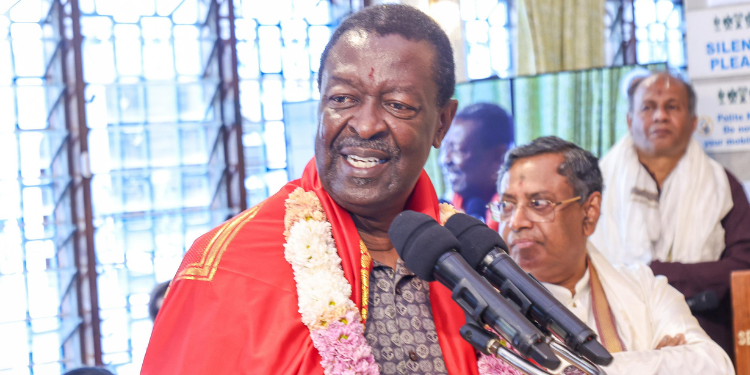
Prime Cabinet Secretary and Cabinet Secretary for Foreign and Diaspora Affairs Musalia Mudavadi, in a statement presented to the National Assembly on April 1, 2026, said Kenya’s embassy in Moscow estimates that about 252 Kenyans may have been recruited into Russia’s Special Military Operations, although the actual number could be higher.
So far, 47 Kenyans have been rescued and safely repatriated to the country with the help of the Kenyan embassy in Moscow.
Mudavadi added that the government remains in contact with Ukrainian authorities to secure the safety and eventual repatriation of any Kenyan captured during the fighting.
Kenya has also engaged the Russian government to explore arrangements that would allow any Kenyan prisoners of war held in Ukraine to be transferred to Russia, with the aim of facilitating their return home through diplomatic channels.