
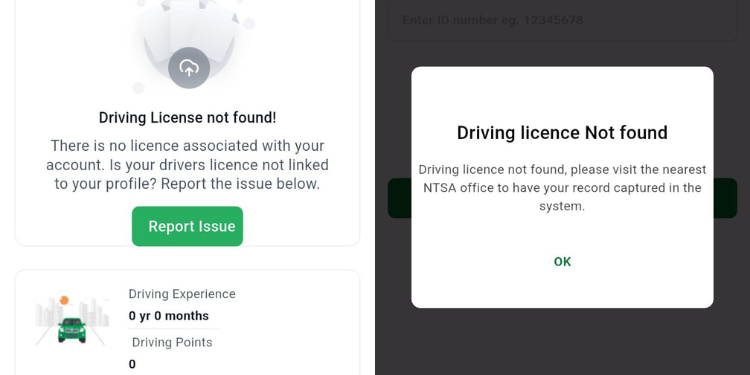
Drivers across Kenya have raised alarm after discovering that their driving license records are missing from the National Transport and Safety Authority (NTSA) system, triggering confusion and concern over a possible technical failure affecting the digital platform.
Several motorists attempting to access their details on the NTSA Transport Integrated Management System (TIMS) on June 28 encountered error messages indicating that their driving licenses could not be found.
The issue has been reported by multiple users, with screenshots shared online showing similar notifications across different accounts.
In one of the widely circulated images, the system displays a message stating, “Driving license not found. Driving license not found, please visit the nearest NTSA office for further updates in the system.”
The prompt has left many users questioning how their records could disappear despite having previously been linked to their profiles.
The apparent glitch has caused anxiety among motorists who rely on the platform for license verification, renewals, and compliance checks.
Some drivers fear that the problem could result in penalties if enforcement officers are unable to verify their credentials during routine road checks.
NTSA Put on the Spot
The issue quickly gained attention on social media, where motorists and transport stakeholders called on NTSA to urgently explain the situation and clarify the status of affected records.
A number of users questioned whether the problem points to a wider system breakdown or a data error within the authority’s database.
One widely shared post by the Long Distance Drivers and Conductors Association (LODCCA) questioned the situation.
“NTSA, what is going on? Many drivers are reportedly missing from the @ntsa_kenya system, yet there has been no official communication. Is there a system breakdown or what’s going on?” LODCCA posted on their official X account.
One user publicly raised the concern, saying that many drivers were missing from the system despite no official communication from NTSA.
Others tagged government agencies and road safety bodies, urging them to intervene and provide clarity.
Also Read: Matiang’i Calls for Suspension of NTSA Vehicle Inspection Fees
“This is another money-making scheme, no doubt,” replied Sido, an X user.
Key NTSA Services at Risk
The NTSA TIMS platform is the central system that holds and manages driver and vehicle records in Kenya, linking key road transport services into a single digital database.
Through it, motorists apply for and renew driving licenses, register vehicles, transfer ownership, book inspections, and pay traffic fines.
The system also supports real-time verification of license status and compliance records, allowing enforcement officers to confirm driver details during roadside checks.
Any disruption therefore affects core functions, including license validation, renewals and applications, vehicle transactions, and inspection processes.
It may also slow enforcement operations that depend on accurate, up-to-date data.
Also Read: Full List of Kenya’s 42 Public Universities, Colleges, and Their Heads
Because these services are interconnected, even a temporary failure can create delays, block access to essential records, and undermine the reliability of a system that underpins daily transport regulation and compliance across the country.
NTSA Reforms
NTSA reforms have focused on centralizing and digitising road transport services under a single authority.
Established in 2012, the regulatory body consolidated licensing, inspection, and transport regulation functions that had previously been handled by different agencies.
The rollout of the Transport Integrated Management System (TIMS) in 2016 consolidated driver and vehicle records into a single digital database, replacing fragmented manual systems and reducing fraud.
In 2024, services were integrated into the eCitizen platform to create a single access point for applications, payments, and verification.
In 2026, NTSA introduced electronic logbooks, replacing paper ownership records with fully digital documents accessible online.
These changes shifted licensing, registration, enforcement support, and record verification onto real-time digital systems.
Follow our WhatsApp Channel and X Account for real-time news updates.