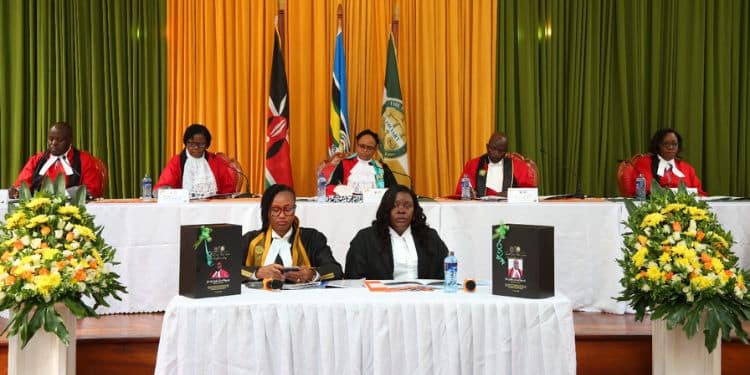
The Court of Appeal has faulted a High Court judge for relying on information allegedly obtained through a Google search in a multi-billion-shilling KenGen procurement dispute.
According to the Court of Appeal, courts must base their decisions on evidence properly presented by parties during proceedings.
In a judgment delivered on June 26, 2026, the appellate court overturned a High Court ruling that had sided with Kenya Electricity Generating Company (KenGen).
“We also find it troubling that whereas the record shows in pellucid fashion that the 5th respondent did not have any evidence before it that the 1st and 2nd respondents had complied with the statutory requirement under section 63(2) and (3), the learned Judge answered this critical issue by ‘simply googling’ and finding that the written report had been uploaded onto the official Public Procurement Information Portal,” part of the ruling read.
According to the court, the case was an appeal of a High Court ruling on a dispute over the cancellation of a KenGen tender linked to the Olkaria VII Geothermal Power Project.
Also Read: Court Delivers Landmark Ruling on Time Limits for Employment Claims
Court on Canceled Geothermal Tender
The case involved Tender No. KGN-BDD-016-2024 for consultancy services relating to the supervision and management of the Olkaria VII Geothermal Power Project, according to the court.
Olkaria VII Geothermal Power Project tender attracted bids from several international firms, including a joint venture between Sintecnica Engineering S.R.L and Steam S.R.L.
However, controversy arose in the tendering process after the European Investment Bank (EIB), a financier of the project, declined to issue a mandatory ‘No Objection’.
According to the Appeal Court, the mandatory letter was required before the procurement process could proceed to the contract award stage.
Following the refusal, KenGen terminated the procurement process due to the financier’s disapproval and funding commitment, and thus, the project could not lawfully proceed.
Further, the bidders challenged the decision before the Public Procurement Administrative Review Board (PPARB), emphasizing that KenGen’s termination did not comply with procurement laws.
Review Board Cancellation
In February 2026, the PPARB explained that KenGen had failed to satisfy both the substantive and procedural requirements for terminating the tender.
Additionally, the Board canceled the termination letters and directed the utility to proceed with the procurement process to its lawful conclusion.
KenGen, however, later moved to the High Court and successfully challenged the board’s decision.
The High Court in favor of KenGen ruled that the procurement process could not continue without the EIB’s approval, leading the bidders to appeal the ruling.
Also Read: IG Kanja Faces Court Action Over Unannounced Nairobi Road Closures
Appeal Court Questions High Court’s Handling of Evidence
The Court of Appeal noted that the key issue before it was whether KenGen had submitted a written report to the Public Procurement Regulatory Authority (PPRA) explaining the termination, as required under Section 63 of the Public Procurement and Asset Disposal Act.
According to the review board, no evidence had been presented to it demonstrating compliance with that requirement.
Following the finding, the appellate judges alleged that the High Court improperly resolved the issue by relying on information that had not been formally produced before the review board.
According to the court, the burden rested on KenGen to prove compliance before the review board.
The judges, however, rejected arguments that the review board lacked jurisdiction because the dispute involved the EIB’s refusal to issue a “No Objection” letter.
In addition, the judges added that the financier’s decision was central to the cancellation of the tender and could not be ignored in determining whether the procurement process had been lawfully terminated.
Further, the court found that the review board properly exercised its mandate by assessing whether KenGen complied with the legal requirements governing termination of procurement proceedings.
The Court of Appeal ultimately allowed the appeal, set aside the High Court judgment, and reinstated the PPARB decision that had nullified the cancellation of the tender.
KenGen’s cross-appeal was dismissed, with the court directing that each party bear its own costs.
Follow our WhatsApp Channel and X Account for real-time news updates.