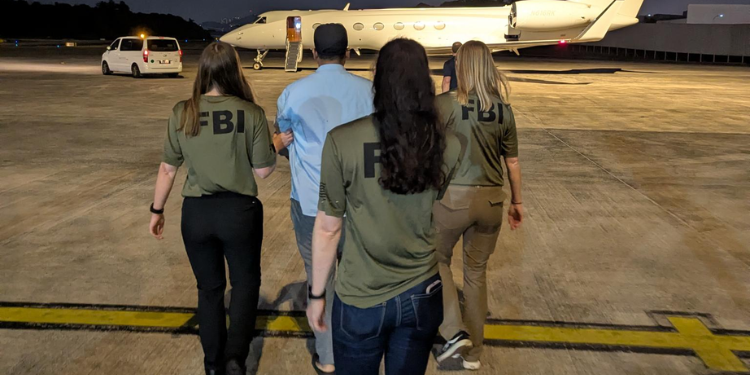
Federal agents captured a key figure in one of Minnesota’s biggest fraud cases this week, snatching him from Mogadishu, Somalia, after he fled the country to avoid trial.
Abdikerm Abdelahi Eidleh, 42, of Burnsville, was taken into custody on June 25, 2026. FBI Director Kash Patel confirmed the arrest on Saturday, June 27.
He faces charges as one of the main players in the Feeding Our Future scheme, which stole roughly $250 million from federal child nutrition programs.
Eidleh was originally charged in a 2022 indictment with 31 counts, including conspiracy to commit wire fraud, wire fraud, bribery involving federal programs, and money laundering.
Prosecutors say he helped run a pay-to-play operation inside Feeding Our Future, a nonprofit meant to sponsor meal sites for kids.
How the $250 Million Feeding Our Future Fraud Scheme Worked
Court records show Eidleh worked for the organization and handled recruiting and the oversight of sites that received federal funds.
He and others took bribes and kickbacks from people who wanted quick approval to run meal programs, even when those programs were fake.
Operators would send back a cut of the stolen money, often funneled through shell companies as fake “consulting fees.”
Eidleh went further, according to the indictment, by setting up his own sites with nominee owners and claiming they served thousands of meals a day to children.
Also Read: DOJ Announces Charges Against 15 Members of Left-Wing Anti-ICE Group Direct Action Minnesota
He created fake vendor companies, sent phony invoices, and pulled in federal dollars that never bought any food.
More than $5 million in kickbacks, bribes, and fraud proceeds ended up in accounts tied to his shell companies, which he used to hide the money’s source.
The scheme diverted federal money meant for low-income children and families across Minnesota to fraudsters who fabricated sites, padded meal counts, and divided the proceeds.
How Investigators Tracked Down the Fugitive After He Fled the United States
“This defendant was a central figure in one of the largest fraud schemes in Minnesota history,” said Assistant Attorney General Colin M. McDonald of the Department of Justice’s National Fraud Enforcement Division.
“Rather than answer for his crimes in the United States, he fled to Somalia in a futile attempt to evade justice.
“That attempt ended thanks to the exceptional work of our FBI partners. The Department of Justice will continue to track down and prosecute fraudsters wherever they run and wherever they hide.”
Eidleh’s arrest marks another win for investigators who have spent years chasing those involved. He left the U.S. after the 2022 charges and tried to stay out of reach in East Africa.
International Cooperation That Led to the Arrest in Mogadishu
FBI officials emphasized that their partnerships with law enforcement worldwide helped to nab the suspect in Somalia’s capital
The case was built by a team including the FBI, IRS Criminal Investigation, U.S. Postal Inspection Service, and Homeland Security Investigations.
Assistant U.S. Attorneys Rebecca E. Kline, Matthew C. Murphy, and Austin Bowyer are handling the prosecution.
The arrest comes weeks after the Justice Department launched its National Fraud Enforcement Division in early April.
That unit focuses squarely on fraud cases against federal programs. It supports a major push by the Trump administration, including the Task Force to Eliminate Fraud, chaired by Vice President J.D. Vance.
Also Read: FBI Reveals Number of Suspects Indicted in $90 Million Minnesota Medicaid Fraud Crackdown
Feeding Our Future drew national attention when the massive fraud came to light. Dozens of people have been charged in the case.
Many sites existed only on paper, while millions in taxpayer money vanished into personal accounts, luxury purchases, and overseas transfers.
Eidleh’s extradition process will now proceed so that he can face the charges in federal court in Minnesota.
Authorities say the full scope of the fraud hurt real kids who missed out on meals during and after the pandemic, when demand for food assistance was high.
The money that disappeared could have funded thousands of actual lunches, snacks, and dinners.