



The High Court in Malindi has ruled that Kenya’s next presidential election should have been held in August 2026 rather than 2027, but suspended the effect of its decision to avoid disrupting the country’s constitutional order.
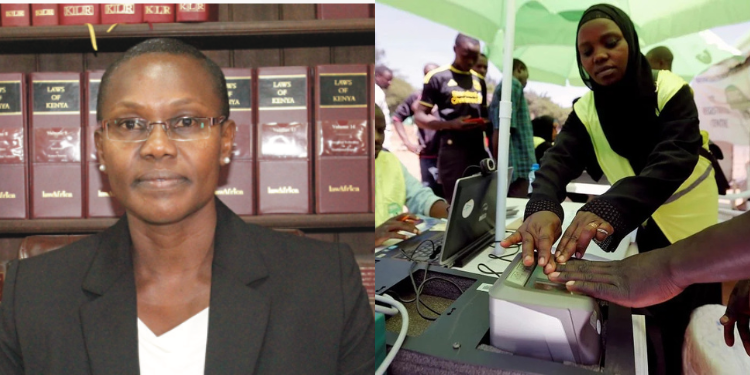
The landmark judgment was delivered by Justice Mugure Thande, a High Court judge appointed in 2015, who held that the Constitution requires a presidential election to be conducted on the second Tuesday of August in the fifth year after the previous General Election, rather than five years after the swearing-in of the President.
Justice Thande also ruled that Kenya’s 2022 General Election was conducted contrary to the Constitution, finding that it should have been held in 2021.
The judge said the Constitution requires a presidential election to be held on the second Tuesday of August in the fifth year following the previous General Election, and not after the fifth year.
“A Declaration is hereby made that the fifth year after the previous presidential election held on 9th August 2022 commences on 9th August 2026; A Declaration is hereby made that holding the next presidential election on any date other than the second Tuesday in August 2026 will violate and contravene Articles 2, 3, 10, 136(1) & (2)(a), 142(1), 249, 259(1) & (5)(c) of the Constitution, and will consequently be null and void,” read part of the judgement.
Also Read: Ruth Kulundu: Profile of IEBC’s Acting CEO and Commission Secretary
Education and Career of Justice Mugure Thande
Justice Mugure Thande is a Judge of the High Court of Kenya with more than three decades of experience in the legal profession. She was admitted to the Bar in 1991 and was appointed to the High Court bench in 2015.
Since then, she has served at the High Court in Mombasa and Milimani, where she has handled cases in the Commercial, Family, and Constitutional and Human Rights divisions.
She holds a Master of Laws (LLM), a Bachelor of Laws (LLB), a Bachelor of Arts (BA), and a Postgraduate Diploma in Law from the Kenya School of Law.
Throughout her judicial career, she has undertaken various professional development programmes at the Kenya Judiciary Academy (KJA).
Known for her work in constitutional and public interest litigation, Justice Thande has presided over cases involving governance, elections, taxation, human rights and public accountability.
Also Read: Francis Gachuri Profile: Deputy President Kithure Kindiki’s Right-Hand Man
Notable Cases Handled by Justice Mugure
Justice Mugure Thande came into the national spotlight in June 2023 when she suspended the implementation of the Finance Act 2023 after petitions were filed challenging its constitutionality. The ruling temporarily stopped several tax measures introduced by the government pending the hearing of the case.
She was also part of the three-judge bench that declared the Housing Levy unconstitutional in November 2023, finding shortcomings in its legal framework and raising concerns about discrimination and public participation
Ahead of the 2022 General Election, Justice Thande ordered the Independent Electoral and Boundaries Commission (IEBC) to provide a manual voter register as a backup to the electronic voter identification system. The decision was aimed at protecting voters and ensuring the electoral process could continue in the event of technical failures.
She also handled a case involving the recruitment of IEBC commissioners, issuing orders that affected the selection process and attracted public attention because of their implications for electoral reforms and the NADCO recommendations.
In another ruling, Justice Thande struck down provisions that restricted public commentary by litigants and lawyers involved in presidential election petitions. She held that some of the rules exceeded the powers of the Supreme Court and infringed on the role of Parliament
Follow our WhatsApp Channel and X Account for real-time news updates



Thanks
Justice Mugure Thande’s ruling is a pivotal moment for Kenya’s electoral landscape. It’s refreshing to see such commitment to democratic principles. Her profile truly highlights the importance of judicial independence.