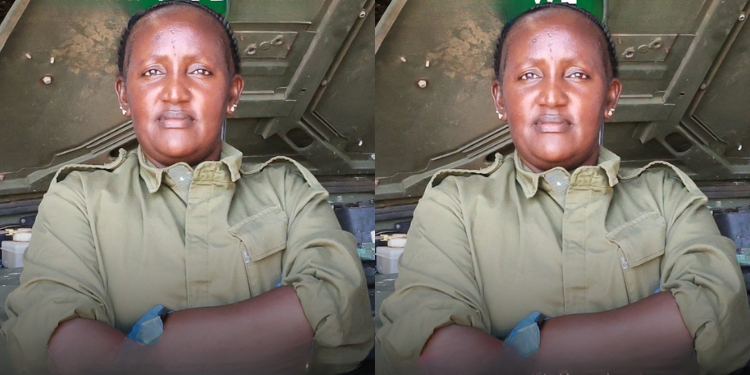
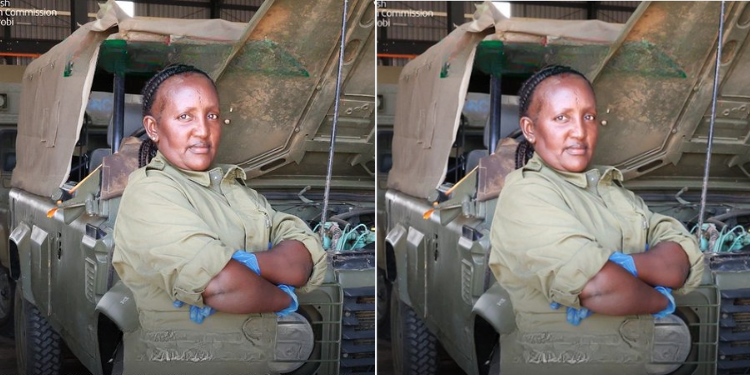
Purity Naitore spent five years working as a cleaner at the British Army Training Unit Kenya (BATUK).
Today, she repairs vehicles.
The transformation followed years of study, apprenticeship and balancing work with family responsibilities.
Purity Naitore’s Story
In an interview with BATUK, Naitore said her breakthrough came when she learnt of a scholarship opportunity to study Automotive Engineering.
“I applied and I got it,” she said.
The opportunity marked the beginning of a demanding routine.
Naitore worked as a cleaner in the morning, spent afternoons in the workshop and attended classes in the evening while raising her family.
“I worked as a cleaner in the morning, spent my afternoons in the workshop, went to class in the evening, and became a mother at night. But I kept showing up,” she said.
After completing her studies, she joined an apprenticeship programme where she gained hands-on experience in vehicle maintenance and repair.
Also Read: Chinese Operator Reaps Billions as Nairobi Expressway Revenue Increases by 7.3 Percent
She said the apprenticeship gave her the opportunity to learn from mistakes and improve her skills.
When a vehicle mechanic vacancy arose at BATUK, Naitore applied.
“I was ready,” she said.
She secured the position and now works as a vehicle mechanic.
Naitore believes empowering women benefits society more broadly.
“A woman being empowered is a community empowered,” she said.
How to Become a BATUK Cleaner
To become a cleaner at the British Army Training Unit Kenya (BATUK), applicants must apply through BATUK’s official online jobs portal when a Cleaner vacancy is advertised.
BATUK’s cleaner advert outlines three essential competencies that candidates must demonstrate in their applications, which are Communicating and Influencing, Working Together, and Planning and Managing Resources to Deliver Results.
Desirable qualities highlighted by the employer include good communication, organisation, self‑drive and awareness of recycling.
The role may involve overtime, shifts and occasionally working away from the normal duty station.
Applicants are required to visit the BATUK Cleaner job page, fill in their personal details and upload a CV or provide a LinkedIn profile.
A clear, legible KCSE certificate must be uploaded, as BATUK states that applications without it will not be considered.
Candidates must also complete a mandatory Cleaner Survey linked in the form and answer three competency questions using the STAR method—Situation, Task, Action and Result—with each response limited to 1,500 characters.
Applications must be submitted before the deadline shown on the live advert.
Shortlisted candidates are assessed on the three core competencies and job‑related cleaning knowledge.
Those who succeed at interview must pass BATUK employment screening and a medical examination before receiving a formal offer.
BATUK in Kenya
The British Army Training Unit Kenya (BATUK) traces its roots to the months after Kenya’s independence in December 1963.
Also Read: Motorists Face 12-Day Closure of Westlands Exit on Nairobi Expressway
On 3 June 1964, the UK and the newly independent Kenyan government signed a post‑independence defence agreement that allowed British troops to conduct training exercises in Kenya, initially up to twice a year.
In 2008, the unit was officially named BATUK, and in 2009 it relocated its main base from Nairobi to Nyati Barracks near Laikipia Air Base in Nanyuki, about 200 km north of the capital.
A smaller logistics element remained at Kifaru Barracks in Kahawa, Nairobi.
BATUK became the British Army’s largest contingent in Africa, with roughly 100 permanent UK service personnel, around 280 rotating troops and more than 500 locally employed Kenyan civilians.
Its stated purpose is to provide demanding infantry training for British units preparing for operations or high‑readiness tasks.
Under agreement with the Kenyan government, up to six infantry battlegroups per year can undertake up to eight weeks of exercises in Kenya.
The unit also hosts Royal Engineer projects such as borehole installations and medical deployments that run pop‑up clinics in remote communities.
Joint training with the Kenya Defence Forces (KDF) and cooperation on counter‑terrorism have been recurring features of the partnership.
Follow our WhatsApp Channel and X Account for real-time news updates.