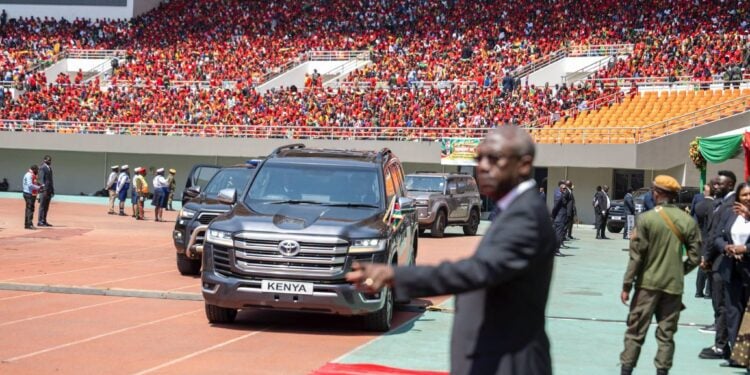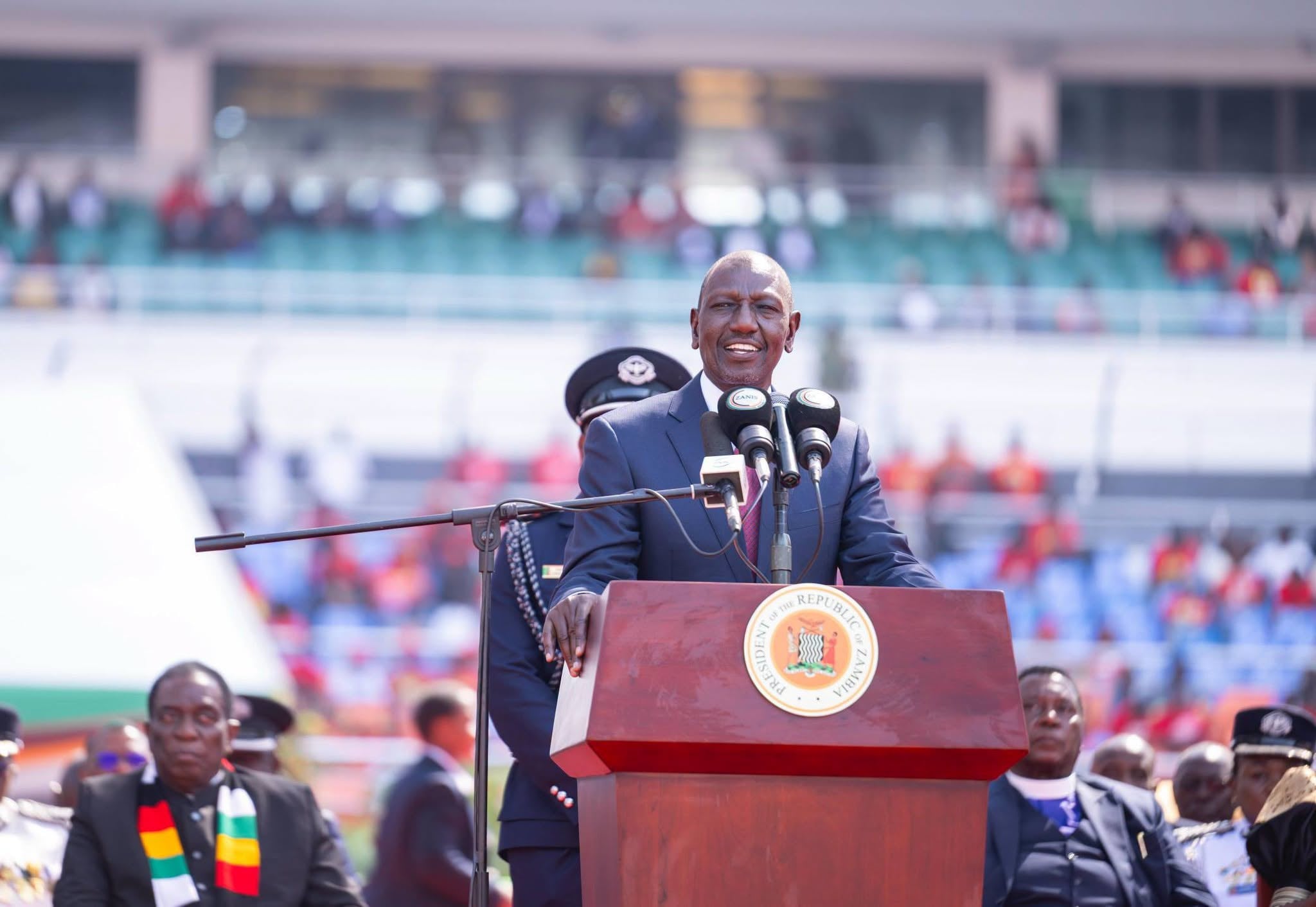
Kenya’s President William Ruto attended the inauguration of Hakainde Hichilema in Lusaka on September 1, 2026, as the Zambian leader began his second term. In his address, Ruto congratulated Hichilema and used Zambia’s “One Zambia, One Nation” creed to argue that elections should settle who governs, not who belongs. At the same time, the Kenyan President stated that democracy is tested when nations disagree rather than when they agree. He praised Hichilema’s first-term work on debt, inflation and free education. Here is Ruto’s full speech:
“Your Excellency Hakainde Hichilema, President of the Republic of Zambia, Distinguished Heads of State and Government, Members of the Diplomatic Corps, Fellow Africans, Ladies and Gentlemen,
On behalf of the Government and people of Kenya, I congratulate you, my brother President Hichilema, as you begin your second term, and wish you and the people of Zambia every success.
We gather today in a country that gave Africa one of its most enduring political convictions: One Zambia, One Nation.
It is a statement of national identity. But it is also an African idea: that our differences should never become our divisions; that political contest need not become national conflict; and that what unites a people must ultimately be greater than what separates them.
Democracy is not tested when we agree. Democracy is tested when we disagree. Elections will produce winners and losers. Some will celebrate. Others will be disappointed. But when the contest is over, the nation must remain whole.
Elections are designed to settle who governs. They should never determine who belongs. That is the responsibility of democratic leadership: not merely to secure the authority to govern, but to preserve the common nation in whose name that authority is exercised.
My brother, President Hichilema,
I am confident that in this new mandate, you will govern for all Zambians; those who voted for you and those who did not; those who support your government and those who oppose it. They all belong equally to Zambia, and they must all have a place in its future. Political competition may divide our choices. It must never divide our destiny.
What will Africa do with its freedom?
Excellencies, Fellow Africans,
This is not Zambia’s challenge alone. It is Africa’s. The generation of Kenneth Kaunda confronted the great question of their time: Can Africa be free? They answered it.
They fought colonialism. They confronted apartheid. They built independent nations and gave Africans the right to determine their own destiny.
Our generation has inherited that freedom, and history now asks us a different question: What will Africa do with its freedom?
We have the land to feed ourselves and others. We have the energy to power our transformation. We have the minerals that the industries of tomorrow will require. And, in the youngest population on earth, we have our greatest resource of all: our people.
The challenge before us, therefore, is not the absence of resources. It is how we use these resources to create opportunities and wealth.
![Ruto In Zambia: “Elections Settle Who Governs — They Should Never Decide Who Belongs” [Full Text]](https://cdn.thekenyatimes.com/2026/09/Ruto-Smiling-Lusaka-750x375.jpg "What Will Africa Do With Its Freedom? Ruto’s Full Speech At Hichilema’s Inauguration In Zambia")
Our task is to turn political freedom into economic freedom; natural wealth into African prosperity; sovereignty into self-reliance; and democracy into opportunity. These are the tests by which our generation of African leadership will be judged.
Our people do not vote merely for the privilege of voting again. They vote for work and incomes; for education and healthcare; for dignity and opportunity; and for the confidence that their children can build better lives here, at home, in Africa and beyond.
Delivering that promise requires democracy that works, political competition that does not create conflict, and leaders who understand that no victory, no office, and no ambition can ever be greater than the nation itself.
Africa cannot industrialise if every election becomes a moment of national uncertainty.
Businesses cannot build where tomorrow is uncertain. Capital will not flow where institutions cannot be trusted. And prosperity cannot take root if politics repeatedly threatens the foundations on which it depends.
That is why constitutional government, credible institutions, the rule of law and national unity are not merely political ideals. They are foundations of prosperity.
For all of us who seek political leadership in Africa, therefore, the responsibility is clear: we must compete vigorously without becoming enemies; we must disagree without destroying; and we must seek victory without excluding. Our politics must never become more important than our countries.
Kenya, too, will hold a General Election next year. We therefore speak not as spectators, and certainly not as lecturers, but as fellow Africans travelling the same democratic path.
The standards we affirm must be the standards we uphold: peaceful political competition, credible institutions, respect for the law, respect for the sovereign voice of citizens and, above all, the unity of our nations.
A second mandate asks a harder question
My brother, President Hichilema,
A second mandate changes the question before a leader. The first asks: What will you do? The second asks: What will define your legacy?
You begin this second term having confronted formidable economic circumstances. You assumed office with Zambia already in debt default. Your first term was then tested by a severe cost-of-living crisis, drought, and energy shortages. Your choices in those difficult moment demonstrate leadership and statesmanship not populism.
Your administration has made demonstrable progress in resolving that debt crisis, restoring Zambia’s standing with its creditors and rebuilding confidence in the economy. International reserves have risen significantly, while inflation has fallen.
These are significant gains in restoring economic stability. And beyond the numbers, Zambia has made an important investment in its people. The expansion of free education from early childhood through secondary school has opened the doors of learning to millions more Zambian children.
The challenge of this second term, my brother, is to build on these gains and translate economic stability into prosperity for your citizens: in jobs and incomes, in opportunities for young people, and in the daily lives of Zambian families.
Kenya will walk that journey with Zambia. Our friendship must increasingly be measured not simply by its warmth, but by the prosperity it creates: by the trade we increase, the investments we unlock, the infrastructure and markets we connect, and the jobs and opportunities we create for our people.
Stop exporting Africa’s jobs with Africa’s minerals
Excellencies, Fellow Africans,
What is true for Kenya and Zambia must become true for Africa. For too long, we have exported African minerals, African agricultural produce, and African raw materials, only to import their value back at a premium.
For too long, Africa has helped to industrialise others while exporting the jobs our own people need. That must and will change with courageous leadership like yours.
Through the African Continental Free Trade Area, we have the opportunity to turn fragmented national markets into one powerful African economic community.
Africa must industrialise. Africa must manufacture. Africa must add value to what it produces, and Africa must trade with Africa.
By connecting our markets, capital, and productive capacity, we can create the scale necessary for African enterprise to compete at home and across the world.
This is not a retreat from the world. It is how Africa prepares to engage the world from a position of strength; not merely as a supplier of commodities, but as a producer of value and a continent of scale.
Excellencies,
More than sixty years ago, the founding President of this Republic, Kenneth Kaunda, compared the African spirit to the mighty waters of the Zambezi, a tremendous force which, when harnessed to purpose, could produce tremendous power.
That image speaks to us today. Because Africa does not lack power. We have the power of our people. The power of our resources. The power of our markets. The power of our ideas. And the extraordinary power of the youngest population in the world.
Our task is to harness that power to purpose. Kaunda’s generation did. They harnessed African solidarity to defeat colonialism and apartheid. Their mission was liberation. Ours must be transformation.
They fought so that Africa could govern itself. We must build an Africa capable of feeding itself, powering itself, trading with itself, adding value to its own resources and creating prosperity for its own people. They secured political freedom. We must secure economic freedom.
That is the Africa we must build together: An Africa in which democracy endures because citizens experience its dividends. An Africa that transforms its own resources into African prosperity. An Africa whose young people see their future not somewhere else, but at home. And an Africa that takes its rightful place in the world with confidence, dignity, and strength.
My brother, President Hichilema,
As you take forward this mandate, I wish you wisdom and strength in the service of the people of Zambia.
May this new chapter strengthen the unity of this nation, enlarge opportunity for every Zambian, and advance the larger African journey to which generations before us devoted their lives.
They gave us freedom. Our duty is to turn that freedom into prosperity.
One Zambia, One Nation. One Africa, one destiny. God bless the people of Zambia. God bless the Republic of Kenya. God bless Africa. I thank you.”
Follow our WhatsApp Channel and X Account for real-time news updates.