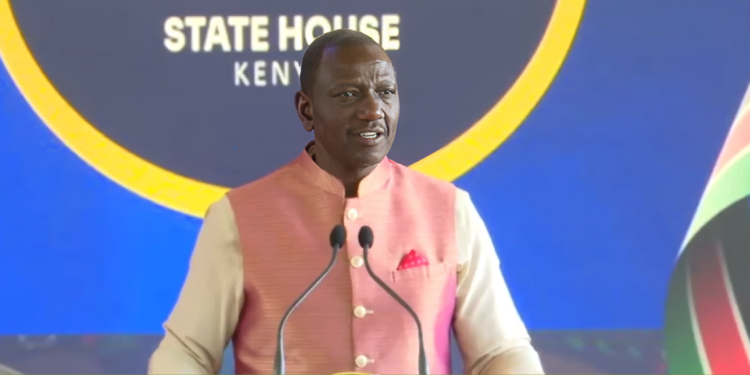
President William Ruto has directed school heads across the country to prioritise foundational learning by ensuring pupils in Grades 1, 2 and 3 acquire essential reading, writing and numeracy skills.
Speaking during the Kenya Comprehensive School Heads Association (KESSHA) National AGM and Conference on Thursday, November 12, the President said the early years of primary education were critical in shaping learners’ long-term academic progress.
Ruto challenged school heads to take greater responsibility for improving learning outcomes, warning that no child should complete Grade 3 without the ability to read, write and count.
“I ask three things of school heads in this hall. First, secure the foundations. Make Grade One to Three the most protected years in your school. Let no child leave Grade Three unable to read, write or count,” he said.
The President urged school heads to deploy their most experienced teachers to lower primary classes, arguing that the formative years shape a learner’s educational journey.
“Put your strongest teachers where the stakes are highest, and that is at the beginning. Grades One, Two and Three are very significant and very important,” Ruto stated.
Also Read: Ruto Lobbies to Remove Kenya from Global Wash Wash List
Ruto Sets 2030 Target for Foundational Learning
The President announced a national target to ensure every Kenyan child can read, write and count by the end of Grade 3 by 2030.
He said the government would assess progress every year and publish the results at county and school levels to allow parents to monitor learning outcomes.
“By 2030, every Kenyan child must be able to read, write and count by the end of Grade 3,” he said.
Ruto directed the Ministry of Education to work with the Teachers Service Commission (TSC), Kenya National Examinations Council (KNEC), county governments and school heads to establish an assessment and reporting system to track progress towards the target.
The system is expected to show how individual schools and counties are performing, giving parents a clearer picture of whether pupils are acquiring basic literacy and numeracy skills.
Ruto Gives Education Ministry 90 Days to Propose Law Changes
In a separate directive, Ruto instructed the Ministry of Education to work with KESSHA and submit proposals within 90 days to amend the Basic Education Act.
Also Read: Ruto Courts European Powers on Election Observation as He Eyes Second Term
The proposed amendments are intended to provide a clear legal framework for the governance, staffing and financing of comprehensive schools.
“I direct the Ministry of Education to work with the Kenya Comprehensive School Heads Association and to present, within 90 days, proposals to amend the Basic Education Act so that governance, staffing and financing of comprehensive schools rest on a firm legal ground,” he said.
The President argued that comprehensive schools needed a clear legal foundation to guide their operations and ensure consistent management.
“Institutions built on clarity outlast those built on custom,” Ruto added.
Ruto also announced plans to review school capitation and introduce a consolidated funding model for primary and junior schools amid rising economic pressures.
The President said he had instructed the Ministry of Education and teachers’ unions to review learner capitation, citing inflation and other economic pressures that have increased the cost of supporting teaching and learning.
Follow our WhatsApp Channel and X Account for real-time news updates, and subscribe to our YouTube Channel for in-depth interviews.