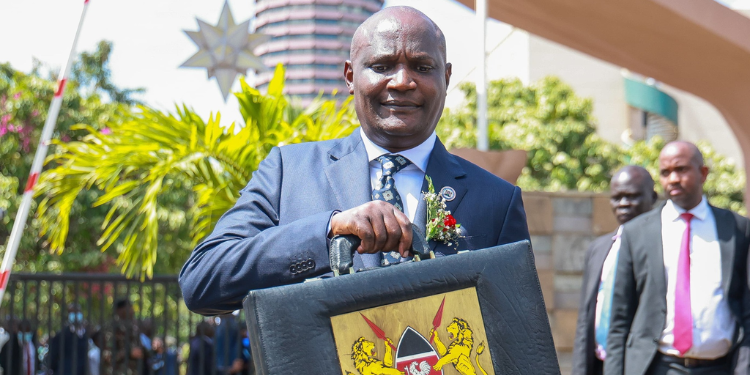
Kenya’s national budget for the 2026/27 financial year has been set at Ksh4.727 trillion, with President William Ruto’s administration allocating the largest share to the Executive arm of government.
According to figures from the National Treasury, the Executive will receive Ksh 2.801 trillion, representing 59.3 percent of the total allocation, leaving the Judiciary with only Ksh29.9, or 0.6 percent.
The National Government, comprising the Executive, Parliament, and Judiciary, will collectively absorb Ksh 2.879 trillion, accounting for 60.9 percent of the total budget.
Within the Ksh2.789 trillion, according to the report by the National Judiciary, Parliament is allocated Ksh48.8 billion, translating to 1 percent of the total share.
The Judiciary’s allocation remains the smallest among the three arms, despite its critical role in upholding the rule of law.
Beyond the National Government, Consolidated Fund Services—covering domestic and foreign interest payments, pensions, and salaries for state officers—will take Ksh1.427 trillion, or 30.2 percent of the budget.
County governments, through sharable revenue, are set to receive Ksh420 billion, representing 8.9 percent of the total allocation.
National Treasury Medium-Term Projections
The budget report by the National Treasury shows continued growth in allocations over the medium term.
For the 2027/28 financial year, the total budget is expected to rise to Ksh 5.230 trillion.
The National Government will command Ksh 3.295 trillion, with the Executive projected at Ksh 3.213 trillion, Parliament at Ksh 51.05 billion, and the Judiciary at Ksh 30.86 billion.
Consolidated Fund Services will increase to Ksh 1.493 trillion, while county governments will receive Ksh 440.88 billion.
Also Read: Full List of National Schools in Kenya for Grade 10 Students
By 2028/29, the total budget is forecast to reach Ksh 5.446 trillion.
The National Government will absorb Ksh 3.469 trillion, with the Executive taking Ksh 3.382 trillion, Parliament Ksh 52.90 billion, and the Judiciary Ksh 33.29 billion. Consolidated Fund Services will rise to Ksh 1.527 trillion, and county governments will secure Ksh 450.37 billion.
The percentage shares for the medium term show a consistent pattern, with the Executive maintaining a dominant position, rising from 59.3 percent in 2026/27 to 61.4 percent in 2027/28, and 64.7 percent in 2028/29.
The Judiciary remains at 0.6 percent, while Parliament holds 1 percent across the three years.
Impact on Kenyans as Judiciary Woes Continue
The 2026/27 budget allocations will directly affect public services and the national economy.
The Executive’s share of Ksh 2.801 trillion covers infrastructure development, education programs, healthcare services, and social protection initiatives, and is expected to sustain ongoing road construction, expand electricity access, and support universal health coverage.
In contrast, the Judiciary’s allocation of Ksh 29.94 billion may restrict its ability to clear case backlogs and improve access to justice.
Projects such as court construction, digitization of case management systems, and recruitment of judicial officers could face delays due to limited funding, slowing dispute resolution, especially in rural and underserved regions.
Also Read: List of Senior Schools to Offer Agriculture, Aviation and Home Science For Grade 10 Learners
County governments, which will receive Ksh 420 billion, are expected to deliver devolved services such as primary healthcare, early childhood education, and local infrastructure.
Governors have repeatedly warned that rising service delivery costs and pending bills could strain county budgets, even with projected increases to Ksh 440.88 billion in 2027/28 and Ksh 450.37 billion in 2028/29.
The allocation of KSh 1.427 trillion to the Consolidated Fund Services highlights Kenya’s growing debt obligations, with a large portion of this amount going toward interest payments on domestic and external loans, thereby reducing funds available for development programs.
With public debt estimated at Ksh 11.1 trillion by the end of 2025, debt servicing will continue to absorb resources that could have supported social programs and economic growth in the country.
For households, the budget’s impact will be felt through taxation and changes in the cost of living.
Follow our WhatsApp Channel and X Account for real-time news updates.