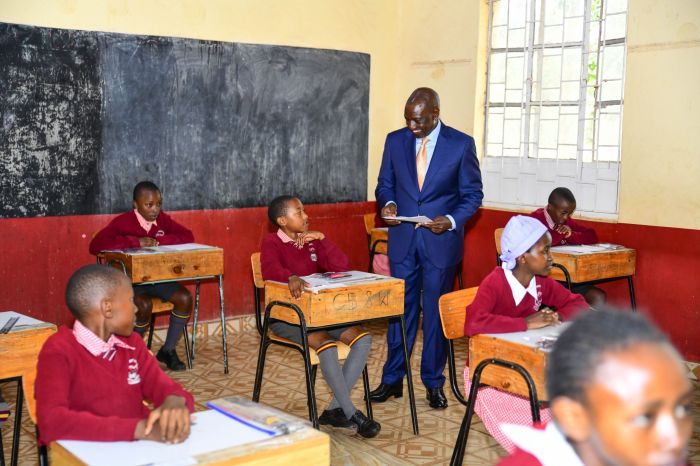

President William Ruto said teachers employed as interns should serve on contract for a maximum of two years before being automatically absorbed into permanent and pensionable terms.
Speaking at the national education conference on May 7, Ruto explained that the internship system was introduced in response to staffing and funding constraints in the education sector.
He emphasized that no teacher should remain on internship beyond two years under the current framework.
” I want to ask the TSC, I hope there are no teachers who have served more than two years as interns. Any teacher can only serve for two years on contract after which they transition automatically,” Ruto said.
According to his remarks, the transition from contract to permanent status should occur automatically upon completion of the two-year period.
Also Read: TSC Takes Stand on Hiring 44,000 Intern Teachers on Permanent and Pensionable Terms
He added that the process should not require additional interviews once the internship period ends.
“Without any other interview or whatever, they will transition automatically to permanent and pensionable. That is the commitment that I made. That is what I began for,” he said.
Ruto Addresses Intern Teachers’ Issue
President William Ruto said the government has been addressing three key challenges in the education sector: a shortage of teachers, unemployment among trained teachers, and limited resources.
He explained that the government has opted for a compromise by employing teachers on contract to address staffing gaps and employment needs.
“We have discussed the issue of intent teachers. We have three issues. We have learners who have no teachers. And then we have teachers who are not employed. And then we have limited resources. What do we do? You know? So, we said, let us have a compromise. Let us employ teachers on contract. I think we are going to correct it,” Ruto said.
Also Read: Supreme Court Suspends Ruling on TSC Internship Programme
Additionally, Ruto stated that teachers will be employed on a two-year contract, with a firm commitment that they will automatically transition to permanent, pensionable terms without additional interviews.
He said the approach is designed to ensure that all learners have access to teachers while also creating job opportunities for trained but unemployed teachers, noting that the policy also takes into account limited government resources, which must cover multiple national priorities.
He added that about 28% of the national budget is already allocated to education, making further increases difficult without affecting other sectors.
Ruto said the model was adopted to balance staffing needs in schools, employment demands, and available fiscal capacity.