
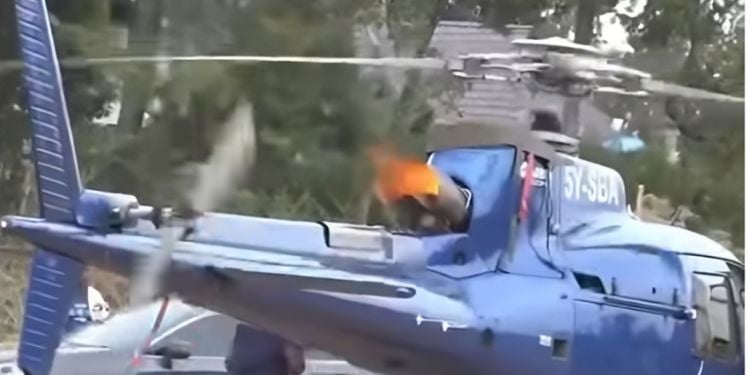
Panic briefly erupted at a local airstrip in Kabarnet after a helicopter carrying Kapseret Member of Parliament Oscar Kipchumba Sudi and several other leaders emitted flames from its tailpipe moments before take-off.
The incident occurred while the aircraft was still on the ground and reportedly preparing to ferry the delegation to a regional event. Witnesses at the scene said visible flames or sparks were seen near the rear exhaust section of the helicopter while it remained stationary.
A viral online video shows flames coming from the helicopter before take-off as members of the crowd nearby shouted in surprise.
The footage captures the aircraft on the ground as the flames appear briefly from the exhaust area.
The occurrence led to a temporary halt in operations as ground crews assessed the situation before the helicopter could take off. Security personnel and onlookers were seen reacting as the assessment was carried out.
At the time of reporting, there were no confirmed injuries. MP Sudi and the other passengers were reported safe and unharmed following the incident.
Helicopter Exhaust Flares: Possible Causes
Helicopter exhaust flames before takeoff, as seen in Kabarnet with MPs Oscar Sudi and Kipchumba Murkomen, are a standard feature of turbine-engine startups.
According to aviation experts on SKYbrary, these tailpipe fires occur normally when excess fuel ignites in the hot exhaust during high-power spool-up.
The turboshaft cycle suck, squeezes, bangs, blow forces compressed air and fuel to burn continuously, producing visible flames up to several feet as engines hit 100%+ RPM for liftoff.
Also Read: Report Reveals Most Preferred Helicopter Models in Africa, America and Asia
Pilots intentionally allow brief flames (5-10 seconds) while monitoring EGT, torque, and RPM.
According to the FAA Helicopter Flying Handbook, this confirms ignition before full power; persistent flames indicate issues such as wet starts (fuel pooling).
The Handbook provides related guidance on turbine engine startups, confirming ignition through instrument checks before applying full power.
In Chapter 4, it states: “The pilot monitors engine instruments during startup to ensure proper operation, including gas producer speed (Ng), power turbine speed (Np), and exhaust gas temperature (EGT).”
Also Read: AU Helicopter Bursts Into Flames With 8 on Board
Distinguishing normal Helicopter Exhaust Flares from dangerous ones
In the incident, flames from the rear dissipated safely as the chopper rose, matching routine ops in models like Bell 407s used regionally, no leaks or stalls reported.
Exhaust glow is blue-orange gas, not dripping fuel.
According to Helicopter Maintenance Magazine, compressor transients cause this at takeoff torque (2,000+ HP), unlike black smoke (oil burn) or bangs (stalls).
In Reddit aviation maintenance threads, note that windmilling clears residue, explaining plumes post-idle.
Follow our WhatsApp Channel and X Account for real-time news updates.

A collage image of Kapseret MP Oscar Sudi speaking during a previous public address and Interior Cabinet Secretary Kipchumba Murkomen. PHOTO/Sudi/CS Kipchumba Murkomen-X