President William Ruto has come under renewed scrutiny over his continued use of chartered luxury aircraft for international travel, with his latest trip to South Africa reigniting debate over presidential travel arrangements.
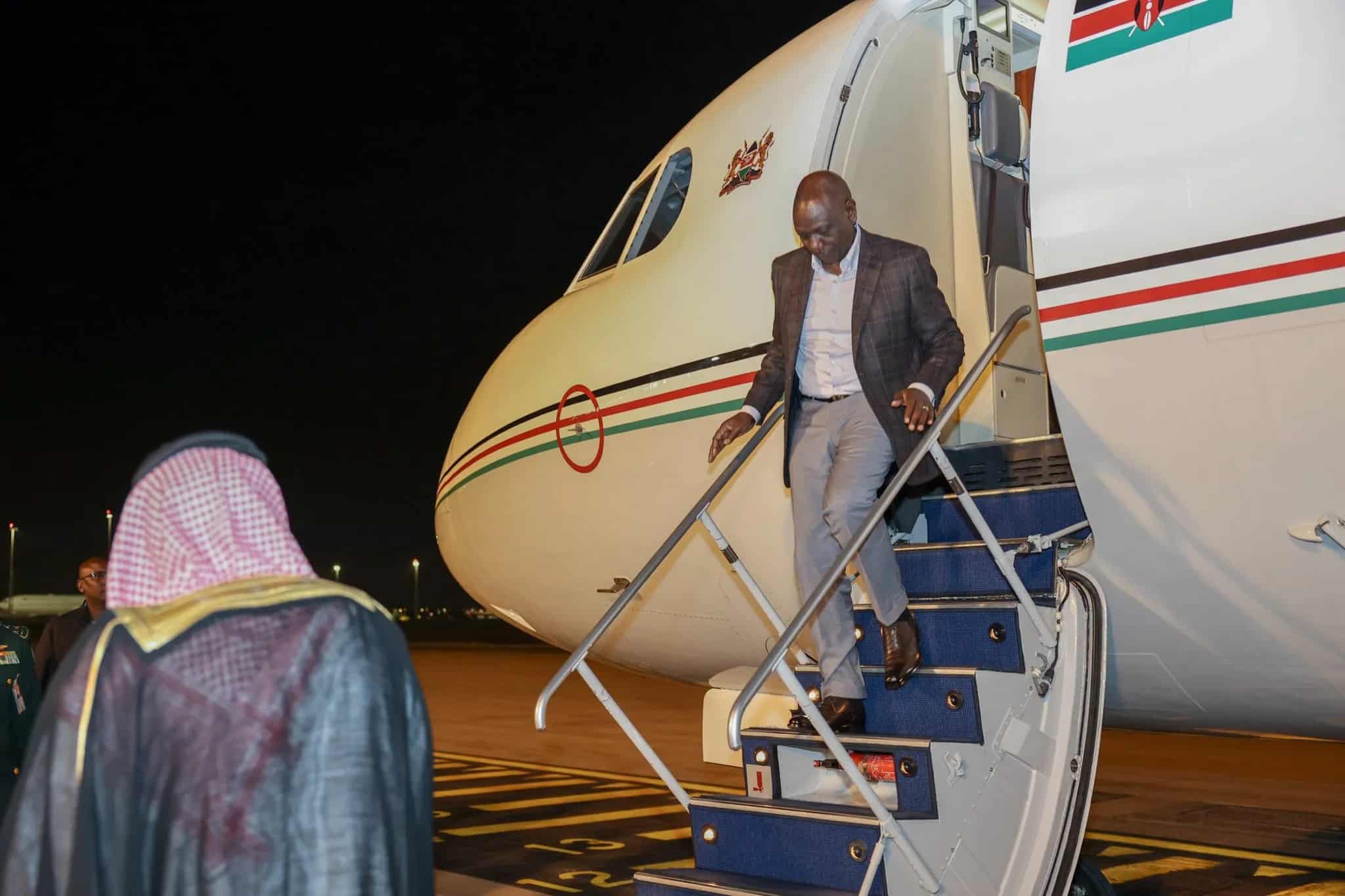
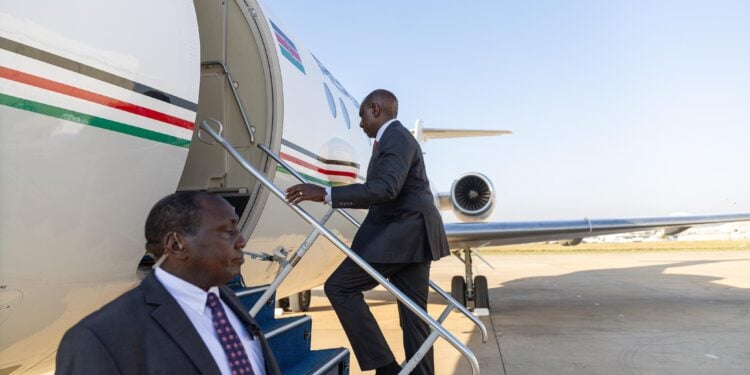
The Head of State arrived in South Africa on Wednesday evening aboard a privately chartered Boeing 737-800 BBJ2, marking the latest in a series of foreign trips undertaken using executive jets.
Flight tracking data and aviation records show that Ruto departed Nairobi on June 3 aboard a Boeing Business Jet 2 (BBJ2), registered T7-BBJ2 (Hex: 500517), a VIP-configured variant of the Boeing 737-800 operated by Dubai-based Empire Aviation Group.
Chartered Flights for International Travel
The latest trip follows Ruto’s May visits to Azerbaijan and Kazakhstan, where he also relied on a chartered executive jet, underscoring what appears to be a temporary solution as uncertainty persists over the future of Kenya’s presidential fleet.
The aircraft, registered T7-BBJ2, arrived in Nairobi from London on May 14 at 6:04 p.m. after an 8-hour, 57-minute flight from London Luton Airport.
It had earlier ferried the President to Baku, Azerbaijan, for the World Urban Forum.
On May 16, the same jet departed Jomo Kenyatta International Airport (JKIA), spending seven hours and 47 minutes airborne before landing at Heydar Aliyev International Airport in Baku at 6:06 p.m.
Flight tracking data further shows that the aircraft later departed Baku at 11:30 a.m. for Astana, Kazakhstan, arriving shortly after 3:00 p.m.
Earlier, the President had travelled to neighbouring Tanzania aboard a Kenya Air Force aircraft for a state visit. However, he reportedly used the T7-registered executive jet for his return journey to Nairobi.
In November 2024, Ruto also travelled to Angola aboard an Embraer Legacy 650 private jet, landing at Luanda International Airport under similar arrangements.
The President has previously defended his use of chartered aircraft. In 2024, he faced criticism after travelling to the United States aboard a chartered Boeing Business Jet.
Ruto dismissed reports that the trip cost $1.5 million, stating that the aircraft had been availed at a cost of about Ksh10 million through the support of unnamed “friends” of Kenya.
State House later said the United Arab Emirates had facilitated the arrangement.
Also Read: Pressure on Ruto to Allow Atheism in All Schools Countrywide
Before the aircraft was withdrawn from service, flight records show that KAF308 was used by President Ruto on February 13, 2025, when it departed Nairobi for Addis Ababa, Ethiopia.
Earlier, on January 13, 2025, the aircraft transported the President to the United Arab Emirates for the Abu Dhabi Sustainability Week (ADSW) Summit.
On January 8, 2025, the Fokker 70 returned Ruto to Nairobi from Luanda, Angola, following a stopover after his visit to Accra, Ghana.
Flight tracking data also shows that KAF308 returned the President to Nairobi from Addis Ababa following an official visit to Ethiopia in November 2024.
President William Ruto also boarded the Presidential jet to Burundi to attend the 23rd COMESA Summit on October 31, 2024.
Also Read: Ruto Recalls How Leaders Warned Him Against Appointing Francis Ogolla
Why Ruto Is Opting for Private Luxury Jets Instead of the Presidential Fokker 70 KAF308
Ordinarily, the President is expected to travel on Kenya’s official presidential aircraft, the Fokker 70 Extended Range (ER), registration KAF308.
Acquired in 1995, the aircraft has served successive presidents for nearly three decades.
However, the presidential jet has been out of service since August 2025 and was flown to the Netherlands for extensive maintenance amid growing concerns over its age and reliability.
The 31-year-old aircraft was ferried to Fokker Techniek in Woensdrecht on August 22 for what is expected to be its final major maintenance cycle.
The work is projected to take about a year, after which the aircraft will return to Kenya for a limited period of service before its eventual retirement.
Known as Harambee One, the Fokker 70 has been operated by the Kenya Air Force since its delivery to Kenya.
Its most recent technical setback occurred during the joint East African Community (EAC) and Southern African Development Community (SADC) summit in Dar es Salaam in February 2025, when the aircraft developed technical problems and was grounded.
The Kenya Air Force was subsequently forced to dispatch one of its DHC-8-100 aircraft to fly President Ruto back to Nairobi the following day.
About the Presidential Jet Fokker 70 KAF308
The Fokker 70 first landed in Kenya on December 20, 1995, at Moi Air Base, where it was received by then-President Daniel Arap Moi.
Manufactured in the Netherlands, the aircraft was originally designed as a 70-seater but was later reconfigured to carry 26 passengers, creating additional space for presidential and VIP travel.
According to the Kenya Air Force commemorative publication, Kenya Air Force Story 1964-2014, military officials travelled to Europe to inspect the aircraft during production, while cabin crew underwent specialised training ahead of its delivery.
Retired Colonel James Gitahi, the aircraft’s first captain, recalled the excitement surrounding its arrival.
“The first sight of our Fokker 70 Extended Range Presidential aircraft, tail number KAF308, will remain in our memories for a long time to come. It struck most of us as the most beautiful plane we had ever seen. It looked elegant with a splendid outside finish,” he said.
Before the acquisition of the Fokker 70, Kenya relied on a Canadian-built Dash 8 aircraft for VIP transport. However, the aircraft proved unsuitable for long-haul international travel, prompting the government to acquire a dedicated presidential jet.