
Monday, June 1, 2026
  • News
    • Latest News
    • Breaking News
    • Fact Check
    • Investigations
    • Explainers
  • Politics
    • Global Politics
    • Elections
    • Government & Policy
    • Diplomacy
    • Conflicts & Security
    • Political Analysis
  • Business
    • Global Economy
    • Markets
    • Technology
    • Startups
    • Energy
    • Finance
  • World News
    • Americas
    • Asia
    • Asia Pacific
    • Africa
    • Europe
    • Middle East
  • Africa
    • Central Africa
    • East Africa
    • West Africa
    • Southern Africa
  • Health
    • Global Health
    • Public Health
    • Health Policy
    • Medical Research
    • Diseases & Conditions
    • Mental Health
    • Nutrition
    • Climate & Health
    • Health Explainers
  • Sports
    • Athletics
    • Basketball
    • Boxing
    • Cricket
    • Football
    • Formula 1
    • Golf
    • Rugby
  • Weather
    • Climate Business
    • Climate Change
    • Climate Solutions
    • Living Green
  • Culture
    • Arts
    • Film & TV
    • Food
    • Music
    • Lifestyle
    • Travel
  • Opinion
    • Editorials
    • Letters
  • Behind The Brand
REGISTER
LOGIN
No Result
View All Result
The Kenya Times
  • News
    • Latest News
    • Breaking News
    • Fact Check
    • Investigations
    • Explainers
  • Politics
    • Global Politics
    • Elections
    • Government & Policy
    • Diplomacy
    • Conflicts & Security
    • Political Analysis
  • Business
    • Global Economy
    • Markets
    • Technology
    • Startups
    • Energy
    • Finance
  • World News
    • Americas
    • Asia
    • Asia Pacific
    • Africa
    • Europe
    • Middle East
  • Africa
    • Central Africa
    • East Africa
    • West Africa
    • Southern Africa
  • Health
    • Global Health
    • Public Health
    • Health Policy
    • Medical Research
    • Diseases & Conditions
    • Mental Health
    • Nutrition
    • Climate & Health
    • Health Explainers
  • Sports
    • Athletics
    • Basketball
    • Boxing
    • Cricket
    • Football
    • Formula 1
    • Golf
    • Rugby
  • Weather
    • Climate Business
    • Climate Change
    • Climate Solutions
    • Living Green
  • Culture
    • Arts
    • Film & TV
    • Food
    • Music
    • Lifestyle
    • Travel
  • Opinion
    • Editorials
    • Letters
  • Behind The Brand
  • News
    • Latest News
    • Breaking News
    • Fact Check
    • Investigations
    • Explainers
  • Politics
    • Global Politics
    • Elections
    • Government & Policy
    • Diplomacy
    • Conflicts & Security
    • Political Analysis
  • Business
    • Global Economy
    • Markets
    • Technology
    • Startups
    • Energy
    • Finance
  • World News
    • Americas
    • Asia
    • Asia Pacific
    • Africa
    • Europe
    • Middle East
  • Africa
    • Central Africa
    • East Africa
    • West Africa
    • Southern Africa
  • Health
    • Global Health
    • Public Health
    • Health Policy
    • Medical Research
    • Diseases & Conditions
    • Mental Health
    • Nutrition
    • Climate & Health
    • Health Explainers
  • Sports
    • Athletics
    • Basketball
    • Boxing
    • Cricket
    • Football
    • Formula 1
    • Golf
    • Rugby
  • Weather
    • Climate Business
    • Climate Change
    • Climate Solutions
    • Living Green
  • Culture
    • Arts
    • Film & TV
    • Food
    • Music
    • Lifestyle
    • Travel
  • Opinion
    • Editorials
    • Letters
  • Behind The Brand
No Result
View All Result
The Kenya Times ~ Trending, Breaking News and Videos
No Result
View All Result
ADVERTISEMENT

Why Entrepreneurship Doesn’t Always Work in Kenya

The ConversationbyThe Conversation
March 1, 2025
Reading Time: 6 mins read
Daraja Mbili Market In Kisii County. Photo/ Cra

Daraja Mbili Market in Kisii County. Photo/ CRA

FacebookTwitterLinkedInRedditWhatsApp
Advertisement

International development agencies and non-governmental organisations often seek to advance community development by fostering entrepreneurship. The premise is that poor people can enhance their household incomes by establishing small businesses or by adding value to natural resources.

Such programmes commonly include training and the provision of loans to enable micro-entrepreneurs to get started. But these interventions aren’t straightforward and often fail to achieve their objectives.

Prior research has pointed to the fundamental economic challenges of entrepreneurship in the context of poverty. Cultural and institutional factors also play a role. Researchers have argued, for instance, that cultural norms of collectivism shape how entrepreneurs define themselves. They are likely to prioritise their roles as mentors or community safety net. This constrains their ability to innovate and grow their businesses.

We wanted to explore an entrepreneurship-focused intervention in more detail. Specifically, why do some people seem more inclined than others to adopt these new behaviours?

In a recent paper we set out our findings based on a study we conducted with 25 participants in northern Kenya. We built on our combined interests in entrepreneurship in resource-constrained environments, identity theory, and community development. We found that programme participants responded to the intervention in very different ways, and that religion helped explain these differences.

Our findings have implications for interventions promoting entrepreneurship as a means to reduce poverty. First, such interventions can create profound identity tensions for participants and so their proponents need to take into account local cultures much more than is commonly the case. Second, entrepreneurship-focused interventions can change participants’ behaviours in ways that potentially disadvantage the poorest community members, leading to greater inequality at the community level.

On the ground

The development intervention we examined was aimed at fostering entrepreneurship in extremely poor pastoralist communities. The programme built on a small government cash transfer and put recipients into savings groups of up to 30 people. Participants were encouraged to start small businesses in these group discussions. They also received training in life skills and basic financial and business skills, such as the concept of profit and how to buy and sell goods.

We found that over the five-year period of our study, an increasing number of pastoralists began engaging in businesses involving the sale of livestock, beadwork, sugar, tea leaves, washing powder and other necessities. But we discovered that these new business-oriented behaviours created profound tensions for the participants, and participants responded in different ways.

The source of these tensions was in how individuals defined themselves within the local culture.

The collectivist culture in these communities involved norms such as nkanyit (loosely translated, respect), which meant that people should share their belongings with others. But the training and the credit repayment requirements associated with the intervention made this problematic.

To make profits and repay loans, the programme participants had to deny other community members’ requests for handouts or loans. This contravened local norms and expectations. It also created the fear that community members might curse the entrepreneur or her or his family.

One participant explained:

Business is different from what we were doing; business is not to give credits and also not to just give things to people… but people can curse you {if you say no}.

Yet participants responded to these tensions in different ways. Some (about one-third of our research participants) gave in to the existing expectations and the need to avoid curses. As a result, they gave handouts to community members and often this led to their business languishing or collapsing. One participant noted:

When I have food {business goods} in the house, I can’t tell people that I don’t have anything, and they know that I do. I just give some to avoid {curses}.”

Others, however, continued with the new business activities despite the threat of curses. We discovered that a key factor explaining this was religion.


Also Read: Govt Rolls Out Funding Support for Small Businesses in 21 Counties


Christians believed that their faith would protect them from curses. For some this occurred from the beginning. Others, fearful of curses early on, came to believe that curses would not apply in the context of the businesses that they wanted to keep running.

For instance, one participant argued:

Don’t give to people because of the fear of curses, just say no and pray for protection from the curses because God is great.

Implications

We highlight the importance of people’s social identities – specifically religious identities – in explaining why some participants are more likely to adopt capitalist behaviours (such as borrowing money to invest in business or charging consumers interest on loans) than others.

Organisations delivering entrepreneurship interventions and education in contexts of extreme poverty need to be aware of what identities they are encouraging participants to construct, either directly or indirectly through training and mentorship, and even through the questions that they ask participants.


Also Read: How to Avoid Black Tax During the Festive Season


They need to be careful about creating tensions between existing cultural norms and the new concepts and behaviours they are introducing.

More broadly, there may also be unintended negative consequences at the community level. Among the research participants in our study that adopted the entrepreneur role, this was linked to a diminished willingness to support poor community members. So, even if participants in the programme benefit through higher incomes, their entrepreneurial behaviours reduce traditional habits of giving to the needy. This could increase hardships for the very poor and create greater inequalities.

This article is co-authored by Jody Delichte, and it is based on her PhD research at the University of Cape Town Graduate School of Business. Jody currently works as an international development and culture consultant. We are grateful to Jeremy Upane for his translation support in the field.The Conversation

This article is republished from The Conversation under a Creative Commons license. Read the original article.
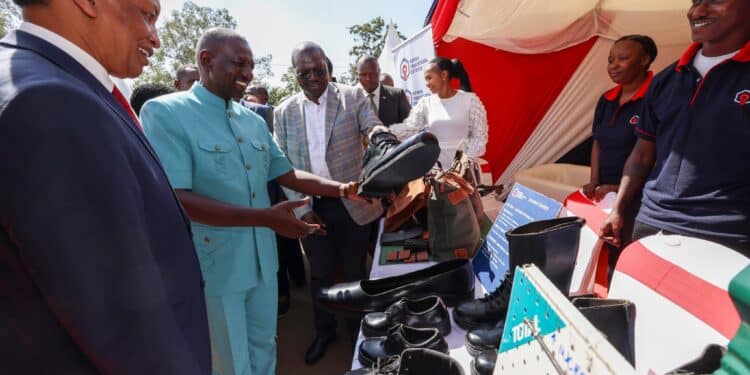

President William Ruto (Second From Left) Interacts With Traders During The Celebrations Of The First Anniversary Of The Hustler Fund.
President William Ruto (second from left) interacts with traders during the celebrations of the first anniversary of the Hustler Fund. Photo/ PCS
Tags: BusinessEnterpreneurship
The Conversation

The Conversation

The Conversation is an independent news organization that publishes evidence-based articles written by experts to help readers understand diverse topics. We cover a wide range of areas including arts, culture, education, health, politics, science, and more¹. Their content is characterized by in-depth analysis, research, news, and ideas from leading academics and researchers. The Conversation aims to provide academic rigor with journalistic flair.

Related Posts

Jill Biden Admits She Wouldn’t Have Backed Joe Biden’s 2024 Re-Election Bid In New Interview

Jill Biden Reveals Regret Over Joe Biden’s 2024 Run in New Interview

June 1, 2026
Doctors Raise Questions Over Missing Key Details In Trump Cardiac Exam Report

Doctors Question Transparency of Trump’s Heart Test Results

June 1, 2026
Kma Reveals How To Know Licensed Doctors After Deadly Kitale Surgery

KMA Reveals How to Know Licensed Doctors After Deadly Kitale Surgery

June 1, 2026
Wise Vs Remitly 2026: Best International Money Transfer Comparison Guide

Wise vs Remitly vs Western Union: Best International Transfer in 2026

June 1, 2026
ADVERTISEMENT

The Kenya Times Facebook

LATEST ARTICLES

  • Jill Biden Reveals Regret Over Joe Biden’s 2024 Run in New Interview
  • Stars Abroad: Moses Shumah, Kenyan Striker Breaking Records in Zambia
  • Doctors Question Transparency of Trump’s Heart Test Results
  • Corazone Aquino: Kenyan Star Named After Philippines’ Former President
  • KMA Reveals How to Know Licensed Doctors After Deadly Kitale Surgery
  • Iran Ends All Negotiations With US, Vows to “Completely” Block the Strait of Hormuz
  • Wise vs Remitly vs Western Union: Best International Transfer in 2026
  • KDF Soldiers Take Charge as Protests Erupt in Nanyuki Over Ebola Quarantine Facility
  • End of an Era as Paris Lounge & Grill Rebrands, Kentwood Address Undergoes Renovation
  • Benny McCarthy Makes Changes to Harambee Stars Squad Days After Unveiling 24 Players
  • Ruto Delivers Weighty Apology During Madaraka Day Speech [FULL TEXT SPEECH]
  • Njeri Maina Explains Why President Ruto Can’t Be Impeached
  • Plane Crashes in Maasai Mara
  • How “And” Lost to “Or” in the Finance Bill 2026
  • Opinion | How New Taxes on Bank Card Transactions Charges Will Raise the Costs for Ordinary Kenyans if Adopted by Parliament
ADVERTISEMENT

Company

About Us

Our Authors

Our Experts

Social Media

Policies

Privacy Policy

House Rules

Standards and Policies

Terms and Conditions

Subscription

My Account

Contact Us

Contact Us

Join Our Team

Advertise With Us

© Copyright 2026 | The Kenya Times | All Rights Reserved

Welcome Back!

Sign In with Facebook
Sign In with Google
Sign In with Linked In
OR

Login to your account below

Forgotten Password? Sign Up

Create New Account!

Sign Up with Facebook
Sign Up with Google
Sign Up with Linked In
OR

Fill the forms below to register

All fields are required. Log In

Retrieve your password

Please enter your username or email address to reset your password.

Log In
Your Privacy and Cookies
We use cookies on our website to give you the most relevant experience by remembering your preferences and repeat visits. By clicking “Accept”, you consent to the use of ALL the cookies.
Do not sell my personal information.
Cookie settingsACCEPT
Privacy & Cookies Policy

Privacy Overview

This website uses cookies to improve your experience while you navigate through the website. Out of these cookies, the cookies that are categorized as necessary are stored on your browser as they are essential for the working of basic functionalities of the website. We also use third-party cookies that help us analyze and understand how you use this website. These cookies will be stored in your browser only with your consent. You also have the option to opt-out of these cookies. But opting out of some of these cookies may have an effect on your browsing experience.
Necessary
Always Enabled
Necessary cookies are absolutely essential for the website to function properly. This category only includes cookies that ensures basic functionalities and security features of the website. These cookies do not store any personal information.
Functional
Functional cookies help to perform certain functionalities like sharing the content of the website on social media platforms, collect feedbacks, and other third-party features.
Performance
Performance cookies are used to understand and analyze the key performance indexes of the website which helps in delivering a better user experience for the visitors.
Analytics
Analytical cookies are used to understand how visitors interact with the website. These cookies help provide information on metrics the number of visitors, bounce rate, traffic source, etc.
Advertisement
Advertisement cookies are used to provide visitors with relevant ads and marketing campaigns. These cookies track visitors across websites and collect information to provide customized ads.
Others
Other uncategorized cookies are those that are being analyzed and have not been classified into a category as yet.
SAVE & ACCEPT
LOGIN | REGISTER
  • Login
  • Sign Up
  • Cart
No Result
View All Result
  • News
    • Latest News
    • Breaking News
    • Investigations
    • Explainers
    • Fact Check
  • Politics
    • Global Politics
    • Conflicts & Security
    • Elections
    • Diplomacy
    • Government & Policy
    • Political Analysis
  • Business
    • Global Economy
    • Markets
    • Technology
    • Startups
    • Energy
    • Finance
  • World News
    • Americas
    • Asia
    • Asia Pacific
    • Africa
    • Europe
    • Middle East
  • Africa
    • East Africa
    • West Africa
    • Southern Africa
    • Central Africa
  • Health
    • Global Health
    • Public Health
    • Health Policy
    • Medical Research
    • Diseases & Conditions
    • Mental Health
    • Nutrition
    • Climate & Health
    • Health Explainers
  • Sports
    • Athletics
    • Basketball
    • Boxing
    • Cricket
    • Football
    • Formula 1
    • Golf
    • Rugby
  • Weather
    • Climate Business
    • Climate Change
    • Climate Solutions
    • Living Green
  • Culture
    • Arts
    • Film & TV
    • Food
    • Lifestyle
    • Music
    • Travel
  • Opinion
    • Editorials
    • Letters
  • Behind The Brand
  • Contact Us

Not enough quota to unlock this post
Unlock left : 0
Are you sure want to cancel subscription?